
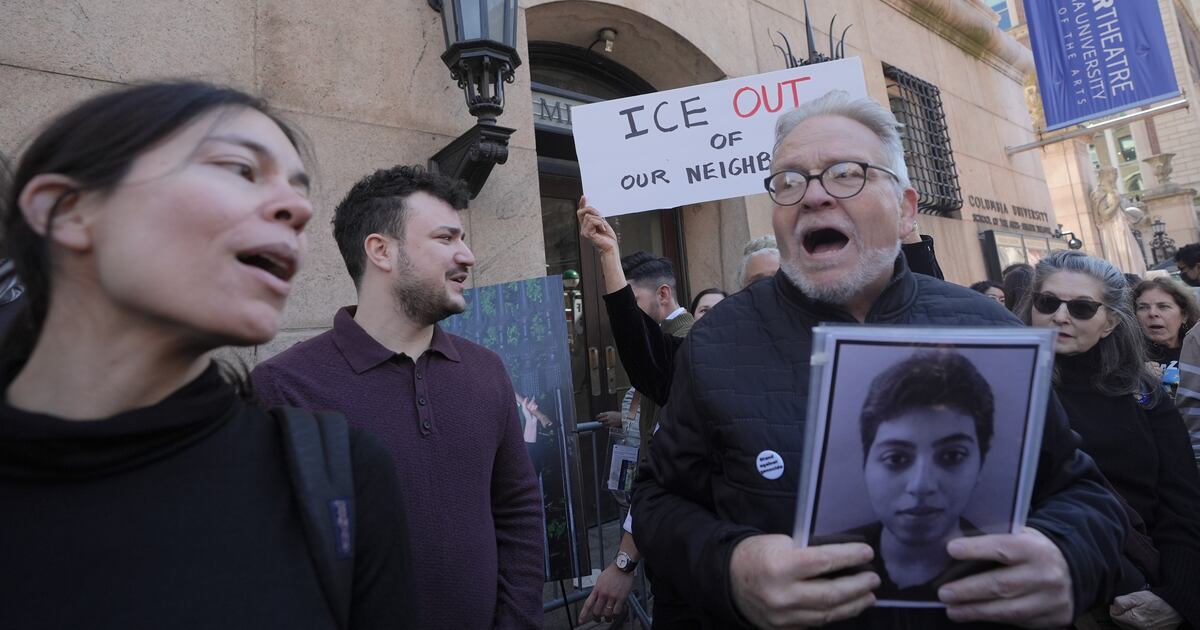
Eva Yi Xie has kept busy while she has been in Ice (Immigration and Customs Enforcement) custody, practising her Spanish on fellow detainees and reading a book about cognitive ecology. Her classmates at Princeton University, she said, should “keep on doing science and not worry too much about me”.That was what Xie told her academic supervisor, Carlos Brody, a neuroscience professor, in a phone call on Tuesday from the Immigration and Customs Enforcement facility in Virginia, where she has been held since Saturday.Brody worries about the impact her absence is going to have on his lab. “There are some projects where . . . without her, they just come to a crashing halt,” he says.Ice detained Xie, a 24-year-old Chinese-born PhD student, last Thursday at Ronald Reagan Washington National airport after attending the Society for Neuroscience’s annual meeting. She remains in custody.READ MOREHer arrest has sent a chill through US academia, already worn down by president Donald Trump’s multipronged assault on some of the country’s most venerable institutions of higher learning.It has also exposed the vulnerability of America’s huge population of international students to an immigration crackdown that shows no sign of abating. Some critics said the campaign had escalated in recent weeks, with more arrests at US airports of people who have allegedly overstayed their visas.The US department of homeland security said Xie had entered the US on a temporary visa “but chose to violate our nation’s laws by refusing to depart by the required date of September 15 2016”. It said she had “never had valid authorisation” to study in the US.Xie’s lawyer said she had filed for asylum, which allowed her to stay in the country even after her visa expired, and her asylum application was pending.Her arrest shows how Trump appears to be intensifying his immigration enforcement drive even after sweeping Democratic gains in this month’s midterm elections that many interpreted as, in part, a repudiation of the White House’s hardline approach to immigration.That impression was reinforced when, immediately after the elections, Trump appointed Stephen Miller, architect of his mass deportation drive, as his chief of staff.A protest in Boston outside a legal hearing for Rümeysa Öztürk, a Turkish national and Tufts University doctoral student who was detained by Immigration and Customs Enforcement in June 2025 for an op-ed she wrote for her university's student paper. Photograph: Anadolu via Getty Images Trump’s policies were “disrupting and dismantling the international student talent pipeline in the US”, said Miriam Feldblum, head of the Presidents’ Alliance on Higher Education and Immigration, a coalition of American university leaders.“We’re seeing threats that are targeting international students, researchers and graduates at every step of their academic and professional journeys here,” she told the FT.The administration says it is cleaning up a system plagued by manipulation and denies the crackdown is hurting American science. The DHS said: “Where was the outrage when foreign nationals were abusing the system, violating the terms of their student visas and making a mockery of our immigration laws?”“If the media really cared about legitimate international students, they would be thanking President Trump for cracking down on the rampant fraud to ensure only those truly intending to study in the United States are given the privilege.”Since returning to the White House in 2025, Trump has frozen billions of dollars in federal research funding for universities, investigated a clutch of institutions over alleged antisemitism and demanded governance changes that academics view as an unprecedented assault on their independence.But his most consequential moves might be in the area of immigration. The US state department revoked thousands of student visas in 2025 for alleged violations, and this year the administration imposed tough restrictions on international students.Under the new rules, those whose studies extend beyond four years will be forced to seek government approval to remain in the US. A federal judge vacated the restrictions this month, but the Trump administration is expected to appeal.Meanwhile, people applying for permission to study in US universities face heightened scrutiny of their social media accounts as well as lengthy waits for visa appointments.Such policies were “wreaking havoc and causing stress, anxiety and fear across [student] populations”, Feldblum said.The White House has made no bones about its desire to cut the number of foreign-born graduate students in the US. In its blueprint for a “golden age of science”, it bemoaned the fact that in 2024 temporary visa holders accounted for about half of American doctoral graduates in computer science and mathematics with confirmed post-graduation plans.“This reliance on foreign talent sidelines American students, a deep domestic talent pool that remains under-supported by its own government,” it said. It “also creates a security challenge our institutions are ill-equipped to address”.The hostility is having an effect. In the 2025-26 school year, the number of new international students in the US fell 18 per cent, according to the Institute of International Education’s annual Open Doors survey.Gisela Perez Kusakawa, head of the Asian American Scholar Forum, said: “It’s uncertainty about immigration enforcement, whether students can complete their studies, whether they can graduate, that really influences the decision-making of future students in our country.”Xie is hardly the first foreign-born student to fall foul of Ice. Rümeysa Öztürk, a Tufts University graduate student, was arrested in March 2025 and held for six weeks after publishing a pro-Palestinian opinion piece in a college newspaper.Algerian-Palestinian activist Mahmoud Khalil. Photograph: Charly Triballeau/AFP via Getty Images In a higher-profile case, Ice detained Mahmoud Khalil, who had led pro-Palestinian protests at Columbia University, in March 2025 despite holding a permit to live and work in the US. Released after more than three months, he has resisted authorities’ attempts to deport him.The case of Xie, who was born in China and came with her family to the US in 2016, is unusual in that she is by no means an activist. Friends and colleagues describe her as a dedicated, hard-working researcher, mentor and teacher who is widely admired by fellow students and staff.She was arrested after presenting work at the Washington conference based on a theory she developed that explored potential links between how the brain makes decisions and how it navigates through space, according to Brody.One of Xie’s doctoral advisers, Benjamin Eysenbach, assistant professor of computer science at Princeton, said Xie had impressed colleagues with her collaborative, interdisciplinary approach.At a machine-learning conference last winter she had organised a workshop to bring together AI and neuroscience researchers, as part of an effort to build a community at the intersection of the two fields.The many protests at her detention had shown that “Eva is an integral part of so many different communities”, he said. “And it’s really because of these communities that we can do science, that Eva’s research and collaboration with her peers may unlock various scientific breakthroughs over the years and decades to come.”Kirsten Weld, history professor at Harvard University and head of the Harvard faculty chapter of the American Association of University Professors, said Xie was typical of the type of person being swept up in the “authoritarian dragnet that the Trump administration has created”.“What the administration wants is for every single person in this country whose status is not permanent to basically put themselves under house arrest, to live in fear until they can be flushed out at an unexpected moment and purged from the physical borders of the United States,” she said.She said Xie was one of hundreds of people who have been arrested at US domestic airports since Trump returned to the White House and the Transportation Security Administration began sharing information about airline passengers with Ice.Feldblum said foreign students were now scared to fly inside the US. “I do see some individuals who are non-citizens, and especially non-permanent residents, pulling back from travel, and that means by extension, from conferences,” she said. “And that’s actually our loss.”Brody said what happened to Xie was “absolutely terrifying for all the international students” either in the US or those thinking of coming here to study.“All of them now feel, hey, I’m following all of the rules, but I could be [put] in jail any time [like Eva],” he said.American science is “in the business of being the very best in the world”, he said. “That requires recruiting the best talent from everywhere in the world. But this scares that talent away.” - Copyright The Financial Times Limited 2026
The Ice raids ‘wreaking havoc’ across American academia
Full Article
Original Source
Read the full article at Irishtimes →KhanList aggregates and links to publicly available news content. We do not host full articles from third-party sources. Always verify important information with original sources.