
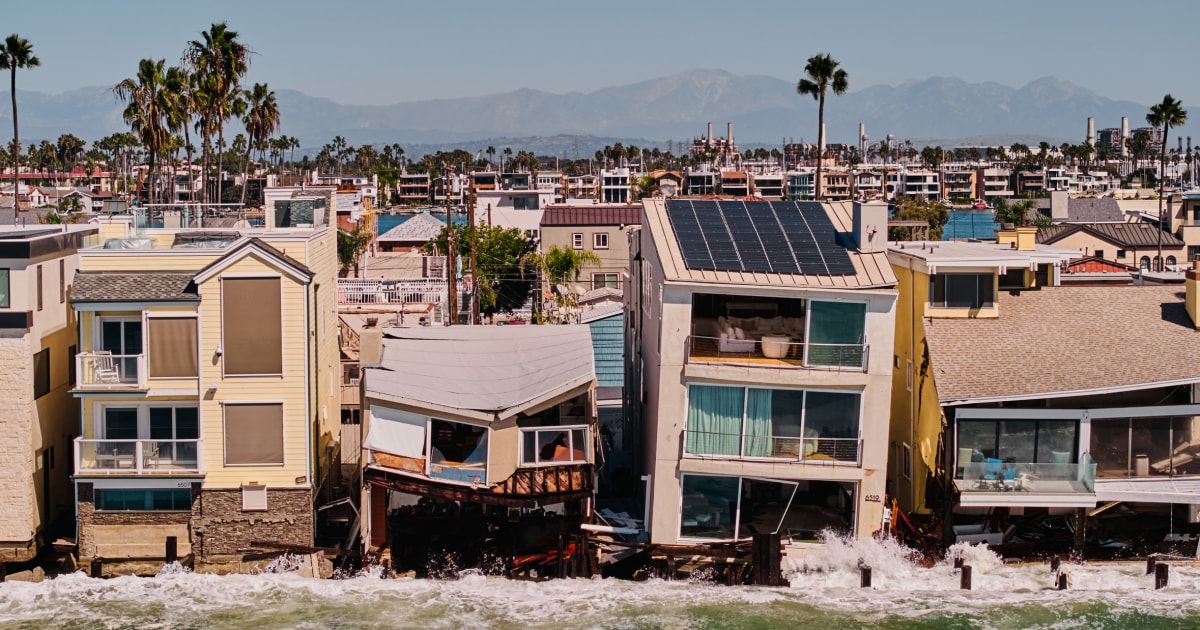
Oct. 17, 2026, 10:00 AM EDTLONG BEACH, Calif. — It was 3:30 a.m. on Oct. 9 and the unthinkable was happening all around Shawn Curtis: The boardwalk in front of his two-story beachfront apartment building was gone. The 25-foot-wide sand beach was gone. Salt water poured in from all sides. And now the building was slanting down into the ocean.Curtis couldn’t make sense of what he saw. “The doorframe was crooked. The window was crooked, and then I saw a big wave crash,” he told NBC News on Thursday.The surf crashed all the way up to the second floor. Neighbors across the street said they could see water cascading down onto the roof of Curtis’ home of nine years. Booming waves were loud enough to wake him and shake his apartment as though an earthquake rippled through, he said.Shawn Curtis and his dog Lux escaped through Curtis' bedroom window when waves overtook his apartment.Adam Amengual for NBC News“We rushed for our lives, but it was clear the house was toast,” Curtis said, referring to his roommate. “It was a foregone conclusion. It was gone.”The worst of El Niño is still months away, but Southern California’s fragile coastline is already being transformed by record-setting king tides and storm surges.An unusually active hurricane season triggered a trio of storms that pummeled Hawaii and Mexico earlier this year. The historic weather pattern claimed more than a dozen homes along the shore in Long Beach, swallowing up boardwalks and portions of the Pacific Coast Highway farther south.“This is just a little bit of a taste of what we will see in the future,” warned Timu Gallien with the Coastal Flood Lab at the University of California, Los Angeles.Long Beach officials have said old infrastructure wasn't built for today's rapidly changing climate patterns.Adam Amengual for NBC NewsLast weekend, destructive surf thrashed coastal communities from Malibu to San Diego, flooding neighborhoods in Newport Beach and forcing people to evacuate homes in Long Beach that were once protected by wide sand beaches and reinforced boardwalks.The devastation spread on a sunny, calm weekend without warning. California did not experience any rain or wind before massive swells overtook Laguna Beach, where a portion of the PCH remains closed as sections crack and slide down toward the ocean.“People don’t realize there was a beach here,” Long Beach Peninsula resident Dana Marie Lazzareschi said Thursday. “These houses aren’t on the water.”Paradise lostLazzareschi said she fell in love with the peninsula’s diversity and sense of community when she first moved into her rental four years ago. Neighbors were chatty and looked out for each other. They walked their dogs, rode bicycles up and down the street and were quick to help if someone needed it.But on Oct. 9, as she watched waves splash onto rooftops, she wondered how long she could stay.“I definitely wouldn’t buy a home here now,” she said. “But it really is such a dream.”Dana Lazzareschi and her dog Harley Quinn evacuated hours before neighboring homes crumbled into the ocean.Adam Amengual for NBC NewsFor decades, scientists and marine biologists have warned that increasing global temperatures would trigger rising sea levels and inevitably lead to more coastal flooding. This year, those existing factors coincide with what is predicted to become the strongest El Niño event in recorded history.El Niño is a natural climate pattern associated with intense rainfall and storms in the Southeast and warm conditions in the Pacific Northwest that can cause strong, dangerous surf.But it doesn’t end there.Kelvin waves, which travel hundreds of miles underwater, can cause waves to rise another foot. Alone, Kelvin waves generally don’t lead to coastal flooding, but when paired with high tides that exceed 7 feet and storm surges on top of that, the combination can be catastrophic, according to the National Oceanic and Atmospheric Administration.“Although the waves and the tide levels are receding slightly right now, very slightly, there still is ongoing coastal flooding, and this is not really going to get any better for months,” said climate scientist Daniel Swain.“In fact, it’s likely to get worse before it gets better,” he said, adding that Northern California will begin to experience similar behavior in November and December.Coastal communities in Southern California began to experience dangerous conditions over Labor Day weekend with the remnants of Hurricane Marie. That was followed soon after by remnants of Hurricane Polo at the end of September and now Tropical Storm Rachel.The peak of a historic El Niño is expected to hit early next year, but three more rounds of seasonal high tides this year will likely bring more flooding and erosion, said Gallien, who is also an associate professor of environmental and civil engineering at UCLA.“It’s a lot of water pointed at our coast,” she said.Several homes in the Long Beach Peninsula have been deemed too dangerous to enter.Adam Amengual for NBC News‘Not built for this’Two weeks before losing his home, Curtis told his landlord he wanted to move out, he said. Seven-foot waves triggered by hurricanes Marie and Polo had already eaten away at the boardwalk in front of his apartment and he worried that the damage would only worsen with the incoming El Niño that is expected to peak in January and February.Using wooden planks and sandbags, Long Beach City work crews earlier this month had patched up holes in the boardwalk’s wall created by the hurricanes, but the reinforcements did not hold.Mayor Rex Richardson told reporters last week that the city’s “infrastructure was not built for this” and said repairs will continue during the lower tides.But residents and experts are questioning how much longer coastal living will be possible with rapid climate change.“We love to live in these vulnerable places because they are beautiful,” Gallien said. “It comes down to what is a risk tolerance for a given homeowner or a given community, or a given municipality. Can engineers protect structures?”This is one of the biggest questions keeping officials, residents and experts up at night. While the ongoing damage to California’s coastline is historic in nature, it is not necessarily unprecedented. Coastal erosion has caused flooding along the PCH during previous El Niños, including in the mid-1980s and late 1990s.On the Long Beach Peninsula, more than a dozen homes crumbled into the ocean between Oct. 9 and 11 when the remnants of Tropical Storm Rachel stirred offshore waves up to 17 feet tall. Eight structures encompassing 13 homes were deemed too unsafe to enter.The balcony of one of the beachfront homes is collapses into the sea.Adam Amengual for NBC NewsCurtis said he loved waking up to the soothing sound of surf every morning. His front door opened onto a popular boardwalk filled with locals and visitors taking in the stunning views.When his apartment began to collapse, Curtis said he and his roommate rushed to shove whatever they could toward the back of the building and into the garage, which remained dry and felt more stable. He escaped by climbing through his bedroom window with his dog Lux and went to the other side of the street, which faces the bay and evaded damage this time.A few days later, friends showed Curtis drone footage of his favorite couch floating in the ocean.“It’s just a couch,” he said. “I feel really bad for the neighbors.”Next door, a three-floor single-family home remained empty this week. Its owners, a family of three, left for a cruise before the remnants of Tropical Storm Rachel destroyed their property. A giant crack snaked from the foundation up to the roof, threatening to split the house in two.Curtis said he told them just to enjoy their vacation. There was nothing they could do.The family could not be reached for comment.On Thursday, Curtis’ roommate, who did not want to be named, rushed to shove what few belongings he saved into a U-Haul truck as inspectors and contractors looked on. Tenants had two hours to retrieve what they could before crews would begin the dangerous process of tearing down the building, the roommates said.Down the block, Curtis walked around his neighborhood with the unmistakable countenance of someone who had just survived a disaster. He’d been wearing the same clothes for a few days and couldn’t remember the date. Days had blurred together into a whirlwind of phone calls and emails to his landlord, city officials, family and insurance.When asked whether he would consider leaving the peninsula, he did not hesitate.“Not a chance,” he said. “But I am moving to the other side.
‘The house was toast’: Surf swallows California homes
Full Article
Original Source
Read the full article at Nbcnews →KhanList aggregates and links to publicly available news content. We do not host full articles from third-party sources. Always verify important information with original sources.