
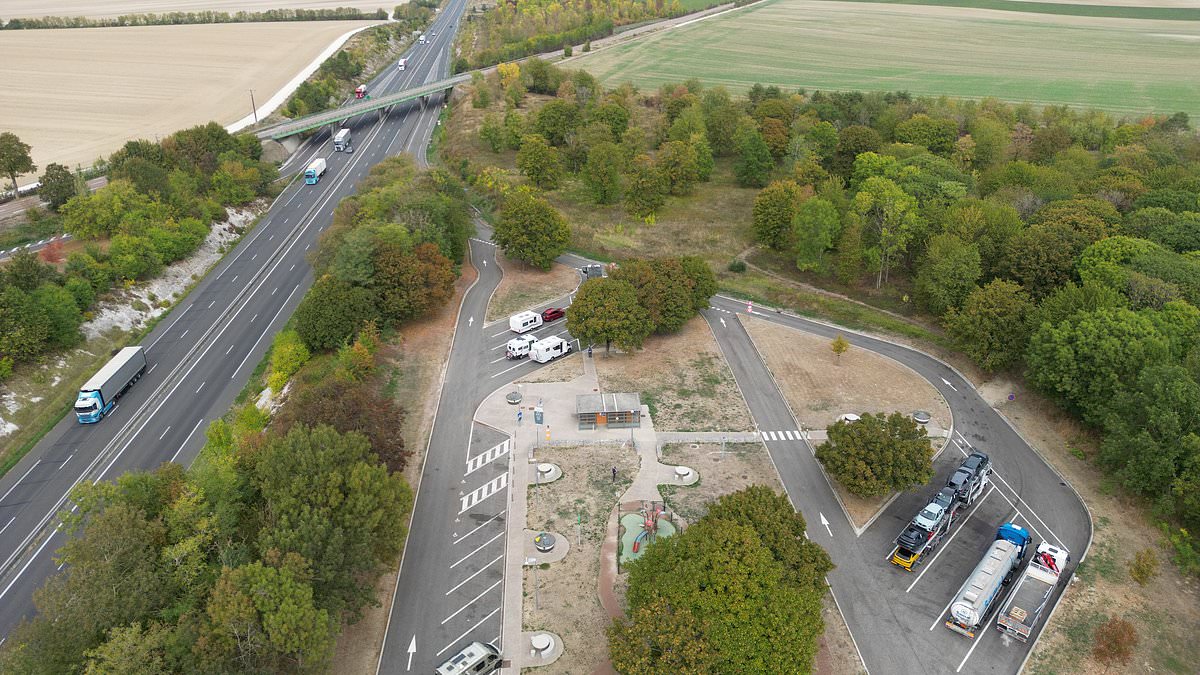
Cutting through France's Champagne region, the A26 is used by so many British tourists on the drive to or from their holiday gites and campsites that it is affectionately known as 'Autoroute des Anglais' – the English motorway.But the 223-mile route from the port of Calais to the historic medieval city of Troyes is starting to earn a new, rather more sinister nickname: 'Autoroute vers l'Angleterre' – the motorway to England.And that's because the high-speed expressway has become increasingly notorious as the route of choice for the people smugglers whose human cargoes are invariably intending to get to the UK by small boat.The rest-stops and services – or aires – which are dotted along the A26 will be familiar to countless British motorists as innocuous places where they stop to refuel, to eat a filled baguette or croque monsieur or simply take a restorative nap.But as darkness falls, these aires become key rendezvous points for the gangsters who are picking up or dropping off migrants ready to be moved at the last minute to beaches to attempt to cross the Channel.While regular motorists flock to outlets like Autogrill or La Croissanterie, in the murkier corners, and the quieter parking areas, military-style operations are under way. The A26 motorway running through France is used by British tourists on the drive to or from their holiday gites and campsites - but is also used to bring thousands of migrants to the UK IThe rest-stops and services – or aires – which are dotted along the A26 have become key rendezvous points for the gangsters who are picking up or dropping off migrants Last week the A26 highway was in the public glare when a suspected people trafficker sat in the driver's seat of a British-registered van was shot dead at Aire Champ l'Épée outside TroyesMigrants who have been ferried by car or van from various parts of France or Germany at carefully allotted times – switch vehicles before being moved to the final stop on their road journey to avoid detection by the French police.And with migrants typically being charged up to £2,000 for their dangerous crossing – meaning a single mega-dinghy crossing can earn the gangs almost £500,000 – the stakes are high.Consequently the competition between rival gangsters is becoming steadily more ruthless.This point was made starkly on Friday last week when a 47-year-old man who had been sitting in the driving seat of a British registered van was shot dead at Aire Champ l'Épée outside Troyes.One man was arrested at the scene but others fled before police arrived.In the back of the van police found ten migrants huddled in fear.The murder of the suspected people-smuggler was this week upgraded to a full organised crime enquiry conducted by France's National Anti-Organised Crime Prosecutor's Office, which is based in Paris.A senior investigating source told the Daily Mail that despite the vehicle's registration status the victim is not thought to be British but foreign born.He is thought to be a member of the Iraqi-Kurdish gangs which have largely controlled the trafficking routes for some time but are now being challenged by newer rivals from Eastern Europe.It is thought he was either due to take his migrant passengers, who came from various countries across Africa and Asia, towards the coast around Calais or further west, possibly as far as Normandy.Or he may have been dropping them off for someone else to undertake this final leg.But what is clear is what happened next: he was shot in the head, dying at the scene.The source said: 'This has all the hallmarks of a gangland killing carried out by an international syndicate.'They make millions of pounds from the trade in human life to Britain, and all work ruthlessly to protect their routes, especially along the "English Motorway".'Iraqi-Kurd gangs have been in control of the lucrative trade for many months now, but others from places such as Bulgaria and Albania are increasingly trying to cut in.'That's usually why these shootings happen.'The motorway rest areas are isolated, and often not covered by video cameras. They are obviously designed for vehicles to come in and out, so the gangs can operate freely at all times of the day and night without attracting much attention.'They can complete any kind of business there – from organising the transportation of migrants to settling scores.'The smugglers are thought to favour UK-registered vehicles for one rather obvious reason: on 'the English motorway' they blend in and do not tend to attract police nearly as much as plates from, say, Bulgaria or Albania might.The fact that the van was UK-registered may also indicate that the driver, his criminal associates or both may have previously obtained residency in Britain – and so live here.This would mean that, having dropped off their final human cargo, they themselves would be free to return to their homes here as seemingly ordinary passengers on ferry or LeShuttle.The scale of the number of British-registered vans hopping across the Channel to move migrants up and down the A26 is impossible to quantify because it is a phenomenon police are only beginning to understand, but it's feared that this incident is only the tip of the iceberg.Investigators are currently keeping the identities of all those involved in the latest shooting confidential – including both the victim and the suspected gunman – as they try to trace others who might be connected with the crime.But the source said that gangs have started to move their operations further inland away from the squalid woodland camps around Calais, Dunkirk and Boulogne-sur-Mer due to an increase in police surveillance there.Because although French police are notoriously reluctant to interfere once the migrants are in the water – they have lately become much more effective at intercepting both small boats and their passengers before they are able to put to sea.Migrants, mostly from Afghanistan, the Middle East and Africa, arrive in France from Italy or Germany ready to pay cash to get across to Britain. Rather than housing them in the Calais camps, where they would be under the watchful eyes of the police, they are instead put up in budget hotels and hostels dotted around northern France, mainly within easy reach of an Autoroute.They are then given a time to meet and are picked up in vans and taken to one of the rest-stops used by the gangs on the A26 before being transported north in a second vehicle to avoid detection.The drive from Troyes to Calais, skirting around the cities of Reims and Lens, takes around 3.5 hours.Once on the coast, the migrants are dropped off at a third meeting point close to the shoreline to await being picked up in a small 'taxi boat' usually within an hour – as this is the point when they are most likely to be stopped.The taxi boat then takes them out to a mega-dinghy further out to sea. These are 18m long and can have as many as 230 people crammed onboard.Close to the shore operations to deter the smugglers are run by the French Frontier Police (PAF).A PAF officer confirmed: 'The gangs charge thousands for a passage across Europe, following journeys from Africa and the Middle East.'This means there is money available to look after the migrants anywhere in France – in small cheap hotels or hostels – before they finally travel on to the Channel beaches, to get on board a boat.'The A26 contains 35 aires de repos – simple rest stops with few facilities beyond toilets – and 14 aires de service which are full-blown service stations, with at least a 24/7 petrol station, fast food restaurants and shops.The gangs prefer the smaller, quieter ones, those without CCTV.In the past, they tended to use the rest stops closest to Calais, particularly La Grande Bucaille, Saint-Hilaire-Cottes and Aire de Nortkerque but the problem became so bad that police operations forced them to start further south towards Troyes.The rest-stop where the suspected people smuggler was shot dead is called Aire de Champ l'Epée.It is situated 20 miles north of Troyes and nestled deep in the countryside, flanked by towering wind turbines.A ring of oak, maple and ash trees provides a natural screen around the rest-stop, which contains just a toilet block, five stone picnic tables, a recycling bank and a small children's playground comprising a climbing frame and slide.There are no security cameras and the only lights are those outside the toilets.A steady stream of lorry drivers use the stop throughout the day as do campervan drivers from Britain and around Europe. But at night it's deathly quiet.One British woman, who had parked up en route home to West Yorkshire after holidaying in Girona, Northern Spain, said: 'We've been told not to stay in places like this overnight because of the risk of thieves targeting camper-van owners.'I didn't know that they were now being used by people smugglers but it makes sense, given how dark and secluded these rest-stops are at night and the fact that there's no security presence or CCTV at all.'One Russian lorry driver told the Daily Mail: 'I try to avoid places like this at night, it's just somewhere to rest for 45 minutes in the afternoon.'Another trucker working for an Irish haulage firm added: 'It's normal for people smugglers to use these truck stops in France. I've never seen migrants getting in and out of vans myself but I've heard about them from many other drivers.'In 2023, six members of a smuggling gang from Bulgaria and Turkey were imprisoned after smuggling hundreds of migrants through France via the A26.The Toulouse Criminal Court heard how they provided forged identity documents to their illegal 'clients' who were made to pay the equivalent of £1,000 a head for just one stage of the journey, from Eastern Europe to Toulouse, travelling via Italy.One of the biggest traffickers smuggling people into Britain is Idriss Ghazi Kareem, a 46-year-old Iraqi Kurd who is believed to still be pulling the strings of the vile trade from his prison cell.He was sentenced to 15 years by French judges in August 2023 for the manslaughter of seven Afghans who drowned on the way to the UK.They had paid up to £1,200 each for a place in a flimsy dinghy organised by Ghazi Kareem's 'family business', and many had got to the coast via the A26.Ghazi Kareem is the oldest of three brothers, all of whom helped build up their £50million-a-year trafficking syndicate.His younger brother – Karzan Ghazi Kareem, 39 – was killed during a shoot-out with French special forces last February following an earlier shooting at the Troyes-Le Plessis rest stop on the A5 motorway, close to the junction with the A26, just south of Troyes.As well as bringing their operations further inland, the criminal networks are also spreading their launch points along the northern French coast, diversifying away from the traditional migrant hotspots like Calais and Dunkirk.Overcrowded migrant boats have been spotted launching from Jobourg at the tip of the Cotentin Peninsula, 200 miles west of Calais. The A26 from Troyes will take people smugglers all the way up to the beaches of northern France where migrants pay up to £2,000 each to be taken by mega dinghies to the UKCrossings have also increased from the area around Dieppe, around 100 miles south of Dunkirk, where there have been 56 attempted departures since the beginning of the year.Some operations are even preparing and launching empty boats from the Belgian coast before sailing into French waters to collect passengers.The different launch sites on the French coast have meant that migrants are now arriving into different parts of England.Kent has long been the entry point into the UK for migrants crossing the channel – and continues to be so – but they are also being escorted by lifeboat teams into docks in Portsmouth and Gosport on the Hampshire coast.The aspect that hasn't changed is the pivotal role of the A26 in all this.A decade ago, before the small boat migrant invasion phenomenon took off, the tens of thousands of British holiday makers using this route into the Continent had got used to being alert for migrants trying to stowaway in their cars, campervans and caravans on their return journey.Now, advances in scanning technology and heightened security – as well as the people smugglers' pivot to dinghies – have meant this is a greatly reduced threat.But instead today's British holiday makers on the A26 are unwittingly providing cover to a vast gangland operation that without them even knowing is going on in front of their eyes.
The highway through France's Champagne region used by middle-class Brits to reach their holiday homes is now a people trafficker rat run bringing thousands of migrants to Britain. Welcome to 'Autoroute vers l'Angleterre', the motorway to England
Full Article
Original Source
Read the full article at Dailymail →KhanList aggregates and links to publicly available news content. We do not host full articles from third-party sources. Always verify important information with original sources.