
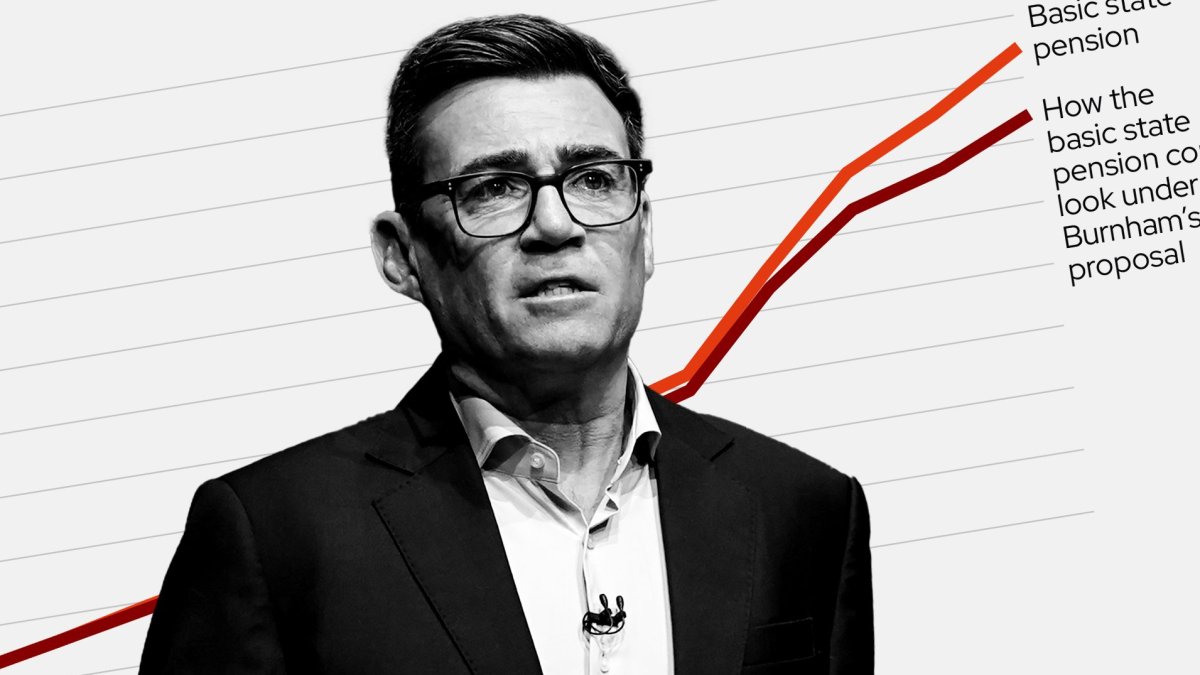
For 15 years, the triple lock has ensured bumper growth to the state pension – helping to transform the living standards of UK retirees. It has been one of the most successful personal finance policies of the recent past, reversing years of stagnation and decline in the state pension since the 1980s. But it has also become unsustainable in the eyes of many economists and policymakers. Shorts Andy Burnham this week pledged to replace the triple lock from 2030 if he wins the next general election, using the cost savings to fund his social care plan. And analysis by The i Paper, verified by multiple experts, indicate how pensioners likely now face a slower rate of growth in their income, over the long-term. Under the triple lock, state pensions rise each year by the highest of 2.5 per cent, average earnings growth or inflation. Burnham has pledged to alter the lock so that the state pension increases by 2.5 per cent or inflation each year. He has promised a backstop to stop it falling behind its level relative to earnings once the lock is adjusted, but the annual link to wage increases is being removed. Crucially, this ends the expensive “ratchetting up” effect – which means if inflation spikes one year and wages lag, the pension jumps with inflation. If wages surge the next year to catch up, the pension jumps again with wages. If this policy had been introduced in 2011 instead of the triple lock, the full basic state pension could be around £564-a-year lower than the current level of £184.90 per week, analysis by The i Paper suggests. While this is an analysis of a hypothetical scenario, it gives an indication of how the change could affect state pensions over time. Sir Steve Webb, who was pensions minister when the triple lock was introduced in 2011, told The i Paper: “The new approach will give a lower pension rate [than under the current triple lock] and the longer the new policy is in force, the bigger the difference will become.” Burnham announced the cut to the lock to save money which can then be redirected to funding a new ‘National Care Service’. How state pensions would look if Burnham’s policy had been introduced instead of the triple lock Since the triple lock was introduced in 2011, the full basic state pension – given to older pensioners who hit state pension age before April 2016 – has increased from £102.15 per week to £184.90. Analysis by The i Paper suggests that if Burnham’s lock had been in place for the past 15 years instead, it could have risen to a lower amount of £174.05, meaning some pensioners would receive around £10.85 a week or £564 a year, less. The analysis, verified by three experts, took the basic state pension rate from 2011/12 – £102.15 per week – and uprated it by the higher of inflation or 2.5 per cent each year – as is Burnham’s plan. It then compared the numbers to the actual increases to the state pension, under the triple lock. There are six times since the lock’s introduction that the earnings figure has been used to increase the state pension – 2016, 2019, 2020, 2024, 2025 and 2026 – and in these years the state pension would have increased by a smaller amount under Burnham’s mechanism, than actually happened. Burnham says he will ensure that the state pension does not fall behind its position relative to average earnings over time. The analysis assumes not have had to do this at any point in the past 15 years, as if his mechanism had been in place since 2011, the state pension would still have increased by a faster rate than if it were linked to wages. But it remains to be seen exactly how he’ll implement this part of the policy. Analysis shows why the lock is such a ‘difficult political issue’ Experts said the analysis showed why the triple lock was such a “difficult political issue” – as slight changes to the uprating system can make a significant difference to pensioner income. Adam Cole, retirement specialist at wealth manager Quilter, said: “A series of seemingly modest differences in annual uprating would, over 15 years, have left the state pension nearly £11-a-week lower than it is today. “While some of the lowest-income pensioners would have the impact cushioned by means-tested support via pension credit, for many retirees who depend heavily on the state pension, it would represent a noticeable reduction in annual income. “The figures underline why the triple lock remains such a difficult political issue. It has been successful in raising the value of the state pension and improving pensioner incomes, but that success comes with a growing cost to taxpayers.” Steve Webb, now a partner at pension consultants LCP, added: “The new policy will clearly take time to have an impact. “If the reformed triple lock had applied since 2012 it would have had no impact for several years. This illustrates the fact that the savings from the new approach may take time to build up. “But eventually the new approach will give a lower pension rate [than under the current triple lock] and the longer the new policy is in force, the bigger the difference will become. Although the calculations are complex, the message is simple – the new policy saves many billions of pounds by reducing the long-run rate of state pension increases”. The Institute for Fiscal Studies (IFS) said that the old triple lock had increased annual state pension spending by £16bn by 2026–27 compared with if the state pension had merely increased with average earnings growth. If the new triple lock had been in place instead, spending in 2026–27 would be £9 billion lower than it currently is, it said. Other parties still pledging to keep the lock Burnham pledged to water down the triple lock at a speech at the Labour Party conference this week, and claimed the money saved from the move would help fund a national care service. But the move is likely to be politically difficult. More than half of all voters – 53 per cent – want to see the triple lock remain in place, while 13 per cent are opposed, according to the survey by BMG Research. The government’s budget watchdog, the Office for Budget Responsibility previously warned about the cost of keeping the lock, saying that state pension spending would rise to around 9 per cent of GDP by 2075/76. But Labour’s main opposition parties, Reform UK, and the Conservatives, have each so far pledged to keep it should they win the next general election, scheduled for 2029. A government spokesperson said: “This settlement is a better deal for pensioners and their families. We are ensuring that the State Pension system is built to last for the pensioners of today and tomorrow. “We are committed to the triple lock for the rest of this Parliament, and the adjusted triple lock will build on the gains the policy has made for pensioners in raising the State Pension “This means the state pension will always increase by at least the highest of 2.5%, CPI inflation or a new earnings link – so that the state pension will never fall below its record high level when we adjust the current triple lock.” Will pensioners be poorer as a result? Pensioners won’t get poorer as a result of Burnahm’s policy, in the sense that their state pension incomes will always keep up with price increases, and won’t fall behind their current level relative to average earnings. It is possible, as the analysis shows, that their pensions will increase by a slower rate than they would do if the triple lock were maintained. Around 10 per cent of pensioners are expected to retire in the 2060s with not enough money to meet the minimum needed for a basic standard of living, as calculated by the PLSA (Pensions and Lifetime Savings Association). However, this is down from 17 per cent of those retiring in the 2020s, and reflects that workers in their 20s have time to build up reasonable pensions under the auto-enrolment system. This could support the argument that a triple lock will be less necessary in future as people will have more of their own pension to rely on.
The hidden cost to pensioners of ditching the triple lock
Full Article
Original Source
Read the full article at Inews →KhanList aggregates and links to publicly available news content. We do not host full articles from third-party sources. Always verify important information with original sources.