
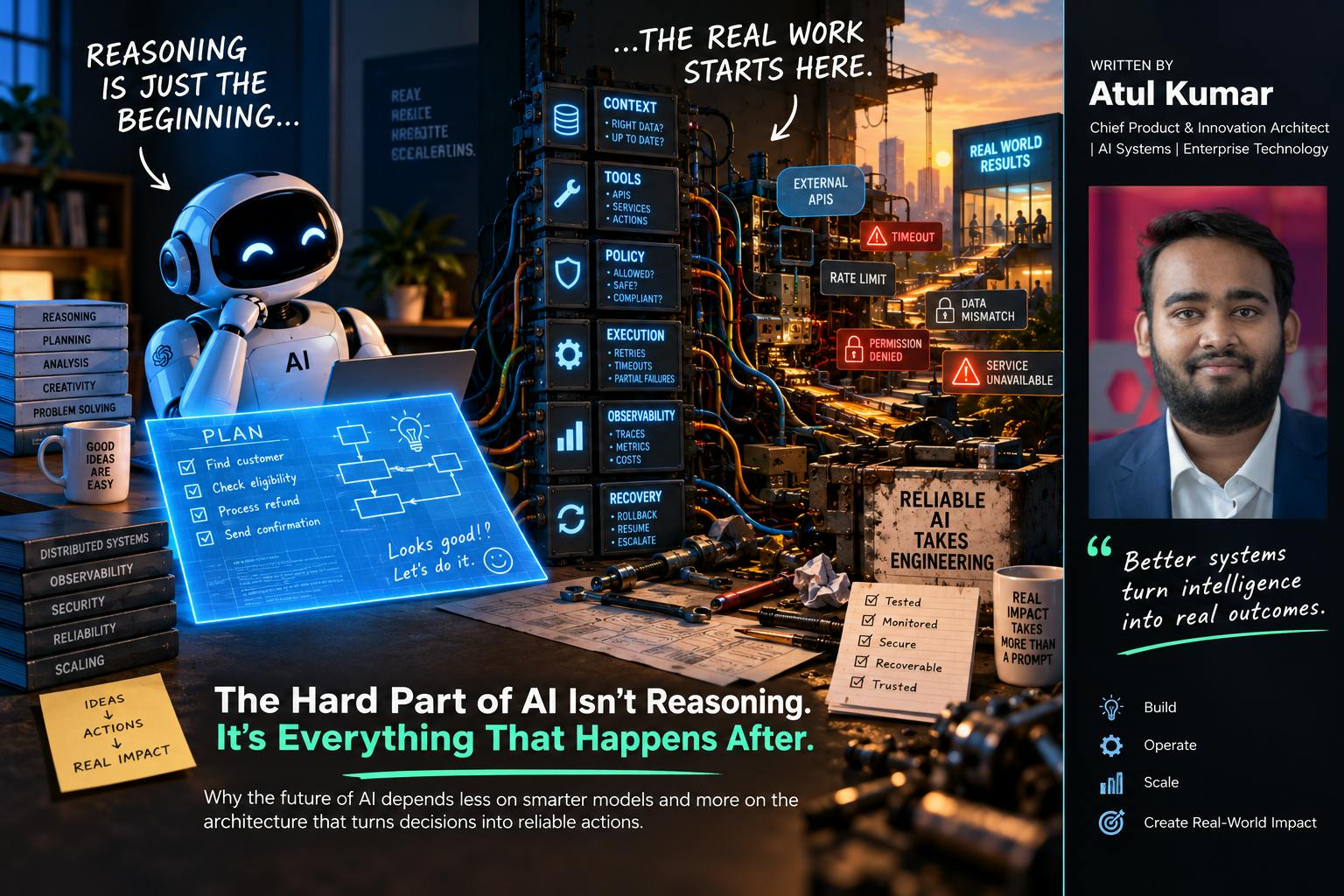
Why turning an AI decision into a reliable real-world outcome is becoming the real engineering challenge. There is a moment in almost every AI project that feels like a breakthrough. You give the model a difficult question. It understands the context. It produces a surprisingly good answer. Maybe it analyses a document. Maybe it writes code. Maybe it finds a pattern that would have taken a person hours to discover. Everyone in the room gets excited. Then someone asks the question that usually changes the conversation: "Okay. But what happens when we put this into production?" That is where things get interesting. The model might be excellent. The benchmark numbers might look impressive. The demo might work perfectly. But production doesn't give you clean prompts and controlled environments. Production gives you stale data, unavailable APIs, duplicated requests, permission boundaries, network failures, conflicting records, unexpected users, changing business rules, cost constraints, and situations nobody thought to put into the demo. The model made the decision. Now the system has to do something with it. And increasingly, that is the hard part. A Good Decision Isn't the Same as a Good System We have become very good at measuring the intelligence of AI models. We compare benchmarks. We measure accuracy. We test reasoning. We evaluate coding ability. We look at context windows and latency. All of those measurements are useful. But imagine an AI system responsible for approving a customer refund. The model correctly determines that the customer qualifies. That's a good decision. The system then needs to: Retrieve the customer's account. Verify the transaction. Check the refund policy. Calculate the amount. Call the payment service. Record the transaction. Update the customer's account. Notify the customer. Now, suppose the payment service times out after processing the refund. What should the AI do? Should it try again? If it retries, could the customer receive two refunds? What if the account was updated, but the notification failed? What if the refund policy changed while the agent was processing the request? What if another process modified the transaction at the same time? None of these questions is answered by a more intelligent model. They are software architecture questions. This is the distinction we need to start making. AI can produce a decision. A production system has to turn that decision into an outcome. Those are very different problems. The AI Application Is Bigger Than the Model One of the easiest ways to misunderstand modern AI architecture is to draw the system like this: User ↓ LLM ↓ Response It is a useful mental model for a chatbot. It is not a useful model for an autonomous system. A production AI application increasingly looks more like: User / Event │ ▼ ┌─────────────┐ │ Application │ └──────┬──────┘ │ ▼ ┌─────────────┐ │ AI Runtime │ └──────┬──────┘ │ ┌────────────┼────────────┐ ▼ ▼ ▼ Context Memory State │ │ │ └────────────┼────────────┘ ▼ Model Gateway │ ▼ LLM │ ▼ Decision │ ▼ Verification │ ▼ Tool Gateway │ ┌────────────┼────────────┐ ▼ ▼ ▼ APIs Databases Services And cutting across all of it: Security Identity Observability Evaluation Policy Cost Controls Failure Recovery The model is still important. But it is only one component. In many cases, it isn't even the component that causes the most interesting production failures. The Moment AI Can Act, Everything Changes A chatbot can give you bad information. An agent can give you bad information and then act on it. That difference is enormous. Consider an AI assistant that can access a company's internal systems. It might have tools for: Searching customer records Creating support tickets Sending emails Updating CRM records Issuing refunds Changing subscriptions Provisioning infrastructure The architecture can no longer treat tool calling as a simple extension of text generation. Instead of: Agent → API we need something closer to: Agent ↓ Intent ↓ Tool Selection ↓ Authorization ↓ Input Validation ↓ Policy Check ↓ Execution ↓ Result Validation ↓ State Update That additional machinery is not slowing AI down. It is what allows AI to operate safely. The model should be able to propose an action. The system should decide whether that action is actually allowed. That distinction becomes critical as AI moves from answering questions to changing things in the real world. The Network Will Still Fail AI doesn't make distributed systems disappear. If anything, it creates more distributed interactions. An agent may communicate with: A model provider A vector database A relational database An authentication service A payment API A CRM A message queue An internal microservice Every dependency introduces the possibility of failure. Let's take a simple example. An agent wants to create an order: Agent ↓ Order Service ↓ Payment Service The payment request succeeds. But the response never reaches the agent because of a network failure. The agent sees: Timeout What does it know? Nothing. The payment might have failed. Or it might have succeeded. If the agent retries blindly, we have a potential duplicate transaction. This is a classic distributed-systems problem. The model has nothing useful to say about it. The system needs idempotency. A request should carry an operation identifier: operation_id = order_8421_payment_01 The payment service can then determine whether that operation has already been processed. If the same request arrives again: Same operation_id ↓ Already processed ↓ Return existing result No duplicate transaction. The lesson is simple: AI doesn't replace distributed-systems engineering. It inherits it. State Is Going to Be One of the Hardest Problems People often talk about AI memory as if memory were simply a longer conversation. It isn't. A production AI system can have many kinds of state: Conversation State User State Task State Workflow State Memory Business State Tool State Policy State These may live in completely different systems. And they don't necessarily change at the same time. That creates a difficult question: What does the system actually know right now? Imagine an AI agent remembers that a customer's account is active. The customer database says the account was suspended ten minutes ago. The model's memory is not authoritative. The database is. This distinction is incredibly important. AI systems need memory to reason. But memory should not automatically become truth. The architecture needs a clear distinction between: what the model believes and what the system knows. Context Is a Data Pipeline The same problem exists with context. We often talk about prompt engineering. But production context is much closer to a data pipeline. Suppose an agent needs to answer a customer complaint. It might need: Customer Profile + Order History + Payment Records + Previous Support Cases + Current Policy + Product Information Those records may come from six different systems. The agent needs to receive the right subset of that information. Not everything. The latest information. Not stale information. Information it is actually authorized to see. And information that can be traced back to its source. That means context needs properties such as: Freshness Provenance Version Relevance Authorization Priority The question becomes less: "How much context can we fit into the model?" and more: "What is the minimum trustworthy context required to make this decision?" That's an architectural question. Retrieval Can Fail Before the Model Does This is particularly obvious in RAG systems. Consider: User Question ↓ Query Processing ↓ Embedding ↓ Vector Search ↓ Metadata Filtering ↓ Reranking ↓ Context ↓ Model If the wrong document is retrieved, the model may generate a perfectly coherent answer based on incorrect evidence. From the user's perspective: "The AI hallucinated." But the root cause may have been retrieval. Perhaps the correct document was not indexed. Perhaps the metadata filter removed it. Perhaps a stale version outranked the current policy. Perhaps the query representation was poor. The model didn't necessarily fail. The information architecture failed. This is why evaluating AI systems only at the model layer can be misleading. We need to evaluate the complete chain. The Model Shouldn't Be the Final Authority There is another architectural principle that becomes increasingly important as AI systems become autonomous. A model should not be responsible for enforcing rules that the system absolutely cannot violate. Suppose a company has this rule: A refund cannot exceed the original transaction amount. We shouldn't rely solely on a prompt that says: Never issue a refund greater than the original amount. The application should enforce it. if refund_amount > original_amount: reject() Simple. Deterministic. Testable. The model can recommend: refund_amount = 125 The system checks: original_amount = 100 125 > 100 → Reject This gives us a useful separation: AI proposes. Software enforces. The more important the invariant, the more important this separation becomes. Failure Recovery Is Part of the Product AI workflows are often presented as linear: Plan ↓ Execute ↓ Complete Production doesn't work like that. A realistic workflow might be: Start ↓ Validate ↓ Retrieve Data ↓ Plan ↓ Execute Step 1 ✓ ↓ Execute Step 2 ✓ ↓ External API Timeout ↓ ? At that point, the architecture needs an answer. Do we retry? Do we resume? Do we compensate? Do we roll back? Do we pause? Do we ask a human? This is why long-running AI workflows need durable execution. Instead of relying on the model's conversation history, the system should maintain explicit workflow state: { "workflow_id": "wf_7821", "status": "waiting_for_retry", "completed_steps": [ "validation", "data_retrieval", "planning" ], "failed_step": "payment", "state_version": 42 } Now a process can crash and restart without losing the workflow. That's not an AI trick. It's reliable software engineering. Agents Will Have Race Conditions Too The moment multiple AI processes operate concurrently, familiar concurrency problems appear. Imagine two agents working on the same customer account. Customer Account / \ / \ ↓ ↓ Sales Agent Finance Agent \ / \ / ↓ ↓ Database The sales agent changes a contract. The finance agent recalculates the customer's credit. Both actions are individually valid. But the second calculation may have been based on a state that no longer exists. Now we have a race condition. The solution isn't to make every AI workflow sequential. That would destroy much of the value of parallel execution. Instead, we need techniques such as: Optimistic concurrency Version checks Transactions Conflict detection State snapshots Event ordering For example: Agent reads state version 184 ↓ Agent computes decision ↓ System checks current version ↓ Current version = 185 ↓ Reject stale action Again, nothing about this requires the model to become smarter. The architecture simply needs to know how to protect shared state. Autonomous Systems Need Identity There is another problem that becomes increasingly important when software starts acting on behalf of people. Who actually performed the action? A production audit record shouldn't simply say: POST /refund It should be possible to understand: Agent: refund-agent-17 Agent Version: 3.2 Model: model-x User Authority: user-882 Policy Version: 19 Workflow: wf-7821 Tool: payment-service Timestamp: ... This is especially important when agents delegate work. Imagine: Human ↓ Manager Agent ↓ Finance Agent ↓ Payment Tool The payment system should be able to establish the authority chain. Who authorized the action? Which agent made the decision? Which policy allowed it? Which permissions were delegated? As AI becomes more autonomous, agent identity becomes an infrastructure concern. An API key isn't enough. Security Moves Outside the Prompt AI security discussions often focus heavily on prompt injection. It is an important problem. But production AI security is much bigger. The real attack surface can look like: User Input ↓ Context ↓ Memory ↓ Model ↓ Tools ↓ APIs ↓ Data ↓ Infrastructure An attacker doesn't necessarily need to manipulate the model directly. They might try to: Influence retrieved documents Poison agent memory Abuse a tool Escalate permissions Exfiltrate data Exploit an overly powerful API Manipulate workflow state This is why least privilege matters.An agent that can read customer information doesn't automatically need permission to delete customer information. An agent that can create support tickets doesn't necessarily need access to payments. Permissions should be explicit. And ideally, narrowly scoped. The model should never be the final authorization mechanism. Observability Has to Follow the Decision Traditional observability tells us whether our infrastructure is healthy. AI systems need to tell us whether the decision-making process is healthy. Suppose an agent makes a wrong decision. We need to understand: User Request ↓ Context Retrieved ↓ Context Version ↓ Model Version ↓ Decision ↓ Tool Selected ↓ Tool Result ↓ Validation ↓ Final Action This is execution lineage. Useful telemetry might include: workflow_id agent_id model_id prompt_version context_version tool_call_id state_version policy_version latency token_usage result This doesn't mean exposing private model reasoning. It means being able to reconstruct what the system did. Without this, debugging becomes: "The AI gave the wrong answer." That's not an engineering diagnosis. It's an observation. Cost Becomes Part of Architecture There is another problem that becomes obvious at scale. AI systems can be technically correct and economically broken. Consider an agent that uses: Planner ↓ Research ↓ Retrieval ↓ Analysis ↓ Verification ↓ Final Response That's potentially six model calls for one user request. Now multiply that by millions of requests. The problem isn't just model pricing. It's architecture. You can reduce cost through: Model routing Caching Context compression Smaller models for simple tasks Batch processing Request deduplication Token budgets Early termination A good AI architecture should therefore ask: Which model should perform this task? But also: Does this task need a model call at all? Sometimes the best AI optimization is not a better model. It's removing unnecessary inference. Not Every Task Needs an Agent This is worth saying because agentic AI is becoming fashionable. Not every problem requires autonomy. If the workflow is: Input ↓ Validation ↓ Deterministic Rule ↓ Output don't introduce an agent simply because you can. Agents make sense when the system needs: Dynamic planning Ambiguous interpretation Tool selection Adaptive workflows Complex reasoning Goal-driven execution For deterministic workflows, traditional software is often better. The best AI architecture isn't the one with the most agents. It is the one that uses the right amount of intelligence for the problem. The Architecture Around AI Is Becoming the Competitive Layer Models are increasingly accessible. A capable model can be consumed through an API. Another model can replace it. Prices can change. Context limits can increase. New providers can appear. That means application architecture becomes increasingly important. A resilient system might look like: Application ↓ AI Abstraction Layer ↓ Model Gateway / | \ / | \ A B C The gateway can handle: Routing Fallbacks Rate limits Cost controls Provider abstraction Usage tracking Observability The application doesn't need to be rewritten every time the underlying model changes. This is a subtle shift. The model remains the intelligence engine. But the system architecture determines how effectively that intelligence can be used. The Real AI Engineering Stack The more AI systems evolve, the less convincing this becomes: Application ↓ LLM A more realistic stack looks like: ┌──────────────────────────────┐ │ Application Layer │ ├──────────────────────────────┤ │ AI Runtime │ ├──────────────────────────────┤ │ Context / Memory / Retrieval │ ├──────────────────────────────┤ │ Planning / Orchestration │ ├──────────────────────────────┤ │ Verification / Policy │ ├──────────────────────────────┤ │ Tools / APIs / Actions │ ├──────────────────────────────┤ │ Identity / Authorization │ ├──────────────────────────────┤ │ Observability / Evaluation │ ├──────────────────────────────┤ │ Model Gateway / Routing │ ├──────────────────────────────┤ │ Models │ └──────────────────────────────┘ And underneath all of that: Databases Queues Caches Networking Compute Storage Security The model is sitting in the middle of a software system. That software system determines whether the model's capabilities become useful—or become another source of operational risk. We're Moving From Model Engineering to Systems Engineering The first phase of modern AI was largely about the model. Make it smarter. Train it on better data. Increase context. Improve reasoning. Reduce latency. Those things still matter. But the next challenge is different. We need to build systems that can operate with intelligence. That means dealing with uncertainty. A model can be wrong. A database can be stale. A tool can fail. A network can disappear. A workflow can be interrupted. Two agents can disagree. A policy can change. A model provider can update an API. A user can ask something the system wasn't designed for. A production system has to survive all of that. The Hard Part Is Everything After the Decision This is the shift I think is easy to miss. We tend to celebrate the moment the AI produces the answer. But in an autonomous system, that's often where the real engineering begins. The model says: "This is what I think should happen." The system then has to determine: Is the decision valid? Is it allowed? Is the information current? Has somebody else already acted? Can the action be executed safely? What happens if the API fails? What happens if the action partially succeeds? Can we recover? Can we explain what happened later? Can we measure whether the system is actually improving? That is the difference between an AI demo and an AI product. Conclusion: Intelligence Is Only the Beginning The next generation of AI systems won't be judged only by how well a model reasons. They will be judged by what happens after the reasoning. Can the system turn a decision into a reliable action? Can it maintain state? Can it recover from failure? Can it prevent duplicate operations? Can it protect sensitive data? Can it enforce business rules? Can it coordinate multiple agents? Can engineers trace what happened? Can humans intervene when necessary? Can the architecture survive a model change? These aren't model benchmark questions. They're engineering questions. And that may be the most important shift happening in AI right now. We spent years trying to make machines more intelligent. Now we're entering the harder phase: building software that knows how to safely use that intelligence. The model can reason. The system has to execute. The model can make a decision. The architecture has to make that decision reliable. And when AI moves from generating answers to taking actions, the quality of everything surrounding the model may matter just as much as the model itself. The hard part of AI isn't reasoning anymore. It's everything that happens after.
The Hard Part of AI Isn't Reasoning. It's Everything That Happens After.
Full Article
Original Source
Read the full article at Hackernoon →KhanList aggregates and links to publicly available news content. We do not host full articles from third-party sources. Always verify important information with original sources.