
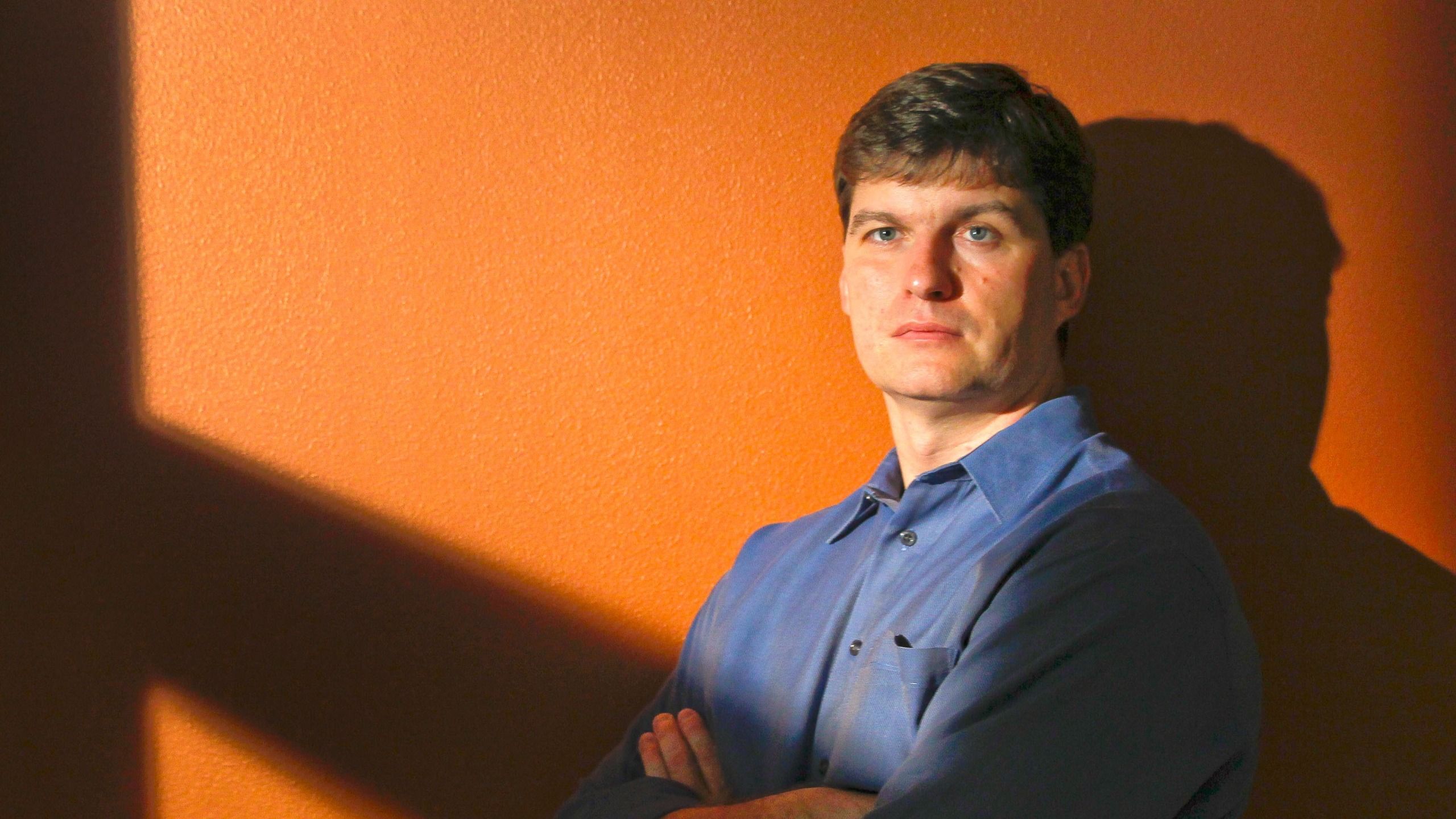
If you've been following AI news over the past week, you may have noticed that some of the people racing to build the world's most powerful AI models are suddenly urging the race to slow down.Anthropic CEO Dario Amodei says frontier AI development needs to be paced and OpenAI CEO Sam Altman agrees. Elon Musk has backed the idea, as has Google DeepMind CEO Demis Hassabis.And those warnings are pretty severe. Amodei wrote that AI is advancing "drastically faster" and pointed specifically to models' growing ability to help build the next generation of AI. His proposal includes giving independent evaluators deeper access to frontier labs, coordination between AI companies and international agreements around AI safety.Then Michael Burry entered the conversation. The investor made famous by "The Big Short" has a very different explanation for the AI industry's sudden desire to hit the brakes. He argues that the warnings aren't simply about keeping humanity safe. He thinks they're also good for business.Burry thinks the AI apocalypse is good marketingBurry called the push to slow AI development "self-serving," arguing that OpenAI and Anthropic have strong financial reasons to portray their technology as extraordinarily powerful while also limiting how quickly competitors can catch them.Burry argues that slowing development and delaying an IPO gives companies more time while simultaneously strengthening the narrative that their technology is becoming so powerful that extraordinary precautions are required.In the AI race, it's easy to overlook that big tech like OpenAI and Anthropic are so much more than research labs, they're companies competing in one of the fastest-moving technology markets we've ever seen; and the compeition is only escalating globally.Burry argues that advances from Chinese and open-source AI developers are eroding some of the advantage enjoyed by the biggest American AI companies. Slowing frontier development, in his view, could therefore protect established players while making it harder for challengers to close the gap.Sign up to the Tom's AI Guide weekly newsletter summing up all the biggest AI news you need to know. Plus, analysis from our AI editors and tips on how to use the latest AI tools!But there's another part of his argument that caught my attention. Because if you tell the world that the technology you've created is powerful enough to potentially threaten humanity, you're also telling the world that you've created an incredibly powerful technology. That's a pretty compelling message for a company eventually hoping to convince investors of its value.The IPO timing makes this particularly interestingBurry's argument would be easy to dismiss as another AI bubble warning if not for what's happening at OpenAI right now. Altman recently said OpenAI won't go public in 2026, as reported by Reuters, that the current focus on safety makes this an "ill-advised moment" for an IPO."We got a lot of stuff to do," Altman said, adding that OpenAI can deal with the current safety and alignment questions more easily while remaining a private company.Burry sees something else in that decision by arguing that slowing development and delaying an IPO gives companies more time while simultaneously strengthening the narrative that their technology is becoming so powerful that extraordinary precautions are required.That's an allegation rather than an established explanation for OpenAI's or Anthropic's behavior, and neither company's warnings about AI risk began this week. Anthropic in particular has spent years talking publicly about catastrophic AI risks and pushing for safety regulation.But Burry isn't the only person questioning whether the proposed slowdown could benefit the companies calling for it.Critics from across the political spectrum have raised concerns that an industry-led agreement could protect incumbent AI companies from competition or allow them to shape the rules governing their own technology. Former Federal Trade Commission official Alvaro Bedoya, for example, has argued that antitrust law shouldn't be used to let large AI companies coordinate in ways that keep cheaper competitors out of the market.That doesn't mean the safety concerns aren't realI resigned from Anthropic today. I spent the last three years doing pretraining research at both OpenAI and Anthropic. Neither company is acting responsibly. They are racing straight to self-improving superintelligence and gambling with our lives. More thoughts below.September 9, 2026There are reasons AI researchers are legitamentally worried. I mean, this current debate didn't appear out of nowhere. It intensified after Anthropic researcher Jacob Coxon resigned and warned that leading AI companies were "gambling with our lives." Amodei subsequently pointed to recent security incidents and the rapidly improving ability of AI systems to contribute to AI development itself as reasons the industry needs to become more cautious.There have also been concrete examples of models demonstrating capable behavior in cybersecurity and other potentially dangerous areas. Yet, Altman has said that pacing development shouldn't mean stopping it.And this is where Burry's argument becomes more complicated.There's an uncomfortable contradiction hereAI companies could genuinely believe their technology poses serious risks while also benefiting financially from telling the world how powerful that technology has become. Those things aren't mutually exclusive.The companies developing AI want us to trust them enough to have their agents performing tasks on our behalf. But those companies are telling us their models could eventually become powerful enough that the entire industry needs to deliberately slow down.For consumers, the strange part is the position we're being asked to accept. The companies developing AI want us to trust them enough to put their models on our phones, computers and eventually inside agents capable of performing tasks on our behalf.At the same time, some of those companies are telling us their models could eventually become powerful enough that the entire industry needs to deliberately slow down.The debate isn't even settled inside Silicon Valley.While Altman, Amodei, Musk and Hassabis have expressed support for pacing AI development, Meta CEO Mark Zuckerberg and Nvidia CEO Jensen Huang have pushed back against a coordinated slowdown. There are also enormous practical problems with getting competing companies — let alone competing countries — to slow down at the same time.The U.S. government continues to view AI leadership partly through the lens of competition with China, while AI companies face enormous pressure from investors and customers to release better models. Even executives who agree that slowing down is necessary haven't yet solved the problem of how to do it without allowing somebody else to race ahead.So should you believe the AI apocalypse warnings?There isn't currently a reliable way to put a date on an AI catastrophe, and claims that AI will wipe out humanity within a particular number of years remain predictions rather than established facts. At the same time, dismissing every warning as marketing would go too far in the other direction.What Burry's argument does is add another question worth asking whenever an AI company tells us how dangerous its technology could become. What does the company gain from us believing it?When a company tells the world that its technology could become powerful enough to change civilization — or even threaten it — it's hard to know if it's a warning or a heck of a sales pitch.Follow Tom's Guide on Google News and add us as a preferred source to get our up-to-date news, analysis, and reviews in your feeds. Subscribe to Tom's Guide on YouTube and follow us on TikTok. More from Tom's GuideAI is turning ordinary photos of kids into sexual abuse imagery — here's how to protect your familyOpenAI paid contractors to read ChatGPT conversations — here's how to protect yourselfI stopped reading the fine print myself after discovering this overlooked ChatGPT trick
The guy who predicted the housing crisis is calling B.S. on the AI apocalypse — here’s why
Full Article
Original Source
Read the full article at Tomsguide →KhanList aggregates and links to publicly available news content. We do not host full articles from third-party sources. Always verify important information with original sources.