
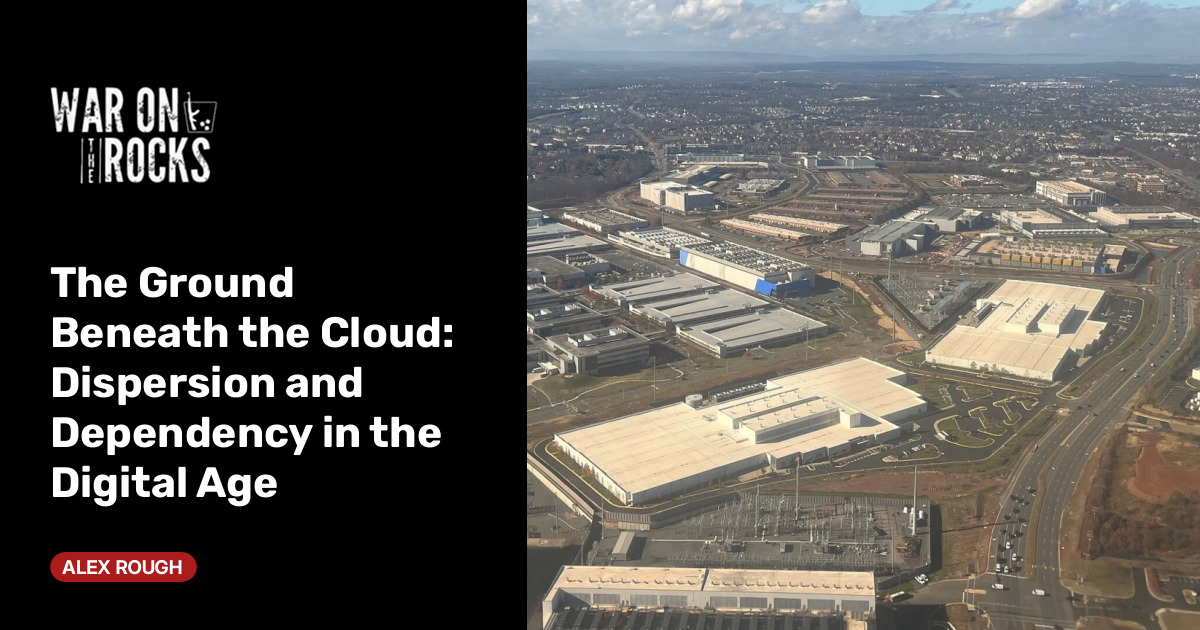
Commercial cloud architecture has made digital infrastructure more resilient to localized disruption. Geographic dispersion, workload migration, and failover have allowed providers to preserve access in instances of degradation or even destruction. Yet, underpinning this resiliency are interlocking dependencies on access to energy, supply chains, and governing bodies that extend well beyond the data centers hosting the commercial cloud. The United States is building digital capacity — data centers and the underlying systems supporting them — faster than the governance frameworks needed to orchestrate the public agencies, private operators, and the physical infrastructure on which that capacity depends. These dependencies extend beyond what individual hyperscale operators can independently address and require state coordination across the physical systems, commercial interests, and jurisdictions that sustain digital capacity. A year ago, I wrote about data centers as the decisive infrastructure of the 21st century, exposed and unaccounted for in real doctrine. Frameworks like the Pentagon’s Joint Warfighting Cloud Capability and its emerging successor, the Unified Cloud Marketplace, established requirements for providers to disperse workloads across data centers hundreds of miles apart and build failover into their contracts, while the Pentagon diversifies across commercial hyperscale providers. This framework should grow to encompass the rapid expansion of infrastructure that threatens to leave behind the geographic dispersion needed to protect data survivability. Writing for Cogs of War in July of this year, Blake Herzinger made the strongest case yet for what digital strategic depth should look like in protecting digital assets with his three pillars: dispersion, elasticity, and optionality — engineered so that a workload can survive an attack on any single point. He cites two recent cases. In Ukraine, critical workloads were moved onto allied territory cloud infrastructure during wartime, demonstrating how geographic dispersion can preserve access to data even when domestic infrastructure is under attack. When Iran struck Amazon Web Services facilities in the United Arab Emirates and Bahrain earlier this year — the first confirmed kinetic attack on public commercial cloud infrastructure — it demonstrated the scale of commercial cloud architecture where customers failed over into other regions. However, strategic depth bought this way is resilience temporarily rented. The cloud that had provided Bahrain a “cloud first” solution could not provide security independent of the physical infrastructure itself. In September, Amazon made that distinction concrete: Amazon Web Services announced it could no longer restore access to resources and data hosted exclusively in its Bahrain region, after physical damage spread across multiple availability zones and exceeded what its regional and multi-availability zone architecture was “designed to withstand.” In the United Arab Emirates, Amazon Web Services made the same determination for one of three availability zones while recovery efforts continue in the other two. The dispersion that mitigated the initial strike could not indefinitely outrun the physical damage on the ground. Hyperscalers would counter that multi-region failover, capacity planning, and supply chain management are their core business and that they do it better than any government could. Bahrain, they would add, is one attack with customers moving workloads to other regions as designed. But what happens when multiple regions — including the failover regions — are subject to multi-theater conflict? Customers’ failover into regions is dependent on strained transmission access and the same fiber, supply chains, and host governments, none of which a hyperscale provider controls. Failover regions do not guarantee operational independence. In June 2025, a single faulty update crashed Google Cloud’s policy-checking system in every region of Google Cloud — one of the Pentagon’s four Joint Warfighting Cloud Capability providers — within seconds. The crash disrupted Google Cloud and Google Workspace services worldwide. Global physical links share similar characteristics as single points of failure. Subsea cables in the Persian Gulf that include Asia-Africa-Europe 1, FALCON, and the Gulf Bridge System run through the Strait of Hormuz. In October 2026, two senior Iranian security officials told Reuters that Tehran has drawn up plans to target the Gulf’s undersea cables if the United States and Israel resume attacks, adding that Iran would aim to prevent repairs to prolong disruption. Moving a workload to another region does not remove it from these shared dependencies on the ground. Scale to the Moon: The Physical Limits of Dispersion Is bigger better? A larger and more geographically distributed data center footprint means more substations, transmission lines, and fiber optic routes over land and sea, all of which fall on the state to protect as the scaling continues. Dispersion compounds nearly every constraint on scaling, from security and energy to space and resources. Every new site needs new transmission, and transmission is currently on backorder. The Department of Energy’s July 2026 transmission study identified data centers as a major source of new load and found an urgent need for more transmission capacity. The International Energy Agency estimates that grid constraints alone could delay roughly 20 percent of global data center capacity planned through 2030. The backup queue continues to grow unabated, further distancing the goals of wider scaling. Backup queues seem to be consistent outside the United States as well. In Brazil, data centers can be built in two years, while transmission lines to power them can take five to seven years to construct. In Chile, the constraints are seen in water availability. Google’s Quilicura Facility used roughly 461 million liters of water in 2024 amidst an ongoing — now over a decade-long — drought where every new site puts more pressure on availability. Across Europe, developers are moving farther away from major cities as power and land become scarce. This is affecting data center development not only going into the 2030s, but right now, as seen in Microsoft’s recently cancelled 50-megawatt data center lease in the United Kingdom due to grid connection delays. New data centers need new hardware to function that’s already becoming scarce. Utilities are competing for transformers, breakers, and switchgear, with some high-voltage transformer lead times exceeding 160 weeks. Expansion is straining supplies of critical minerals and rare earths whose geographic concentration and refinement reside primarily in China. Concentrated control of critical minerals gives Beijing leverage over data center development. Data center demand for gallium alone could reach 10 percent of global supply by 2030, while China produces 98–99 percent of it. Copper and lithium supply gaps are projected into the next decade. China banned exports of gallium, germanium, and antimony to the United States in December 2024, then suspended the ban after the Busan trade truce, with licensing requirements remaining. The suspension expires on Nov. 27, 2026, and the truce itself, extended in September, runs only to Jan. 10, 2027. The suspension’s expiration this month will reveal the measure and willingness of Beijing to execute on its leverage. Expanded interconnection nodes — needed to connect more dispersed data centers — become easy targets as the increased infrastructure bottlenecks in parallel with scaling. Dispersion changes the adversary’s calculus. A hardened hyperscale campus is a more expensive target to hit, but the substation feeding it or the fiber route connecting to it provides much lower hanging fruit. Russia’s suspected Baltic Sea cable sabotage, carried out by commercial vessels, has already shown what cheap, low-tech tactics can do against critical infrastructure. Holding states — let alone individuals — accountable has proven difficult. A Finnish court dismissed charges against three officers of the tanker Eagle S in October 2025, ruling that Finland lacked jurisdiction. The Helsinki Court of Appeal overturned that decision in August 2026 and sent the case back for trial, but the officers have since left the country, making the trial unlikely even with jurisdiction finally established. And yet, while cheap tactics are employed against more built out nodes, states have not shied away from direct data center attacks. Most recently exemplified by Ukraine’s recent attack on the Yandex data center in Russia, the world is seeing a new normalization of attacks on data centers after the incidents in the Gulf. A sustained multi-theater conflict would test the resilience of supply chains, fiber optic interconnection, and power generation sources, with resultant impacts on data center infrastructure. The digital infrastructure scaling intended to provide security through dispersion risks creating new strategic vulnerabilities by deepening the very dependencies that a multi-theater conflict would expose and place under strain. Expanded capacity built during peacetime does not guarantee resilience under wartime conditions. Failover architecture rests on assumptions that connections between regions will survive: a premise that a sustained, multi-theater conflict would fundamentally undermine. From New York to Malaysia: The Shifting Ground of Cross-Border Governance The assumption placed on dispersion being able to effortlessly fail over into more regions is being challenged. Data center hyperscalers face a combination of power rules, water constraints, environmental standards, tax incentives, and community obligations in every market. As computing power becomes more strategically important, those differences will likely determine not only where companies build, but which governments are willing to host them and on what terms, and where failover capacity can exist at all. Data residency makes the problem more pronounced. Many Amazon Web Services customers in the Gulf — among them government agencies, financial institutions and healthcare providers — must by law keep their data within sovereign borders. As TeleGeography noted after the strikes, those customers “couldn’t legally move their data to a functioning international region to restore their services” even as most customers migrated their workloads successfully. That distinction helps explain why some data only existed in Bahrain when the region was lost. Rules like these can make failover illegal, and no provider can engineer their way around that. In July, New York Governor Kathy Hochul imposed a statewide moratorium of up to one year on new hyperscale data centers while the state develops new standards around infrastructure costs, environmental impacts, and community benefits. Texas broadened its moratorium on data center approvals, ordering the Texas Commission on Environmental Quality to stop issuing permits, and several other states have active legislative moratorium proposals. Failover candidates are being removed from the map or arriving with conditions. Outside the United States, many examples point to a constantly shifting landscape and physical limitations that directly impact cross-border governance. Malaysia illustrates a different response in light of stresses caused by the industry. Rather than stopping the buildout of data centers outright, Johor has restricted the most water-intensive classes of data centers, with federal and state governments tightening reviews of projects against available power and water supplies. Brazil created a new tax regime to attract data center investment while attaching domestic investment and sustainability conditions, and Chile has formalized environmental review criteria specifically for data centers. The industry faces targeted restrictions in one market, conditional incentives in another, and environmental constraints in a third. Each divergence shakes up the geography of where failover can go during a crisis. War on the Rocks Membership Newsletters. Podcasts. Analysis. Exclusive members-only dispatches, premium shows like The Russia Contingency with Michael Kofman, and expert analysis of the conflicts shaping national security. Military, government, and students 33% off with a .mil or .gov email50% off with a .edu email Choose annual, then sign up with that email address. No code needed. Public-Private Orchestration In March, the U.S. Army began negotiations to lease land at Fort Bliss and Dugway Proving Grounds to Carlyle and CyrusOne for data center development. Congress, meanwhile, began legislating on the physical and supply chain risks, including a House provision that would bar the Defense Department from leasing land for data centers unless developers agree not to install certain equipment containing components manufactured in China, Russia, Iran, or North Korea. The Pentagon moved ahead with public-private infrastructure while Congress was still developing the rules to govern it. What the moment calls for is proactive orchestration, and the Pentagon has done it before. The Civil Reserve Air Fleet, Commercial Augmentation Space Reserve, and the Cable Security Fleet give the military in national emergencies priority access over commercial airliners, satellites, and a commercial cable-repair capacity. While conferring different authorities in each, all depend on private capacity being available to national security during a crisis. This is no different for cloud infrastructure, where no such equivalents currently exist. The Department of Defense should establish a Commercial Compute Reserve with crisis priority. Creating a reserve would give the United States what no hyperscaler can engineer on its own: guaranteed access to commercial capacity in a crisis. This cannot be done simply, however, and insurance presents a wider scope of issues. Commercial insurers can suspend war risk coverage on short notice. In the example of the Civil Reserve Air Fleet, the Federal Aviation Administration’s war risk insurance program covers carriers flying government missions. A Compute Reserve would need the same parameters, but against a far larger loss of infrastructure than single planes. A reserve would not ensure that capacity survives: that depends on hardening and the energy, fiber optics, and supply chains supporting the cloud. Some loss is inevitable in sustained conflict, so the reserve’s purpose would be continuity and reconstitution. When a region is lost, the reserve determines who gets the capacity remaining, on terms agreed to in peacetime. Participating providers would maintain a contracted baseline of standby capacity for defense workloads, enough to absorb an initial relocation. Beyond that scope, they would agree to preempt commercial workloads only after a declared emergency, with additional capacity activated incrementally — following a model like the Civil Reserve Air Fleet. The Telecommunications Service Priority program, the closest existing analog, shows how the order could be established. It prioritizes communications supporting national security and emergency preparedness, including eligible healthcare, public safety, and financial sector functions. The reserve should preserve those priorities, protecting designated civilian services from preemption as additional capacity is activated. Because the first regions lost may be abroad, the reserve should extend to regions in allied countries. It should also build on the Defense Production Act’s priority ratings, which already place defense contracts ahead of commercial orders, and extend that logic to guaranteed access to existing commercial capacity during a crisis. Airlines commit aircraft to the Civil Reserve Air Fleet in exchange for Defense Department business, but that dynamic does not extend to the cloud. For hyperscalers, that business is too small to buy the same commitment. By 2025, the Joint Warfighting Cloud Capability drew roughly $3.9 billion split among four providers, while Amazon Web Services alone has an annualized revenue of more than $180 billion. A reserve should draw on what hyperscalers need and what the federal government controls: land and energy. Participation should earn expedited power and permitting on federal sites from installations like Fort Bliss and Dugway Proving Grounds — where reserve terms could be written into the leases now under negotiation — or the Energy Department sites already being offered for AI data center development. Congress should support this effort with indemnification against catastrophic loss, with the Defense Production Act’s priority authorities as the backstop if voluntary participation falls short. The United States currently recognizes 16 critical infrastructure sectors. Data centers fall within both the information technology and communications sectors, and neither is organized around data centers’ physical dependence on energy, cooling, and protection from kinetic attack. Congress and the executive branch should create a standalone sector that reflects a defense establishment increasingly dependent on commercial computing power, with its own sector risk management agency and a sector plan built around those dependencies. The Cybersecurity and Infrastructure Security Agency already manages risk for both existing sectors and is a natural lead, with the Energy Department as a partner on energy. However, the agency has lost a third of its staff since January 2025 and would need that gap restored to take on the role. Designation alone would not impose standards, as sector risk management is largely voluntary coordination. Britain’s experience showed the same limits in Its 2024 designation, which gave operators a dedicated government team, priority access to the National Cyber Security Centre, and coordinated emergency support, but no minimum security or resilience requirements. Britain is now legislating those requirements through its Cyber Security and Resilience Bill, requiring data centers of one megawatt or more to manage risk and report major incidents. Congress should pair an American designation with the same obligations from the start. Following the strikes in March 2026, the United Arab Emirates began considering dispersed, underground, and blast-resistant designs for its five-gigawatt AI data center. The Joint Warfighting Cloud Capability shows a certain amount of resilience can be bought at scale with this procurement regime. The Defense Department’s chief information officer should direct the Defense Information Systems Agency to write physical resilience standards against deliberate attacks into the requirements for dedicated government and classified regions and into future Unified Cloud Marketplace task orders — covering on-site power, redundant fiber optic and satellite paths, and stocked replacement components. Providers would accept them there because those regions are built for government customers, where the department’s leverage is far greater, and the cost of meeting standards can be priced into its contracts. Commercial regions would come in through the reserve’s incentives, rather than by mandate. This is not to make every data center a fortress but to ensure — beyond what private industry guarantees on its own — that when one power source, supplier, or communication path goes down, capabilities themselves don’t go down with it. The Missing Doctrine The rapid expansion of commercial cloud architecture has created fundamental security issues for the Pentagon: Scaling capacity is deepening unwieldy operational dependencies that are increasingly difficult to defend during a crisis. While cloud resilience is a marker of 21st-century computing security and can absorb localized disruptions, a sustained multi-theater conflict will overwhelm physical infrastructure if defense strategy relies solely on buildout. The United States should develop a framework capable of coordinating the physical infrastructure, industrial supply chains, commercial operators, and public authorities that make computing power resilient in the first place: the ground beneath the cloud. The Joint Warfighting Cloud Capability and the emerging Unified Cloud Marketplace show public-private orchestration is possible at the procurement layer. The harder task is extending that coordination across energy, infrastructure, supply chains, and security policy. To keep failover migration available during wartime, the Defense Department and private industry require a joint doctrine, anchored by a Commercial Compute Reserve, a dedicated critical infrastructure sector, and physical resilience standards written into government cloud contracts. The U.S. shortfall is the lack of a dynamic doctrine capable of governing the underlying systems that are shifting the reality of modern digital warfare. Alex Rough is a cloud systems engineer and writer whose work explores the intersection of digital infrastructure, environmental sustainability, national security, and strategic competition. He has worked in the data center industry for over a decade and was featured in a BBC documentary on the environmental impact of data centers. He lives in the Washington, D.C., area. Image: Theodore Christopher via Wikimedia Commons
The Ground Beneath the Cloud: Dispersion and Dependency in the Digital Age
Full Article
Original Source
Read the full article at Warontherocks →KhanList aggregates and links to publicly available news content. We do not host full articles from third-party sources. Always verify important information with original sources.