
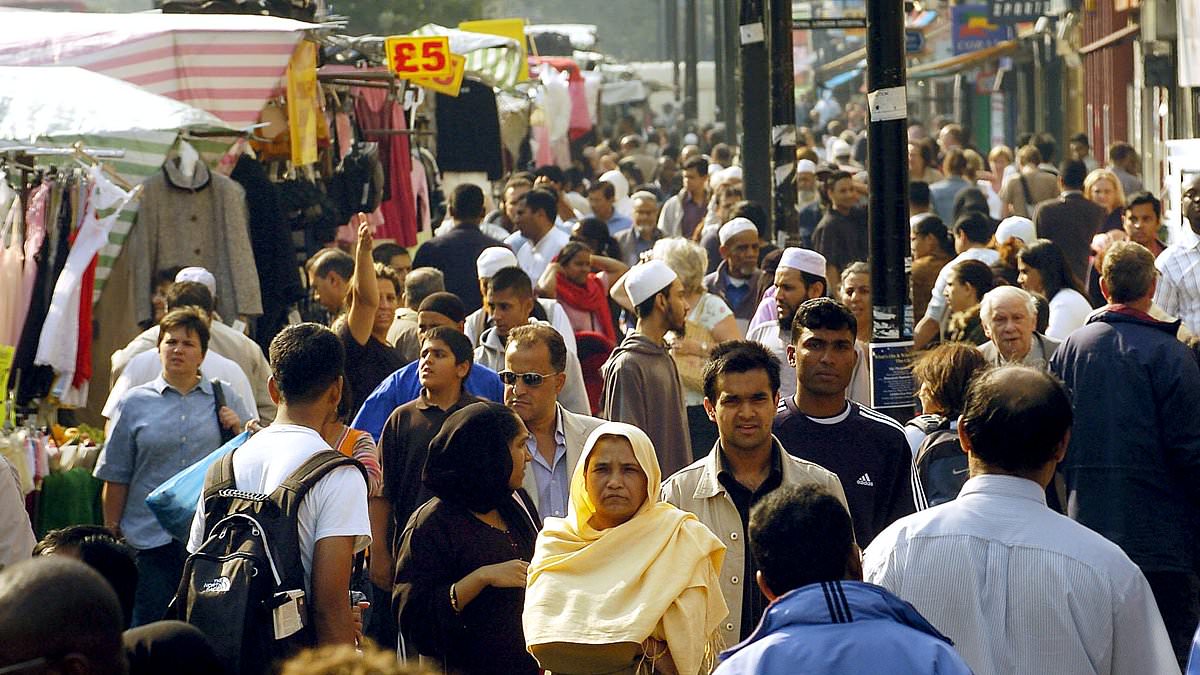
Earlier this year, someone recommended a book to me called The Unknown Warriors, published in 2012.It was written by a journalist called Nicholas Pringle who, between 2006 and 2008, placed notices in local newspapers across Britain inviting Second World War veterans to share their memories of service and their thoughts on the country that had emerged in the decades since.Dozens of men and women, by then in their 80s and 90s, wrote to him, their letters eventually filling a volume of more than 500 pages. It makes for deeply poignant reading.While some express gratitude for improved standards of living, there is another, more troubling sentiment running through many of their accounts: bewilderment, sometimes bordering on bitterness, at what has become of the country they loved, and for which so many had been prepared to sacrifice their lives.'All my war efforts were for nothing,' writes one. 'This is no longer a country fit for heroes,' laments another.A third, reflecting on the transformation of his native Birmingham, observes that in some parts of the city: 'You would never know you were in England.'Those words were written two decades ago. Since then, Britain has been further transformed and at a pace that would have been inconceivable to those who grew up during and immediately after the war.In demographic terms alone, Britain has changed enormously. Back then, for all the country's faults, and for all the many local differences that made the country what it was, there was a strong sense of national identity rooted in shared histories, traditions and ways of life that had evolved over centuries.Britain has changed enormously Britain has changed enormously in terms of demographics over the last few decades (Pictured: Whitechapel in east London, circa 1947) Whitechapel High Street pictured today. It is now one of London's most multicultural and diverse districtsToday, perhaps just three-quarters of the population of England and Wales identify as 'White British' – the census categorisation that, in crude terms, imperfectly captures those with mostly non-immigrant ancestry, unlike, for example, 'Asian British' or 'Black British'. Behind that dry statistic lies the most profound demographic transformation in our country's history.Of course, much else has changed since the Britain of 1945, and often for the better. For all its demographic stability, the country in the aftermath of total war was no idyll. Today we are, by and large, wealthier, healthier and more technologically advanced than ever before.Yet reading those veterans' letters, I found myself returning to questions that statistics alone cannot answer.What does it feel like to see the country you knew as a child transformed almost beyond recognition? And what happens when the familiar landmarks of life – not just buildings and streets, but customs, communities and a sense of belonging – all seem to disappear around you?It was this sense of loss, so rarely explored with much sympathy in our national conversation, that prompted me to make my new film, Britain Before Migration.I wanted, while there was still time, to hear from people who remembered the country before the tumultuous demographic changes of recent decades. At 26, I have known only the Britain, you might say, of Blairism: multicultural and progressive.Yet even in my own lifetime, growing up in Portsmouth, I have been conscious of changes to the country around me: many but not all, of course, brought about by mass immigration.What I had not fully appreciated, until I began filming, was how disorientating those changes could feel to someone approaching the end of a long life. Just three-quarters of the population of England and Wales identify as 'White British' (Pictured: Shoppers at Whitechapel Market on Whitechapel High Street) Spectators celebrating Empire Day on the streets of London around 1950Major General Julian Thompson is a distinguished ex-Royal Marine who commanded 3 Commando Brigade during the Falklands War. Now 92, he has devoted himself to King and Country, and his dismay at what he sees as Britain's diminished sense of national purpose is matched by his anger at its failure to control its borders – in particular the mega-dinghies ferrying tens of thousands of illegal migrants across the Channel every year.Mr Thompson's views, expressed to me for my documentary and reported in last weekend's Mail on Sunday, were uncompromising.'We could stop them [the boats] tomorrow if we really had the guts. I'd shoot them: sorry, but I would,' he said.His suggestion is, of course, unconscionable – but his cry of frustration is surely echoed, in less extreme terms, in pubs and living rooms across the country, by people who feel their concerns about mass migration, legal and illegal, are simply not being heard – and that the Britain they loved is slipping away.Those emotions were captured poignantly last November, when Alec Penstone, a 100-year-old Royal Navy veteran and D-Day survivor (he passed away this May, aged 101) appeared on ITV's Good Morning Britain ahead of Remembrance Sunday. As Mr Penstone said: 'I see rows of white stones, friends who died – for what? The country now? No, it wasn't worth it.'Here was a man who had lived through a century of extraordinary progress and yet, looking back on the sacrifices of his generation, could only question what had been achieved.That same question has particular resonance for me because of my own grandfather, Derek Edginton, now 91, a docker's son who grew up in Poplar, east London.He remembers the German V-1 flying bombs, the 'doodlebugs', moaning overhead during the war, as he counted the seconds after their engines stopped and prayed the coming explosion would not kill him.The danger – and the deprivations of rationing and blackouts – were real. Yet most vividly Derek remembers the extraordinary sense of common purpose. Everyone from the street-sweepers to the telegram operators and the women working in the factories felt they had a part to play. In his words: 'We were fighting for Britain.'Like so many, Derek has watched his country change in ways he could scarcely have imagined. His childhood home of Poplar, which was largely ethnically homogenous, is now 45 per cent 'Bangladeshi' and just 14 per cent 'White British', according to census data from 2021, which is likely hopelessly out of date. Derek is now living in a care home and was sadly too frail to take part in my documentary – but a sprightly 92-year-old called Ron Clark was happy to. I joined Ron on a journey back to Tottenham, the north London neighbourhood where, as a young joiner, he had raised his family. It was his first time there in almost half a century. Shoppers pictured on Tottenham High Road, which is among London's most ethnically and culturally diverse areas Ron grew up playing childhood games along Tottenham's terrace streets. It was where he and his wife Marion-Martha brought up their children before leaving London for rural Norfolk in 1967.As we walked through his former neighbourhood, those terrace houses still stood, although many of the homes Ron remembered as neat and well-cared-for now appeared shabby, their paintwork peeling. Rubbish was strewn along the pavements, alongside fly-tipped furniture.Arriving at the High Street, Ron was dumbstruck. Here, the shops he remembered had vanished, replaced by businesses serving a very different clientele, including stores selling African and Caribbean produce.The newsagent where he started his paper round was a Ugandan shop. The stench of marijuana lingered in the air, and someone had painted large letters on a brick wall imploring people not to urinate on it. For me, it was a busy, multicultural London neighbourhood. For Ron, coming here was to confront a stinging reality that the place he remembered so vividly existed only in his mind.'It's nothing like it used to be,' he told me when at last he recovered his words. 'I don't recognise it any more.' His beloved late wife, he believed, would have found the experience even more distressing. 'She would have burst into tears,' he told me.Of course, no place can remain frozen in time. Shops close, industries rise and fall, new generations emerge and move with the times. That is part of the story of every city, every country.But watching Ron struggle to reconcile the Tottenham of his memory with the place before him, I wondered if we sometimes underestimate the emotional consequences of such rapid change.I encountered a similar melancholy in Ray Holmes, 81, a Cockney who had grown up, he told me, in an east London where neighbours chatted over brick walls and children ran from house to house. Residents of Morpeth Street in London's East End watching one of the entertainments put on to celebrate the coronation of Queen Elizabeth II in 1953Ray, unlike Ron, has stayed in the East End since he was a boy and seen the Cockney life 'die, never to come back', he said. But it wasn't just the East End Ray worried was lost forever. 'England sailed away years ago,' he told me. 'It left port goodness knows when and I don't think we'll ever see it back.'There is something terribly sad about that image: a country sailing out of sight, while those who knew it best remain on the shore, for however long they have left.Certainly, it is hard to overstate the scale and speed of Britain's transformation under mass immigration. In my documentary I spoke to the demographer Dr Paul Morland, who pointed out that for much of the preceding millennium, the ethnic make-up of these islands was remarkably stable.It was only in the closing years of the 20th century, and especially after the turn of the millennium, that immigration began to accelerate dramatically.The consequences have been visible not merely in the composition of our population but in the everyday character of our towns and cities: the languages spoken, the shops on our high streets, the places of worship and the customs of neighbourhood life. Indeed, the changes are apparent even in something as apparently enduring as our surnames.Data obtained by the Daily Mail this week revealed a striking shift in the most common surnames given to newborn babies in England and Wales. In 1996, the top ten were Smith, Jones, Williams, Taylor, Brown, Davies, Evans, Thomas, Johnson and Wilson.Today, that list includes Khan, Ahmed, Ali, Hussain, Singh, Patel and Kaur.There is nothing inherently troubling about a changing list of names. But it is a vivid illustration of how rapidly the country's demographic character has altered in a single generation.And Dr Morland believes the transformation is far from complete. On current trends, and depending on future immigration and fertility rates, he considers it entirely plausible that people identifying as 'White British' – as I say, a shorthand for that segment of the population with extensive indigenous ancestry – could become a minority by the early 2060s. Such projections are, of course, not certainties. They depend on assumptions about policies and behaviour that may change considerably over the decades ahead.Nonetheless, the calculations suggest that in a few decades, Britain could be just as different, or even more so, as the one Ron and Raymond remember from their childhoods is from today.For some, that prospect will be a cause for celebration. For others, it will provoke anxiety, even grief. We should, I believe, be capable of discussing both responses without automatically assuming the worst of those who express them.During filming, I was struck by how reluctant many older people were to speak openly about their feelings: worried that even expressing sadness about the changes they had witnessed would lead to accusations of racism.But there is an important distinction between legitimately criticising immigration policy and expressing hostility towards people because of their ethnicity or background.It should be possible to question the scale and speed of immigration, or to mourn the disappearance of a familiar culture, without being assumed to harbour 'hatred' towards any new arrivals.Love for England and a wish to preserve its historic civilisation are not the same as antipathy towards outsiders.Indeed, concern about mass migration is not confined to families whose roots in Britain stretch back centuries. It is shared, as I found during filming, by many second and third-generation immigrants, who themselves feel deeply patriotic towards this country and are concerned about the pace of change.We should not romanticise postwar Britain. Class distinctions were more pronounced, social attitudes were different and prejudice existed.Immigration, meanwhile, has brought some benefits. It has helped fill gaps in our economy, while other cultures have brought the country music and art, as well as – this is a cliche, but true – new cuisines.Nor, of course, can every problem in modern Britain can be laid at immigration's door. The decline of neighbourliness, for instance, has many causes. The disappearance of traditional industries, changing working patterns and the rise of digital technology have all altered the way we live. There is no reason to imagine that a Britain without large-scale immigration would be a utopia.My grandfather Derek expresses it most simply. He does not blame people for wanting to come to Britain to make better lives for themselves. His frustration is directed instead towards the politicians who, he says, effected such enormous changes while repeatedly ignoring the voters, who made their views clear on the subject in election after election.As he puts it, with a sadness I now understand better than I once did: 'Looking back, Steven, it seems to me that we won the war. But, my goodness, we lost the peace.'
The grief that dare not speak its name: It's only whispered for fear of accusations of racism. But the pain and bewilderment felt by the generation who lived through war at how mass immigration has transformed the Britain they fought for is very real
Full Article
Original Source
Read the full article at Dailymail →KhanList aggregates and links to publicly available news content. We do not host full articles from third-party sources. Always verify important information with original sources.