
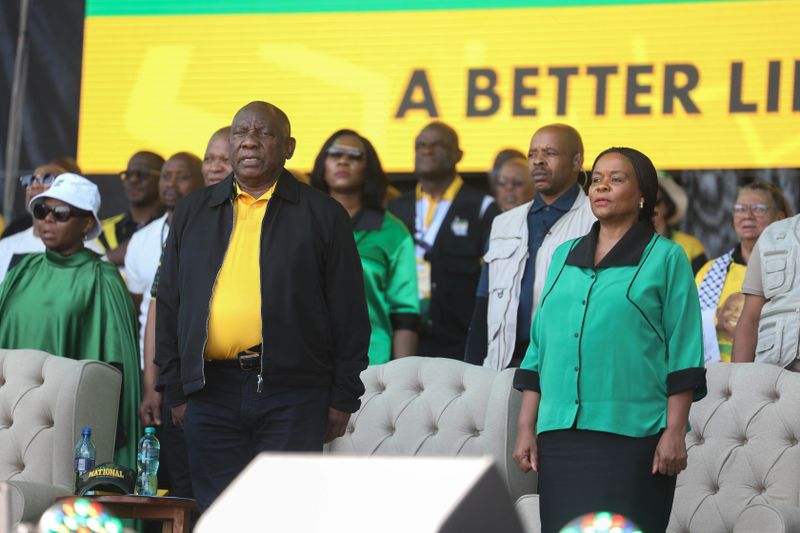
They should have seen it coming, the sages will say. The ANC should have seen the signs of rapid decline during the launch of its 2016 local government election manifesto in Port Elizabeth, now Gqeberha. The party could not fill the Nelson Mandela Bay Stadium, a feat that was previously easily achieved in the erstwhile stronghold. Party hacks ran around claiming that bus companies (presumably working with the ANC’s opponents) had sabotaged the event by not turning up to pick up supporters in townships around the metro.Nonetheless, the rally in the barely half-full stadium kicked off with musical performances. The MC and party leaders did their best to rouse the listless crowd to dance to popular tunes. Then the rally began in earnest, with messages of support being delivered by the ANC’s alliance partners and sister parties from across the world.That is when the crowd began streaming out. By the time then ANC president Jacob Zuma started speaking, the exodus was in full swing. Pleas from the podium to show the leader some respect by staying seated fell on deaf ears, or no ears at all.Bored by the whole affair, thousands of ANC supporters chose to go and frolic on the beach or window-shop at the local malls until the stipulated departure time. Speaking to journalists, many of those from other parts of the Eastern Cape and inland provinces revealed that they had never been to the coast before and were not going to forgo the opportunity just to listen to speeches.They had heard all the promises, boasts and excuses before. The trip was great fun and was definitely worth it, but they had no obligation to sit through the dreary proceedings. Again the party hacks went into spin overdrive. It was the heat that drove the crowds away, not disengagement from the ANC’s messages.Empty seats at the Nelson Mandela Bay Stadium on 16 April 2016 as the ANC launched its manifesto in Port Elizabeth, now Gqeberha. (File photo: Lucky Nxumalo / City Press / Gallo Images)Well, the results of the election a few months later showed the extent of the disengagement. The ANC lost its previously guaranteed majority in most metros and was muscled out of power in Gauteng’s big cities and Nelson Mandela Bay itself. It then had to force its way back into power by causing instability among the brittle coalitions and, the story goes, offering some absurd incentives.In the 2019 general election, the 2021 local government elections and the 2024 general elections the trend accelerated.Avoiding embarrassmentOver the past weekend, the ANC gathered in Diepsloot, Johannesburg, to launch its manifesto ahead of what is expected to be a humiliating municipal election in November. It was a rather low-energy affair in a community park, far from the mega-stadiums where the party has previously launched its manifestos.The reasoning behind choosing the small, unglamorous setting was that the Riverside settlement is seen by the ANC as a model for delivering to poor communities. Housing people mostly resettled from inhospitable land in Alexandra, it is a mixed-income development that is nestled between the poverty-stricken Diepsloot, upmarket Fourways and filthy-rich Steyn City. Rental units can go for under R3,000 and bonded houses can be had for up to R550,000.Of pride to the ANC is that Riverside broke with apartheid spatial planning of keeping the poor out of sight and on the peripheries of former townships that the democratic government had perpetuated since 1994.While Diepsloot imposed itself on these formerly lily-white surrounds, Riverside was a planned intervention. So the setting served the dual purpose of avoiding empty seats at a stadium and showcasing what the ANC believes is a jewel (although many of the residents complain of the same neglect that other communities suffer from).(Source: IEC official results (results.elections.org.za), compiled by Daily Maverick. Graphic: Jocelyn Adamson; Photos: Wikimedia Commons) It is now common cause that the ANC went into the launch with egg yolk dripping from its collective forehead. Because of factional politics, the party had already missed several deadlines for announcing mayoral candidates for the metros and secondary cities but still insisted throughout last week, with much gusto, that it would do so at a Sandton shindig on Saturday.That did not come to pass. Instead it provided short lists that were in fact long lists. It then went into a National Executive Committee (NEC) meeting to finalise the list, where more fighting took place. Next, the ANC told us that it would require its councillors to have matric and that those without matric would have 12 months after the elections to get a matric or an equivalent qualification. The reassuring message here was that the organisation’s public representatives would need to have basic literacy and numeracy. Wow! Lightbulb moment, people!Insatiable hunger for powerSo what do you have here? You have a party in disarray, unable to cohere on anything other than the sowing of chaos. After its decades-long frenzy of feeding on the state coffers, it’s now eating itself from within. To death.Let’s go back to the seeds of self-destruction. Most will trace the beginning to the Polokwane conference in 2007, where the delegates ousted Thabo Mbeki and replaced him with Zuma. That is only partly correct.The beginnings go back to 2001, when Zuma out of the blue denied wanting to challenge Mbeki for the presidency at the 2002 national conference in Stellenbosch, declaring that rumours to the contrary were being manufactured by “faceless, destructive quarters” to drive a wedge between himself and his leader and proclaiming that “my confidence in him is unwavering”.He was not lying. At the time the corrupt guy could not believe that he had actually made it to be deputy president of the party and the country.With Zuma seemingly out of the picture, Mbeki’s acolytes targeted other possible contenders. Senior leaders Tokyo Sexwale, Mathews Phosa and Cyril Ramaphosa were accused of plotting to topple Mbeki. That compelled these leaders to distance themselves from the fictional plot. Whether or not Mbeki was involved in the scheme, many believe the increasingly insecure leader would have given the nod. His henchmen, police minister Steve Tshwete and national police commissioner Jackie Selebi, deployed considerable resources to a full-on investigation into the so-called plot. By the time they pronounced that they found nothing, their targets had been neutralised.Jacob Zuma, the ANC’s president at the time, waits to address the party’s election rally in what was then Port Elizabeth on 16 April 2016. (File photo: Mike Hutchings / Reuters)In 2002, the leftist components in the tripartite alliance launched a campaign to “flood the NEC” with their own and thus capture the party in order to defeat what they termed a neoliberal agenda. They knew they were never going to defeat Mbeki, but hobbling him with a national executive packed with leftists would do the trick. They lost spectacularly, with Mbeki loyalists controlling the Top Six and his people dominating the NEC.Licking their wounds, they rallied behind the man who had declared unwavering confidence in the president to be their lodestar and champion of a working-class agenda. Zuma, now besieged by corruption investigations, was obliged to lead a cause that he knew deep down he cared little about. The rest, as they say, is history. Polokwane was the culmination of this civil war that the ANC has never recovered from.A hopeless battleThe ANC has been bleeding ever since. These scars, coupled with the culture of rampant malfeasance that was normalised during the Zuma years, as well as splinters and defections, have led the ANC to the place it is in now.The war raging among the Top Seven, in the National Working Committee and in the NEC is a continuation. It is a war among factions who want ascendancy at next year’s national conference where a successor to Ramaphosa will be elected and national leaders will be chosen.The calculation is simple: taking control of the local structures is crucial to getting the numbers needed for December 2027. The irony is that it is a pointless fight, because the faction that will triumph next year will have won a pyrrhic victory.Whoever becomes president of the ANC has no guarantee of waltzing into the Union Buildings in 2029. The NEC members who will be elected will not necessarily be in the Cabinet after that general election. Nor will the provincial overlords necessarily emerge as premiers or MECs, save for two or three safer provinces.Lower down the chain at local level where the battles are being fought as ferociously as in the NEC and the Top Seven, the incentives seem more immediate. Mayors and councillors have a say over budgets and therefore patronage machinery that means a lot. They have played their cards in the regional executive committees, where they have been split along the lines of who will be supported at national level in 2027. They have leveraged this power to try to influence the national leaders their way. Never mind the lofty appeals to serve and deliver to the people. ANC president Cyril Ramaphosa looks pensive at the ANC’s manifesto launch in Diepsloot on 23 August 2026 in Johannesburg. Whoever succeeds him as party president has no guarantee of entering the Union Buildings after the 2029 election. (Photo: Sharon Seretlo / Gallo Images) To its credit, the selection process run by the Kgalema Motlanthe-led electoral committee has gone some way towards weeding out some bad eggs, but many have still come through. We saw them being paraded before the nation at the manifesto launch. No process can overcome factional politics in a rotten ANC.Again, here is the irony. The daggers that have been plunged into comrades’ backs during this period will come to naught for those who fought so hard.Just like at national level, there is a high chance that the ANC will not be running the prized municipalities after November. The ANC can forget about most of the metros and many of the secondary cities whose mayoral short lists were unveiled last weekend. The patronage pipeline to which ANC leaders and supporters have become addicted will vanish, leaving them shivering like drug addicts who have been forced to go cold turkey.The ANC manifesto – which is a mixed bag of over-promising, realism and common sense – is fanciful because the ANC seems not to have accepted that it has eaten itself and is on its last legs. The second-last nail will go into its political coffin on 4 November. In 2029 the last nail will go in and the procession to the cemetery will begin. DMThis story first appeared in our weekly DM168 newspaper, available countrywide for R35.
THE GREAT UNRAVELLING: ANC devours itself from within as voters steadily turn their backs
Full Article
Original Source
Read the full article at Dailymaverick →KhanList aggregates and links to publicly available news content. We do not host full articles from third-party sources. Always verify important information with original sources.