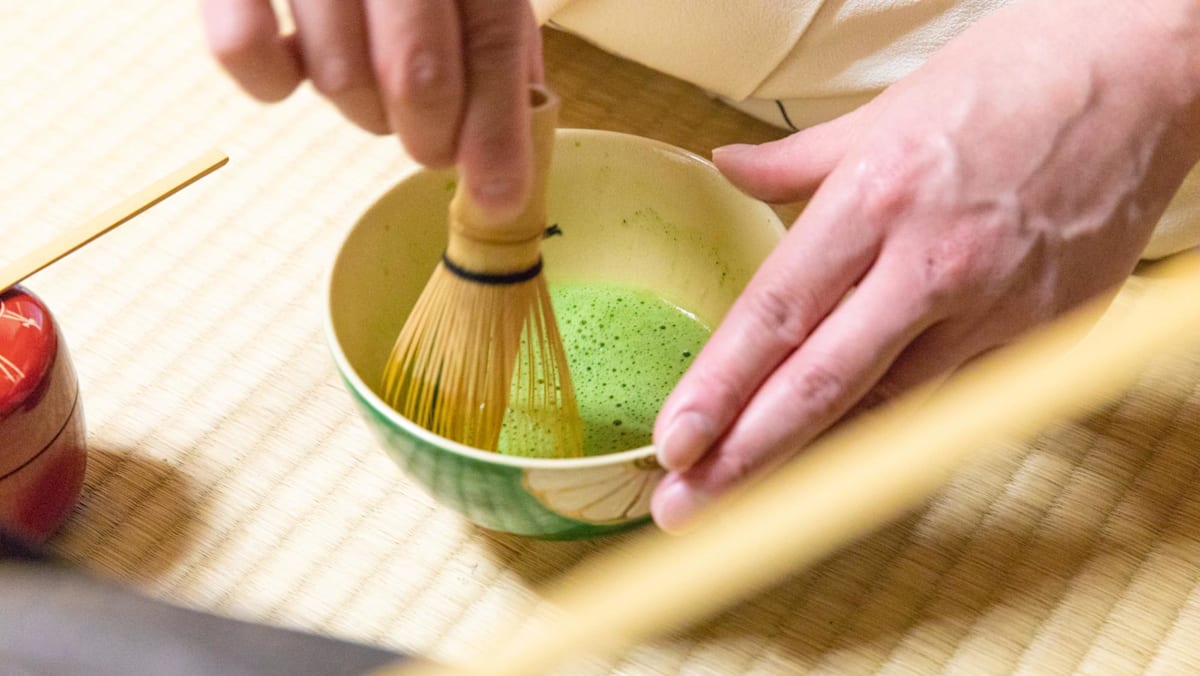
UJI, Japan/TONGREN, China: Before the doors open at Horii Shichimeien, a historic tea store in Uji, customers are already waiting.They have come to this centuries-old tea city in Kyoto Prefecture for some of Japan’s most prized matcha.Inside the shop, tins of its award-winning matcha can cost nearly US$170 each. Prices are now three to five times what they were five years ago. Customers queue outside Horii Shichimeien, a historic tea store in Uji, Japan. For Horii Shichimeien’s president Chotaro Horii, who inherited the family business, the crowds are a welcome sight.“Japanese tea was on a downward trend, but the matcha boom overseas rescued us,” he told CNA.Today, Japan faces a different problem – demand is outpacing supply.At Horii Shichimeien, producing matcha is a slow and painstaking process.Tencha, the tea leaves used to make matcha, is grown under shade for 20 to 40 days before being harvested. Tea plants grow under shade at a farm in Japan, a technique used to cultivate tencha leaves for matcha. (Photo: CNA/Michiyo Ishida) For premium-grade matcha, only the first spring harvest – considered the most flavourful – makes the cut.After they are picked, the leaves are rushed to a processing plant and steamed to prevent oxidation.They are then dried and stripped of their stems before being ground into a fine green powder with traditional stone mills. Traditional stone mills grind tencha leaves into fine matcha powder at Horii Shichimeien’s plant. Each mill produces just 40g of matcha in an hour.There are about 80 stone mills at Horii Shichimeien’s plant, which is shared by seven other tea growers in Uji to reduce costs.The highest-quality tea is ground at only 10 designated mills.During peak periods, high demand can keep the mills running through the night. But Horii said they also need periods of rest to maintain the quality of the powder. Horii Shichimeien president Chotaro Horii. Japan's matcha shortage made headlines around the world in 2025. At the same time, the country was shipping more tea abroad than ever.According to Japan’s agriculture ministry, exports of Japanese green tea – including matcha – have reached record highs for six consecutive years. In 2025, exports exceeded 12,600 tonnes, up 43 per cent from the previous year.Japan has been producing more tencha too. Production roughly tripled over the past decade, reaching more than 6,200 tonnes in 2025.But it is not the only country ramping up production. CHINESE GROWERS STEP INShrouded in the mist of Fanjing lies the city of Tongren in China’s southwestern province of Guizhou.Its cool climate and abundant rainfall have long made the region ideal for growing tea, but the mountainous terrain also held back economic development.Then, global demand for matcha took off.Local authorities encouraged farmers to revive tea fields, offering subsidies and other support. Land that once generated little income became part of a growing matcha supply chain. Fanjing Mountain in China's Guizhou Province. (Photo: CNA/Tan Si Hui) Farmer Yang Xiuyuan, 71, has worked these fields for much of his life.“This used to be a wasteland. Now that it's planted with tea, it brings in income, so earnings are higher,” he said.Yang earns 100 yuan (US$15) a day pruning, fertilising and harvesting tea.More than 100,000 farmers now make a living from the matcha industry in Guizhou, once the nation’s poorest province.Tongren city alone produces roughly a fifth of China’s matcha, helping to drive the country's rise as the world's largest producer.According to the China Tea Marketing Association, the country accounted for about 70 per cent of global matcha supply last year, producing more than 12,000 tonnes. Yang Xiuyuan is among more than 100,000 farmers who make a living from Guizhou’s growing matcha industry. China’s biggest matcha maker, Gui Tea, sold more than 2,500 tonnes in the same year. More than half was exported to over 50 countries, including to traditional matcha powerhouse Japan. Chen Xiaoming, Gui Tea Group’s deputy general manager, sees a gap that Chinese producers are well placed to fill.“Japan's matcha production has also grown rapidly over the past few years, but it simply cannot keep pace with the speed at which global demand is increasing,” he said. “As a result, many Chinese companies have entered the matcha industry in recent years.” Customers sample a matcha beverage in Guizhou. Unlike Japanese matcha, which commands a premium, China's strength lies elsewhere.“The vast majority of demand in the international market is for beverage-grade matcha,” Chen said.“This type of matcha doesn't need to be as ultra-premium or as meticulously crafted as the matcha produced in Japan's renowned growing regions, such as Uji.“In China, we have advantages in terms of our tea plantations and our labour force, which allow us to scale up production very quickly.”Guizhou is investing heavily in matcha, aiming to grow the industry into a US$1.5 billion business by 2030 through upgrades in technology and production. THE BOOM THAT REVIVED UJI TEAChina's ability to produce matcha at scale may help meet the world's growing appetite for the tea. But for Japan’s famed tea-growing regions, matcha is closely tied to where it comes from – and the traditions behind it.That is especially true in Uji.Tea first took root in the fertile lands around the city about 800 years ago, using seeds brought from China.But Uji's tea industry has not always enjoyed today's success.For decades, Japan's tea farms struggled with falling domestic demand for loose-leaf varieties and historically low prices.Margins thinned, and fewer young people saw a future in the industry. In Uji, urbanisation also reduced the amount of farmland available.Now, the global matcha boom has breathed new life into the sector, with the benefits extending beyond tea farms. In 2025, Uji drew a record 6.2 million tourists, many in search of matcha. Tourists explore Uji, which drew a record 6.2 million visitors in 2025, many in search of matcha. As pride in the city’s matcha – and optimism about its future – grows, a new generation is returning to the fields.Among Uji's historic farms is Okunoyama, run by Horii Shichimeien and the sole survivor of the city's legendary Seven Tea Gardens. Horii said Uji's tencha farms offer relatively high returns because of the premium value of their tea and their cultural ties to sado, Japan’s traditional way of tea. But the industry still faces a labour problem.“Leaf pickers, who are mainly women, are ageing. It's hard to find them,” Horii said. Tea pickers harvest leaves by hand at a tea farm in Japan. Horii, however, did not have to look far for his own successor.His son-in-law, 37-year-old Shunta Horii, wants to introduce Uji matcha to more people around the world while preserving what makes it authentic. “We are carrying the branding of the legendary Seven Tea Gardens (as the only surviving estate),” the younger Horii said.“It’s about the estate, the soil, the climate. We should recall our roots and tell this to the world.” FROM SENCHA TO MATCHAThe matcha boom is also reshaping Japan's tea industry beyond Uji.Shizuoka, situated on Japan’s Pacific coast with sweeping views of Mount Fuji, is best known for sencha, the country’s most common green tea.But farmers here are increasingly pivoting to tencha as global demand for matcha grows. Yoshiaki Hattori saw the opportunity in matcha earlier than most.His family founded a tea wholesale business a century ago, specialising in sencha. Unlike tencha, sencha is made from leaves grown in full sun.In 1989, Hattori struck out on his own, starting tea farming and processing company Ryutsu Service. “I tried making sencha into powder. It was not good,” he said.“I researched and eventually learned about matcha … I built a tencha plant (to make matcha) 19 years ago in Tenryu (in Shizuoka).” Yoshiaki Hattori speaks to CNA at his tea farm in Shizuoka, Japan. He also made a bet few others did – on organic matcha. Demand has been growing rapidly.“Last year, we exported 55 tonnes of matcha. The year before, it was 35 tonnes,” Hattori said, adding that he has already received orders totalling 100 tonnes this year. Unlike in Uji, Hattori has no shortage of land to grow tea. As older farmers retire without successors, idle fields are giving him room to expand.“The field I own is about 12ha currently. My goal is to acquire 150ha,” he said. “I am receiving requests from 50 countries and regions. To be able to respond to demand, I need to constantly double production. Otherwise, I won’t be able to keep up.”The shift taking place in Hattori’s fields is playing out across Japan.But as tencha cultivation grows, sencha has moved in the opposite direction.Over the past decade, sencha production fell by more than a quarter, from over 49,000 tonnes in 2015 to about 36,500 tonnes in 2025.The decline is rippling through the wider tea industry.Yoriyuki Nakamura, director of the Tea Science Center at the University of Shizuoka, said some small and medium-sized teahouses have already collapsed.“The price of sencha started to rise last year. It’s rising this year too,” he said. “The issue is – will consumers still buy it?” Visitors tour tea manufacturer Marufuku Seicha in Shizuoka. For some Shizuoka tea businesses, the hope is that matcha will become a gateway to other varieties.Tea manufacturer Marufuku Seicha has built its reputation on sencha for 70 years. But matcha now accounts for 30 per cent of the tea it handles.“I am thankful for the matcha boom as long as matcha can draw interest in tea. How much (of that interest) we can retain is our next challenge,” said the company’s president Asami Ito. Marufuku Seicha president Asami Ito speaks to CNA. But Shizuoka still has work to do to raise its profile overseas. Outside Japan, tea drinkers know Uji – not Shizuoka. Ito discovered that first-hand while promoting the region's tea abroad.“When I was overseas, I talked about Shizuoka tea. The most shocking thing was when I was asked, 'Where is Shizuoka?'” she recalled.CHINA'S MATCHA MACHINEWhile Japanese tea producers grapple with a changing market, China is building the capacity to produce matcha on a much larger scale.In Tongren, Guizhou Jinsanye Machinery Manufacturing supplies matcha processing equipment to producers across China.Its machines cost about 40 per cent less than imported equipment, making it easier for tea-growing regions not traditionally known for matcha to enter the industry.“This year, our order book is already full through December, and our production capacity is simply unable to keep up with domestic demand for our equipment,” said Li Xing, the company’s assistant general manager. Matcha processing equipment at Guizhou Jinsanye Machinery Manufacturing in Tongren, China. (Photo: CNA/Tan Si Hui) China is not just producing more matcha, it is also cultivating a taste for it at home.Across Guizhou province, businesses are putting matcha on the menu – from drinks to desserts. Entrepreneur Zhang Jun has taken that idea further.He quit his job at a state-owned enterprise and invested 6 million yuan (US$890,000) in a restaurant in Tongren built around matcha.“When matcha became available, I thought, ‘Why not try something different?’” Zhang said. Entrepreneur Zhang Jun speaks to CNA. Customers were not convinced by his matcha noodles at first, describing them as bitter and rough.But after two years of refining the recipe, the noodles have become a local attraction, even drawing foreign tourists.The restaurant now incorporates matcha into everything, from noodles to mantou and dumplings.“With matcha, we have shifted the idea from simply 'drinking tea' to 'eating tea',” Zhang said. “The local economy has undergone a fundamental transformation.” Matcha noodles served at entrepreneur Zhang Jun’s restaurant in Tongren, China. (Photo: CNA/Tan Si Hui) ORIGIN VERSUS QUALITYFor some buyers, where matcha comes from matters. Raymond Wang, a director at Wise Clubs and Entertainment, which runs two matcha cafes in London, sources single-origin matcha from Japan’s Shizuoka prefecture.“We have tried some matcha from China. The quality is good, the quality is there,” he said.“But to be honest, as a food business in the United Kingdom, I think the traceability, the credibility is more important than just unit price.”Another reason he sources from Japan, Wang said, is the country's long history of producing matcha and its standardised specifications for different grades. In New York, tea master Souheki Mori believes clearer origin and quality labelling is needed as the global market grows.At her shop, Setsugekka, she tells customers where their tea comes from before serving it. “We should create a certificate or origin label or quality labelling, so that people can understand easily. (For instance, this tea) is from Japan, this is the highest-quality premium Japanese matcha,” she said.Mori said some products on the market are promoted as premium Japanese matcha even though they are produced elsewhere. She added that the lack of an international definition makes it difficult to draw the line between what is and is not authentic Japanese matcha.Japan is now taking steps to distinguish its tea.In July, it registered “Nihon Cha”, or “Japanese tea”, as a protected name for tea grown and processed in Japan.For producers like Hattori, maintaining a clear distinction between origins matters. The Shizuoka grower recalled being approached by a salesperson from a Chinese booth at a trade show. “A salesperson from the China booth came by and said, 'I know Japan is short of matcha. Why not mix it with Chinese (matcha)?'” He recounted.Hattori declined, but said he accepted a sample. “I would not mix it. I received the sample with thanks and sent it for analysis. It was good-quality matcha. It was surprisingly good.” Horii Shichimeien’s Chotaro Horii, who is also chairman of the Kyoto Prefectural Tea Chamber, said the comparison depends on how the matcha is used.“Kyoto's first flush is of incomparable quality,” he said.But when comparing matcha intended for food products, he added: “Ours may be slightly inferior.”Wise Clubs and Entertainment's Wang believes China’s growing production capacity is becoming increasingly important to the global matcha market.“With the Chinese capacity of producing matcha, it will bring a big turning point for the industry,” he said.
The great matcha rivalry: Can Japan’s centuries-old tradition hold its own against China’s scale?
Full Article
Original Source
Read the full article at Channelnewsasia →KhanList aggregates and links to publicly available news content. We do not host full articles from third-party sources. Always verify important information with original sources.