
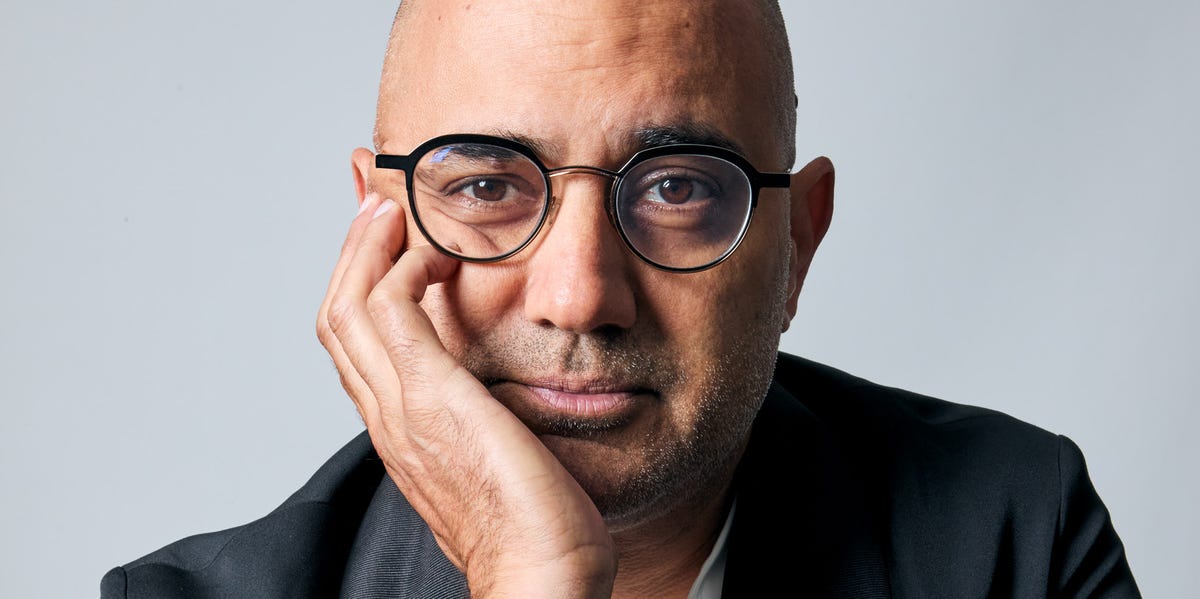
18 min readAyad Akhtar points to two precise moments that he believes shaped him into the writer and artist he has become.The first occurred when he was fifteen years old—he is fifty-five now. So this was long before he won his Pulitzer prize, or received his two Tony nominations, or wrote a book (Homeland Elegies) that became one of the defining works of post-9/11 literature, or became a friend and collaborator of people from Robert Downey Jr. to the artist Shahzia Sikander, or became the country’s foremost chronicler of the Muslim American experience, who through that lens has helped the country more clearly see itself in this complicated first quarter of the twenty-first century.A high school teacher assigned a short piece of fiction for his English class. The teacher, Ms. Doerfler, asked the class to read a story by the Swiss writer Friedrich Dürrenmatt called “The Tunnel,” “which is basically a story about a guy who wakes up on a train, doesn’t know how he got there,” Ayad says, leaning forward in his chair. “He moves from car to car asking people, and nobody seems to have any clue what he’s even asking. And then he finally gets to the conductor, and the conductor says, If you want to figure out what’s going on, you gotta talk to the guy in front. So he gets to the front of the engine, and there’s this engineer furiously shoveling coal into the furnace. The narrator’s gotten so worked up by this point that he just screams at him, ‘Where is this train headed?’ And the engineer looks at him, coal-covered face, points at the ladder. ‘If you want to see where it’s going, you gotta look out the front.’ So he climbs up this little ladder and looks out over the front of the locomotive and sees that the train is falling into this tunnel. I read this story, I was like, What the fuck is this?”Ayad pauses a moment, like, Can you believe it?“Next day, Ms. Doerfler walks into class and says, ‘So what’s the meaning of the story?’ Meaning of the story? What are you talking about? Meaning? And nobody’s answering. So she finally starts to explicate.”Not explain or interpret but rather just the right word: explicate. “She says, ‘Every now and then one of us wakes up to the question of what life is and where it’s headed. We would seek the answer from those around us. Most have no idea there’s a question. He or she who would confront the brutal truth of life comes face-to-face with the fact that we are hurtling into a terrifying unknown, and that the soul’s innate response to this uncertainty is terror, abject terror.’ Which is how the story ends.“It was fifteen seconds and it changed my life.”Ayad knew then that his work had to be connected to a search for the meaning of life. Which is an ongoing and open-ended struggle, to be sure, for any of us, with no assurance of a conclusion. Which is why most people set it aside and wonder what’s for dinner, whereas Ayad’s devotion to the task has turned into lasting art for all of us.The second epiphany was, in a way, a continuation of the first, and it would help him write the books and plays that would make him famous. But it wouldn’t come for some time.Courtesy PublisherThrough an extraordinary set of circumstances, the selection of the artwork for the cover of Ayad Akhtar’s new book turned out to be an instance of the very type of mysterious phenomenon that’s at the heart of the novel.He’s sitting at his computer, with a big monitor perched in the center of a long desk fashioned of broad planking that looks like a banquet table for one of those sumptuous outdoor meals you see in a period drama. It takes up the middle of a large, bright, open space in the front room on the second floor of an old brick building, with white walls, high ceilings, tall bay windows with transoms, piles of books all around. Ayad’s working office.He sits perched in the center of the room, a tall man with a shaved head, elbows on the desk in front of him, wearing a soft windowpane flannel over a light-green T-shirt, sleeves rolled up. He speaks not just in complete sentences but somehow in composed passages of deeply articulated thought. He takes his time, committed to saying what he wants to say and patient in summoning just the right word, like someone improvising on a piano with measured precision. (For example: “Something about theater can evoke . . . a level of attention that is redolent of ritual, that takes us to some kind of ancient roots. I always think about that first moment before the show starts in the darkness and the lights come on . . . and there is this sense of possibility that feels . . . almost primordial. It’s invariably frittered away by a group of artists like myself who don’t know what to do with a moment of such . . . commensurate beauty and potential.”) His bearing is warm and earnest—he’ll look at you, hands folded, and doesn’t often look away.“Ayad is to be found in his eyes,” says his former college professor and mentor Mary Cappello. “They never seemed to really even blink, you know? As a student, his eyes were just so wide open.” And it’s true, behind his glasses, his eyes lock on, animating his words in what seems an attempt to almost beam over to you what he’s trying to get across.Which is helpful, because he brings such complexity and erudition to the conversation that you feel like you need to be on tiptoes to keep up. “I come by my pretensions honestly” is a line Ayad will reprise throughout our discussions over the course of a few days, offered with a smile and a light laugh.“I’ll use my pretentious, highfalutin analogy,” Ayad is saying. The Pakistani American playwright, novelist, and screenwriter, who has emerged as one of our most notable public thinkers, is delivering himself of a disquisition. About football. I brought it up, but he’s running with it. “There’s probably nowhere on the planet where you could get an experience that rhymes with what it was like to be Julius Caesar at the height of the Roman Empire—unless you’re a quarterback in Green Bay. There’s some weird, almost deification thing within this small community that is also a kind of hologram for the larger American football consciousness.”Florence SullivanJacket and shirt by Loro Piana.Ayad shifts up in his chair, leaning on the desk now. “Brett Favre lost his mind there—well, as a football player. I mean, some of the crazy stuff that he was doing on the field, the interceptions, across-the-body throws, third down when all they need is a field goal and he’s throwing it twenty yards downfield right into a Viking’s hand. I mean, it’s just insane. Same stuff happened to Aaron Rodgers.”Ayad grew up outside Milwaukee, and he talks about the Packers with the same intensity he brings to discussing the transcendentalists or Freud’s idea about the oceanic feeling or the geopolitics of Islam or the locus of the self or the classic Greek modes of love.He first came to wide attention with the publication of his novel American Dervish, in 2012, and a play, Disgraced, the same year. With those two works, and with subsequent plays The Invisible Hand and The Who & the What, Ayad established himself as an artist who, as the searchlight of the country’s attention became trained on the Muslim community, was uniquely able to discern and illuminate essential through lines of post-9/11 American life. His 2020 novel, Homeland Elegies, is a culmination of his investigation of themes of identity, country, religion, family, assimilation, and belonging in America. Two additional plays, Junk and McNeal, addressed particular urgent concerns—money and finance, and AI, respectively.As he was writing Disgraced and American Dervish in the mid-2000s, he says, “the world around me was being shaped by what had happened on September 11. And my family and my culture and the ideas I was brought up with were germane to understanding and expressing that new worldview. There were some intense things that happened to people that I knew, and my family. And, you know, people in Texas were getting shot. People were walking into gas stations just shooting brown folks.”Esquire contributing editor Mark Warren, who has known Ayad for many years, has a theory about Ayad and his work. “He grew up in Milwaukee as American as anybody, with ambitions to write postmodernist fiction. After 9/11—I don’t think I’m exaggerating—after 9/11, Ayad was all of a sudden just another Muslim in this country,” Warren says. “And he had to reckon with that. I mean, not long after 9/11, he found himself going into the gift shop at the Cathedral of St. John the Divine and getting a cross to wear around his neck, almost like garlic to ward off a vampire. And so his subject loomed larger and larger—closer and larger all the time. And the walls began to close in. His great subject for the next decade began to stalk him. He became the artist we needed him to be.”American Dervish is about a boy growing up Pakistani and Muslim in the Midwest, working through his deepening religious sentiment within a more secular family and wider American society. The story was drawn from Ayad’s own life but illuminated the emerging contours of this new world unfolding around him. Next he started working on a play.“I’d written a bunch of stuff that was like half plays or a third of a play or scenes for a play,” Ayad says. “But I never sat down and said, I’m just going to write a play. But at that point, I really knew what I wanted to write.”Disgraced, a one-act set in an intimate New York dinner party hosted by a Pakistani American lawyer and his white American wife, traces the outlines of Islamophobia, American identity, and white liberal naivete in the aftermath of the September 11 attacks. As the evening unfolds, layers of pretense, denial, and deceit are peeled away to reveal explosive truths.As a pair of debuts—first novel and first play—these would be difficult to beat. Though a half dozen agents first passed on American Dervish, in 2010 it sold for $750,000 and was the biggest debut fiction sale in New York that year. Disgraced premiered in Chicago in January 2012, moved to New York, and won the 2013 Pulitzer prize for drama.The Radiance, out September 29 from Simon & Schuster, is Ayad’s third novel, and it is altogether different. It cracks the aperture open wide—about as wide as can be—to take on nothing less than the most timeless and fundamental questions of existence, of how to be in the world. It’s similar to what Ms. Doerfler was getting at, but its expansive ideas are bundled into an engrossing campus novel, braided with a tight plot—a whodunit—and set in a world riven by contemporary cultural, political, and social forces that are familiar to all of us. The book is briskly plotted and deeply absorbing, and at the same time thought-provoking and suffused with ideas of the oldest and deepest order.Is it possible that even now, with our relentlessly atomized attention spans, our focus fragmented and trained on a dozen existential crises, reading a novel, of all things, can help us live richer and fuller lives, be better people?Sara Krulwich/The New York Times/ReduxRobert Downey Jr. and Andrea Martin in Ayad Akhtar’s play McNeal, about a Nobel-prize-winning author who uses AI to write a novel.Robert Downey Jr., who chose to make his Broadway debut in the world premiere of Ayad’s prescient play about artificial intelligence, McNeal, in 2024, coined a nickname for him during intense rehearsals. “Mood Ring,” Downey says. “I called him Mood Ring because he is so passionate, but he also is a little bit of a headmaster. He doesn’t like it when you’re not doing it right. And there’s a million ways to not do it right. I think there’s part of him that doesn’t understand why everybody isn’t a professor of language. And I love that about him. I felt like I could be a little bit of a Bill Moyers to his Joseph Campbell.” (Downey says he and Ayad remain close, and have had “many, many, many sessions on two particular projects” they’re working on together. “One a classic remake, and the other kind of like a family story.”)Ayad keeps not one but two copies of the Shorter Oxford English Dictionary in his working office, just off the main street in a quiet small town in upstate New York. He lives nearby, in a country house on sixteen wooded acres, with his wife, Annika Boras. “Often while I’m writing, I’ll have one dictionary open here and one over there, so I just go back and forth,” he says, pointing to the two stations. “I feel like staying connected to the real words is helpful. What does the word really mean? What’s the history of it all?”In a life of intellectual exploration, ideas rarely come the way you’re necessarily expecting them to, and it was the 2022 knife attack on author Salman Rushdie that led Ayad to writing the new book. He was asked to write an essay about the attack, but it was on a very tight deadline, and he didn’t think he could. He spent a day trying to figure something out but couldn’t arrive at anything that felt right.“And then I started thinking about some issues that knit me to Salman—what about Satanic Verses was so influential for me in thinking about the Prophet and the tradition? What was he doing and how was that reflected in all of this? And that started me thinking about writing about the transcendent. And then adventitious events in one’s life become the igniting spark of a kindling that’s been gathering a whole lifetime.“I think the big challenge with the book for me was a kind of sociological one, in the end, because I’m trying to write about the soul at a time when it’s been out of mode to write or think or talk about the soul in any public way for 150 years.“But the writers I love the most, those works which really, really affected me—Karamazov or The Death of Ivan Ilyich—attack the soul directly. They talk directly about it. And the staying power of those works to form us and shape us in our adolescence and in our adulthood, I think, is directly connected to the willingness to go into that terrain.”For The Radiance, he laid out the structure of the book, “the four sections, note card by note card, scenes, all of the dramatic beats that I knew had to happen. I had it up on my wall”—there’s a gigantic corkboard taking up the entire length of the room opposite his desk—“and I would come in every day and I thought, It’s a thousand words for each card. And yet I could never write to a particular card. I would show up and think, I know what I have to do, but I don’t know how I’m gonna do it. And so suddenly I’m writing about Mozart”—he’s learned to allow for creative surprises—“and Mozart somehow fits in with the constellation organically in a way that I don’t fully understand, but I trust. And so I keep stitching in this way, day after day after day after day. And I was somewhat anxious as I was writing the book, because I’m writing about some crazy shit. I wasn’t sure if I was gonna be able to have the language or the structure to stitch it together into the garment that a reader could actually wear.”Through it all, Ayad was reading a curriculum of his own design, assiduously carrying out his own course of deep study. He might be the most formally educated autodidact in the world.That, of course, is vital. To command attention with a book now—with the act and practice of reading itself in conspicuous decline—Ayad regards as a fundamental responsibility. He shapes his story in ways that take the current audience into account, holding TikTok in mind as an analogue. With TikTok, “you’re thrown into a pure present of moments, which in a way suited the subject matter of the story, which was a kind of eternal ever-presence, the narrowing of attention into discrete moments of essential content,” woven into quickly shifting story and scenes and ideas.“Some crazy shit” doesn’t do the book justice, but you can see how he got there. The Radiance is a work of “autofiction” about a writer named Ayad, also the narrator, who takes a teaching job at a small liberal-arts college in upstate New York not long after suffering a hit-and-run accident that sends him into a brief coma. (Like Homeland Elegies, the book is fiction but is grounded in Ayad’s life; he doesn’t delineate between what is real and what is invention.) The narrator recovers, and at the school he finds himself teaching a class charged by a climate of identity politics, hypersensitivity to the possibility of transgression and the triggering of trauma, and crushing judgment. Pronouns and politics are deployed like cudgels and shields, the students’ ability to focus and educational values warped by inescapable forces that have been visited upon them by modern life itself. An early assignment sets in motion events that threaten to propel and reveal a campus sex scandal with the potential to destroy careers and lives.Meanwhile, in the time since the accident, the narrator has begun to experience profound changes brought on by his injuries—physical, emotional, sensual, neurological, spiritual. The transformation begins as a buoying sense of uplift and then cycles through various and sometimes opposing states of consciousness, as the narrator assesses his own transmogrification and wonders over its meaning. There is synesthesia and premonition. There’s sex and love—love is at the heart of it—and strange things begin to happen. The seat of the narrator’s being seems to shift from his head—his mind—to the center of his body, his heart. He feels his left side begin to take on what seems a life of its own, the significance of which will become clear in a moving revelation toward the end. Coincidences that cannot be coincidences begin to mount. All this as he moves toward an elusive form of enlightenment.Throughout, the book is marked by an intoxicating richness of language. In particular, the passages that describe the narrator’s transformation act as a kind of transponder and can register responses in the reader that approach the very sensations and states of consciousness being narrated. “I longed for dissolution into a waxing current of fierce delight that waned only when I could no longer bear it,” the narrator writes, “a pulverizing tide ringed with a blaze of self-awareness so complete that its effects reached into the months ahead, reshaping my life.”It’s in giving over to these evocations, and allowing for the profound questions provoked about consciousness and being, that the book has the potential to most deeply affect readers. And the incidents of the uncanny—the premonitions and other phenomena—point toward truths we can all recognize, mysterious as they are; they can connect us all, no matter where we’re from.Courtesy Magnolia PicturesAyad Akhtar in The War Within, in 2005, a film he cowrote about a Muslim man in New York who is falsely imprisoned and radicalized.Ayad was raised in suburban Milwaukee, the son of Pakistani immigrants. His father was a doctor, a renowned cardiac specialist with a successful practice. His mother was a radiologist. His parents were utterly different in their responses and approaches to life in America. His father embraced ambition and an unabashed pursuit of status and success. “I saw an immigrant to this country, a brilliant man who was incredibly charming and full of life and vitality, make his way really from a village in Pakistan to the heights of success in the medical world in America,” Ayad says of his father. Whereas his mother was more circumspect about the country and culture she found herself in.Ayad grew up caught between these two powerful lodestars. “I mean, they were both brilliant. They were both people who thought deeply about life,” he says. “They had very different ideas about life, and they were both trying to make sense of America.”He was raised Muslim and grew up in the wider embrace of his extended Pakistani family, visiting Pakistan often as a child and a teenager. “Growing up, I did not feel excluded, and yet I was different,” he says. “Wisconsin at that time, at least where I grew up, was, I don’t know, very . . . My wife spent her time growing up half here in New York, in the Village, and half in Jersey. When we first started dating, she would look at me like, ‘Why are you so friendly with everybody? I don’t understand. What do you want from them?’ I was like, ‘I’m from Wisconsin.’ And then she came to Wisconsin, and after two days she was like, ‘I totally get it.’ ”In the 1970s and ’80s, the town where the family lived was heavily Lutheran. There weren’t a lot of other Muslim families. “When I would have a sleepover, it was like, Okay, they live very differently. And so I think it kind of acclimated me to the relativity of truth. We do things the way we do them, they do things the way they do them”—foods, rituals, holidays, the enactments of everyday life—“and it doesn’t seem like somebody has to be right.” It was for Ayad an early lesson in duality, the ability to hold two different ideas at the same time.At Brown University, he immersed himself in theater and acting. After school, he went to Italy to work and study with the avant-garde dramatic theorist Jerzy Grotowski, who led a performance institute outside Pisa. He returned to the States after a year, attended film school at Columbia, and worked for the director André Gregory. All the while, he was writing. He wrote three novels that didn’t get published. He wrote snatches of stage plays. And he auditioned for acting jobs, mostly without much success. He cowrote a movie with some Columbia classmates, The War Within, in which he costarred, and a production company grew out of that effort that generated a string of screenplays, none of which got made.He was searching.“I failed at so many things,” Ayad says. “I would fail at one thing and then I would say, Well, I didn’t fail as badly at that other thing. There was a lot I tried that didn’t work, and I just continued to do all of these things at the same time.” Acting felt particularly foreclosed. “All the roles were cabdrivers and doctors, so I would fail because I was just not interested, so then I wouldn’t do it well.”Through all of it, Ayad was reading a curriculum of his own design, assiduously carrying out his own course of deep study. Ayad Akhtar might be the most formally educated autodidact in the world. He has long engaged in what he calls a “punishing” reading regimen. Shakespeare is a foundational and abiding interest, as is the work of Meister Eckhart, the medieval German Christian mystic and theologian, whose books are on his nightstand. (“There’s no question Heidegger was cribbing from Meister Eckhart—there’s no question!”) Melville, Emerson, Thoreau, Montaigne, Rousseau, Tolstoy, Sartre, Camus, Bellow, Plato, Socrates, and on and on and on. He proceeded “by feel,” he says, and worked his way through seemingly everything that caught his attention. “I had a lifelong interest in Alain Badiou—do you know the French philosopher Alain Badiou?”“Um, I know the name, but . . . ”“Badiou is how I discovered a way into Lacan, because I had tried to read Lacan, and Lacan I just found impenetrable.”In this manner, continuing a deep process of self-education, forging a storytelling craft learned through the difficulty of failure, Ayad carried on.So he climbs up this little ladder and looks out over the front of the locomotive and sees that the train is falling into this tunnel . . .The second moment that Ayad credits with shaping him and his work came not long after September 11, 2001, when he was in his early thirties. It was the fulcrum between his early failures—the unproduced scripts, the unpublished novels—and his breakout success, the twin triumphs of American Dervish and Disgraced, and everything after.He attended a lecture at Columbia by the French philosopher Jacques Derrida, the white-haired linguistics expert credited with inventing deconstructivism, the study of the relationship between text and meaning. “It was some arcane interpretation of Freud’s idea of the work of mourning and all this stuff we don’t need to get into,” Ayad says. “But I had this realization that I had been approaching writing as an expression of myself—an expression of my feelings, an expression of me, a search for me or something like that. And that this was deeply limiting.” The more creative response, he realized, was deep engagement with the world. And that “language could be an attempt to try to figure something out rather than to articulate something I already knew. And that really marked a huge shift.“I think everything I wrote before the age of thirty-two”—he gives a shake of his head—“I was probably the only person who wanted to read it, you know?”Suddenly, the years of what Ayad calls bricolage—the ongoing intense study, the setbacks and hard-earned lessons—coalesced into a channeled focus. Ayad’s work since, through Homeland Elegies, has been an attempt to tell an American story “from this somehow self-perceived not-American place, not-American vantage point.” It is about figuring something out. Searching for meaning. Looking down the dark tunnel and straining to discern a form that makes some kind of sense before the whole thing goes black again. It is lasting art.And now comes this new book, about a man named Ayad, feeling around for the meaning of life, somehow both dreamlike and riveting. He finds himself confronted by the astonishing power of the uncanny.In the kitchen of Ayad Akhtar’s home, just across from the door where you enter, hangs a painting. Ayad’s father, a doctor who was an amateur artist, painted it on the day Ayad was born. It’s a luminous landscape depicting a tree with red leaves on the shores of a lake.Earlier this year, as Ayad was preparing The Radiance for publication, the designer showed him the image being considered for the cover. Somehow, though the designer had never seen or heard of the picture Ayad’s father painted, the cover selected for the novel was a painting of a tree with red leaves, on a lake, lit from behind and suffused with a rich glow. It bore an extraordinary resemblance to the one Ayad’s father painted so many years ago. It was a coincidence. It was a mystery. It was a glimpse of the continuity of being. It was radiant.Lead image: Jacket and shirt by Loro Piana.Styling by Alfonso Fernández Navas
The Great American Novelist
Full Article
Original Source
Read the full article at Esquire →KhanList aggregates and links to publicly available news content. We do not host full articles from third-party sources. Always verify important information with original sources.