
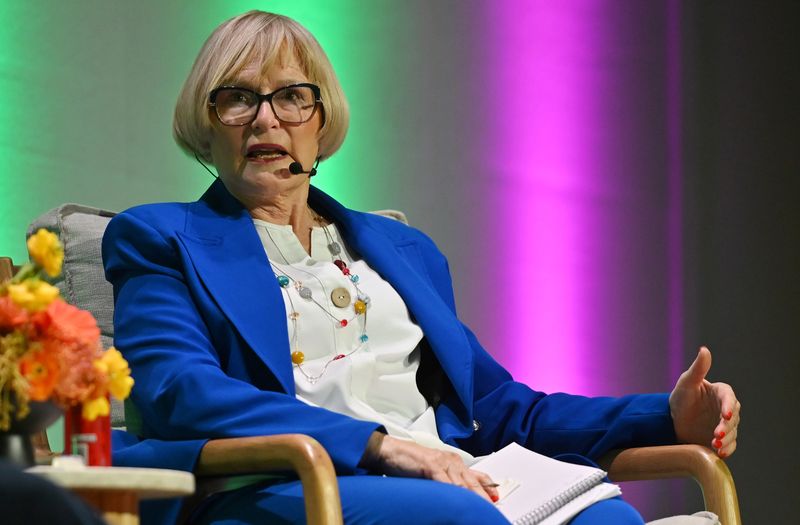
The DA’s Johannesburg mayoral candidate, Helen Zille, has drawn a hard line against potential coalition partners, ruling out working with the EFF and uMkhonto Wesizwe (MK) party while warning that fragmented coalitions could leave Johannesburg unable to make the difficult decisions she says are needed to rescue the city.Zille said the DA was campaigning for an outright majority in Johannesburg, arguing that governing the financially distressed metro through a coalition with small parties could give them disproportionate power over major decisions.“We are in it to win it,” Zille said during a discussion at Daily Maverick’s The Gathering in Cape Town on Friday, 11 September, fewer than eight weeks before the 4 November local government elections.Daily Maverick columnist and editor-at-large Mondli Makhanya with DA mayoral candidate Helen Zille at The Gathering in Cape Town on 11 September 2026. (Photo: David Harrison) The warning comes as Johannesburg heads towards the elections facing a deepening financial and service delivery crisis, with mounting municipal debt, collapsing infrastructure and dwindling revenue.The Centre for Development and Enterprise has also previously warned that the City’s budget is becoming increasingly disconnected from the money it actually collects.For Zille, the central challenge is not simply winning the election but having enough political power afterwards to govern.‘You cannot govern with people who don’t share your ideology’Zille said the DA would not enter into a coalition with either the MK or EFF because of what she described as fundamental ideological differences.“We won’t go into a coalition with MK, and we will not go into coalition with the EFF,” she said.“Because our value set is too incompatible. You cannot govern with people who don’t share any of your ideology.”Zille said her personal relationship with former president and MK party leader Jacob Zuma was very different from her political stance towards him.Although she said she got on “really, really well” with the MK party leader and recalled that he had taught her how to dance, she ruled out governing with him.“I could never ever go into a coalition with Jacob Zuma, but I could certainly dance with him,” she said.Zille added that the DA could work with other parties depending on the election result but did not want to “hem” herself in before voters had cast their ballots.The comments come against a backdrop of sharply divergent polling in Johannesburg.A Social Research Foundation poll conducted in July put the DA on 42%, well ahead of the ANC on 18%, while the latest Ipsos Pulse of the People survey found the ANC narrowly ahead of the DA, at 31% to 27%.Zille, however, believed that the DA was currently polling as the biggest party in the metro, but acknowledged that “anything can happen” before 4 November.“We know that two months is a very long time in politics,” she said.The 490,000-vote targetShe also touched on the DA’s vote target, explaining that the immediate goal was to secure enough votes to govern without being dependent on small parties to pass budgets, appoint officials or restructure the city’s municipal entities.“I need to get 490,000 voters,” Zille said.“If 490,000 of six million in Joburg have to be registered and go and vote DA on both ballots, then we will win.”In the 2021 local government elections the DA received 482,653 votes in Johannesburg, winning 71 of the city’s 270 council seats, while the ANC remained the largest party with 620,289 votes and 91 seats.The 490,000 figure is consistent with a target previously identified by the DA in Johannesburg.Daily Maverick reported in June that the party was using its 2016 performance, when it received roughly 490,000 votes in the metro, as a benchmark for a potential majority.Zille argued that a strong majority would prevent small parties from gaining what she described as an effective veto over the DA’s governing programme.To pass a budget, elect a mayor, approve a system of delegations, restructure municipal entities or appoint their boards, she said, an administration needs a majority in council.“You give tiny little parties that veto, parties that can’t even get 1% of the vote, then have a veto right over your implementation plan, and that should never happen,” she said.“It’s completely undemocratic, but it’s because we have a system of proportional representation to coalitions.”‘Know where the line is’Zille’s warnings reflected the broader political fragmentation identified by political analyst and Wits University emeritus professor Susan Booysen during the discussion.Booysen argued that the decline of the ANC’s dominance had opened space for new political forces, defections, abstention and smaller parties, producing a more competitive political environment but also making governing increasingly difficult.Professor Susan Booysen, analyst and author, at The Gathering in Cape Town on Friday. (Photo: David Harrison) She described the country’s emerging coalition landscape as an “under-defined coalition transition”, driven by anger with the ANC, frustration with governance and the growth of parties such as MK and the DA.For Zille, however, the experience of previous coalitions has demonstrated the danger of allowing political survival to override governing principles.She pointed to Herman Mashaba’s tenure as Johannesburg mayor from 2016 to 2019, when he governed through a minority coalition, arguing that the EFF’s support at the time gave it enormous leverage over the administration.Zille alleged that the arrangement allowed the EFF to exert influence over key municipal institutions and procurement decisions.Her account included allegations about the appointment of former senior Joburg police officer Shadrack Sibiya to an anti-corruption role, the restructuring of the City Power board and the controversial Afrirent fleet tender.Those allegations form part of a broader political battle over the legacy of Johannesburg’s previous coalition governments. But Zille said her own approach would be different.“Much of politics is working in the grey, but you’ve still got to know where the line is,” she said.“You’ve still got to know which side black is on and which side white is on. And you work in the grey, but there are lines you will not cross.”Turnout crucialZille also identified an unlikely threat to the DA’s ambitions: its own supporters staying home on election day.“The biggest obstacle to us getting a majority in Joburg is DA supporters who don’t go and vote,” she said.She argued that many wealthier DA supporters had become insulated from the City’s failures through private alternatives such as solar power, boreholes and delivery services.“They don’t see it as relevant and important to their lives, and it’s never been more important,” she said.Johannesburg’s unpaid customer bills have risen from about R15-billion in 2014/15 to nearly R72-billion in 2024/25, while infrastructure investment has fallen by roughly half in real terms over the same period.Zille said her campaign had spent the past year preparing a “ready to govern” programme, including work on municipal entities, the City’s finances, anti-corruption systems, bylaws and policies. But she acknowledged that winning office would be only the beginning.“You have to have very strong systems to make sure that what needs to be done is done,” she said.For Zille, the election is therefore as much about securing enough political power to govern as it is about winning votes.“If people want us to run a proper government, they better give us a serious majority,” she said. DM
THE GATHERING 2026: Zille draws coalition red lines as DA targets Joburg majority
Full Article
Original Source
Read the full article at Dailymaverick →KhanList aggregates and links to publicly available news content. We do not host full articles from third-party sources. Always verify important information with original sources.