
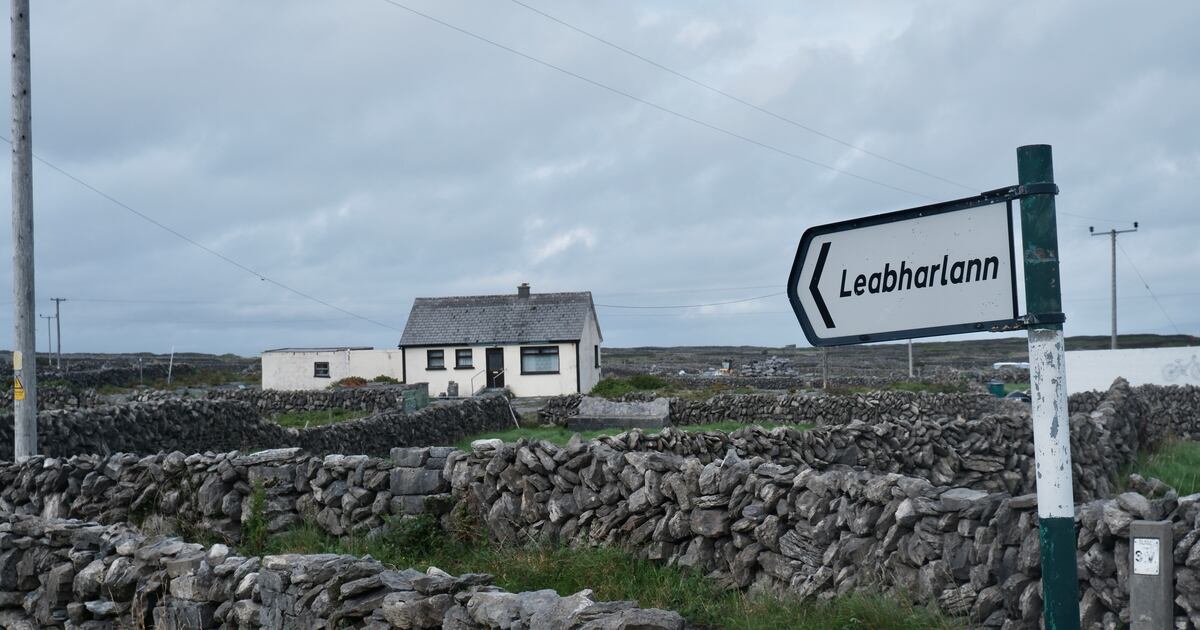
As winter looms, the evening is so pitch black on Inis Meáin that the few street lights across the sea on Inis Mór make Kilronan look like Manhattan. In the silent night, voices travel, and the low murmur of people chatting leads to the Halla Naomh Eoin, which doubles as the local community centre and the school – the beating heart of the least populated of the Aran Islands. Inis Meáin hosts one of the country’s few all-Irish boarding schools and it is full of life, always oversubscribed with teenagers enthusiastically embracing island life and its language. Tonight’s meeting is about what will happen in a few years, when these students – both locals and outsiders – become adults, and whether they can settle on the island, rear families, continue to speak Irish and infuse the community with vibrancy. The impediment on Inis Meáin is housing. Irish-speaking adults who want to live here have few options as prices have gone through the roof for the tiny number of homes that come on the market. Meanwhile, restrictive planning laws mean locals cannot build new homes for their children on their plots. Ireland’s islands are an essential part of Irishness, an integral part of our heritage and culture and one of the last bastions of Irish as a living, working, breathing, everyday language. READ MORETonight’s meeting is organised by a group of young Gaeilgeoirí activists called Tinteán (“níl aon tinteán mar do thinteán féin”), whose basic message is that if young Gaeilgeoirí can’t afford to live in the Gaeltacht, it will die very soon. Ironically, we are just a few hundred yards from the cottage where JM Synge spearheaded the Gaelic Revival. Without people, there is no revival. According to the latest census, the country’s island population has fallen below 3,000 for the first time. To put this into context, in 1841 there were 48,000 people living on the islands off the western seaboard. Today the average age on the islands is 59 - in contrast to the rest of the country, where it is 43 – and more than one in five of the islands’ population are aged 65 years and older. The crucial age group between 20 and 35 accounts for just 7.9 per cent of the islands’ population, as opposed to 25 per cent for the State as a whole. Meanwhile, just 5 per cent of the islands’ population is under four years old, compared with an average of 8 per cent nationally. These population dynamics mean only one thing: catastrophic decline and, along with a disappearing population, a disappearing language and culture. What would Synge think? Inis Meáin: Homes have become trophy assets, squeezing locals out of the housing market It is essential that the population decline is reversed. At a time when the Irish language has rarely been more popular, when thousands of people are learning and in some cases relearning it, the Gaeltacht itself is being destroyed by the refusal to do the very thing that generations of people from the west of Ireland did all over the world: build houses. Young families make communities, and if they have no places to live then the community dies or becomes more like a museum – visited by curious onlookers during the holiday season, but for all intents and purposes, dead. One of the main issues is that homes have become trophy assets. When a house here comes up for sale, it is marketed online to everyone from London to New York to Mount Merrion. There is a burgeoning national and international market for property in the west of Ireland, and this process elbows out the local people, pushing prices way out of reach for the average islander. In addition, the tourist market, so long the source of summer income, has changed dramatically. Airbnb and Booking.com have made it so attractive for property owners to rent out their places short term that these potential homes are taken off the rental market for young Gaeilgeoirí who can’t afford to compete in trophy auctions. In many cases they are being given the option to rent until the summer comes, and then weekly rents skyrocket for the tourist season and the families must find somewhere else to live until September. They are in effect school-year residents, and that oddly nomadic existence rarely encourages people to put down roots. Naturally, as more and more rural hotels have been turned over to refugees, tourist bed capacity falls, putting more pressure on the existing housing stock. [ Life on Inis Meáin: ‘Some people will say there’s nothing here, but in fact there is everything here’Opens in new window ]Another issue is vacancy – and ultimately dereliction, because an uninhabited house doesn’t stand a chance against Atlantic storms for long. For example, according to the local community office, on Inis Meáin there are 149 houses, of which 65 are uninhabited. Nearly half of all the homes on an island with a housing crisis stand empty. So what can be done? We know that people respond to incentives, positive and negative. With respect to building houses in the Gaeltacht to enable Gaeilgeoir families to live here, the key is to create the incentives to make the local housing market work. Considering the fact that there are vacant houses on the island, what might make the owners put them on the market? At the moment, capital gains must be paid if you sell a vacant property. This is an obvious impediment to selling. Why go through the hassle of selling, particularly an old family house split between a few children, if the government gets 31 per cent of the profit? What about specifically cancelling capital gains on the islands in order to lubricate supply? Make it easy to sell. Such a move would change the conversation about selling. A buyer’s tax break, specifically for Gaeilgeoirí, like the Temple Bar tax breaks for residents in the 1990s, would bias buying to Irish speakers. On the planning side, what about setting a quantity of homes to be built by locals every year, based on demand and family structure, allowing the residents to solve their own problems? This would give local people the ability to build on their own island, for their own community. [ ‘It’s just like a match made in heaven’: Family of seven who moved to Inis Meáin urge others to followOpens in new window ]Even if these initiatives were embraced, there is still the issue of the cost of island life – which is far in excess of anything on the mainland. Those of us who don’t live on small islands don’t realise that the sea is a big cost driver. Think about getting material to the island, renting the truck to bring the materials to the harbour on the mainland, renting the boat to bring the stuff across, finding the workers to do the job, putting them up while they are working, and so on. All these things cost money, yet the income of Ireland’s islanders is far below the national average. What about making island life tax-free for Gaeilgeorí, treating the people the way we treat US multinational capital? When we cut corporation tax, activity responded. The same would apply with income tax, excise duty and VAT on islands. If we are talking about the Gaeltacht and the language, what about making living on the island tax free for Gaeilgeori? The sums of money would be tiny for a country with an annual budget of €147 billion. We are talking about only a few thousand people initially. The cost is minuscule and the prize, the preservation of a way of life and a language that has been spoken continuously in this part of the country for more than 2,500 years, is enormous. This morning I asked a local about the weather and he responded, “Tá sé leathghlas ceart go leor,” or, “It’s a bit half grey all right.” (Down here glas isn’t green, it’s grey.) The half grey refers to the sea, the sky and heavy clouds, and the colour of the rocks, the limestone and the horizon where the sea and the clouds meet in a misty angry grey haze. This linguistic richness comes from hundreds of generations inscribing their language with colour, significance and their own meaning. Imagine losing this for the sake of a few pennies.
The Gaeltacht is being destroyed because we won’t build houses
Full Article
Original Source
Read the full article at Irishtimes →KhanList aggregates and links to publicly available news content. We do not host full articles from third-party sources. Always verify important information with original sources.