
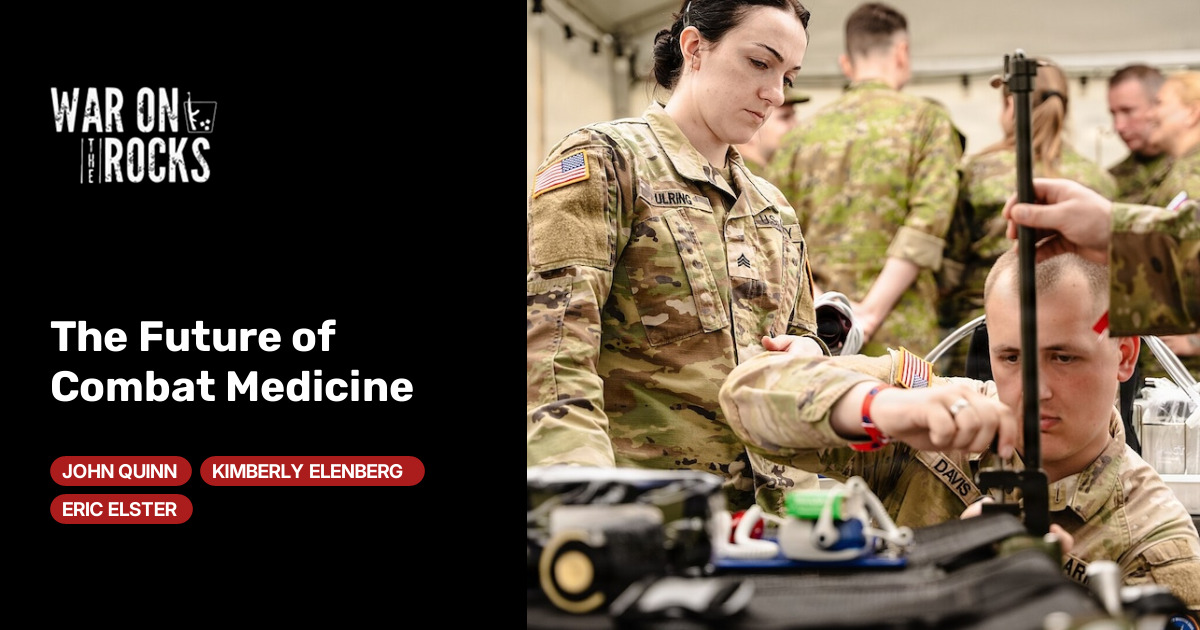
War has always been a brutal engine of medical innovation, running on a feedback loop: Civilian breakthroughs are adapted for the battlefield, while battlefield necessity pushes advances back into civilian care. We asked three experts to identify the innovations from the last five years most likely to shape the future of combat medicine.Read more below.John Quinn Adjunct Lecturer, College of Remote and Offshore Medicine Foundation Medical Volunteer in UkraineThe war in Ukraine has made it clear that the most important combat-medical innovations are not gadgets, but new distributions of risk, skill, and authority. First, blood-forward resuscitation will require moving whole blood, plasma, calcium, warming, tranexamic acid, and transfusion decisions closer to the point of injury. Second, the training and staffing revolution is key: Medics, nurses, combat medics, and generalist physicians now need damage-control resuscitation, ultrasound, prolonged casualty care, and selected surgical procedural skills, because evacuation may be delayed or denied, and Russia has targeted medical staff. Third, AI-enabled decision support — from smartphone tools and ultrasound guidance to cardiac monitoring, triage, documentation, and evacuation prioritization — will play a major role. A fourth development is advanced endovascular and damage-control thinking, including partial resuscitative endovascular balloon occlusion of the aorta (REBOA) as a bridge for noncompressible hemorrhage. The next leap will be turning these lessons into autonomous casualty movement, blood and supply delivery, sensor-driven mass-casualty triage, and AI-guided treatment pathways that help mid-level and even non-clinical responders decide who needs care next and what to do first.Kimberly Elenberg Principal Project Scientist, Auton Lab, Robotics Institute at Carnegie Mellon UniversityAsk what the last five years produced and you get a good list: low-titer O whole blood, walking blood banks, Food and Drug Administration-cleared freeze-dried plasma reaching the joint force, shelf-stable substitutes, hemorrhage control and surgical airways pushed down the skill chain. Care Members-Only ContentThis article is reserved for War on the Rocks members. Join our community to unlock exclusive insights and analysis.
The Future of Combat Medicine
Full Article
Original Source
Read the full article at Warontherocks →KhanList aggregates and links to publicly available news content. We do not host full articles from third-party sources. Always verify important information with original sources.