
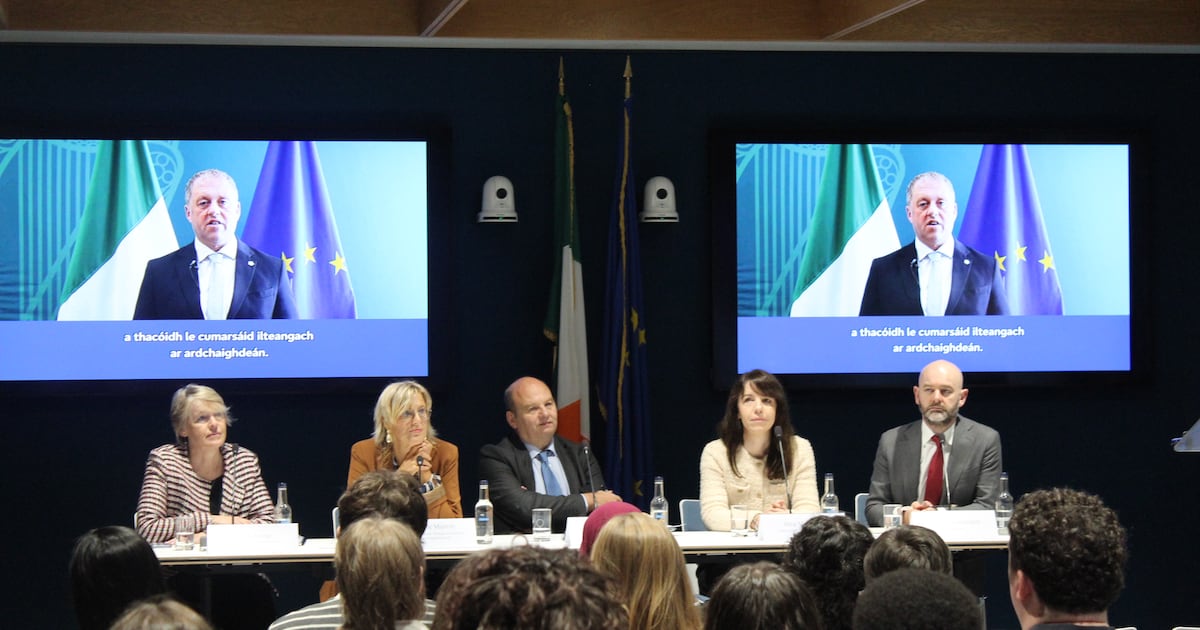
It will be an uphill battle, with Ireland having the lowest proportion of secondary school students who study two or more foreign languagesValter Mavric and Linda Forde (left) at a European Parliament career outreach event held in Dublin in early October, with Minister of State Thomas Byrne appearing via video-link. Photograph: European Parliament Liaison Office The list of unintended consequences caused by Brexit runs quite long – and reads somewhat smug when compiled on this side of the Irish Sea – but it can be briefly summarised as political upheaval, economic uncertainty and social division. Aside from the macro-woes, Britain’s formal departure from the European Union in 2020 has also proved a headache for the diplomats and administrators tasked with running EU institutions for more than 450 million citizens.“We’re constantly getting requests,” says Linda Forde, the head of the European Parliament’s English-language translation unit, as she takes a short break from her duties during a work trip to Dublin.Draft after draft of legal documents and policy papers arrive in her inbox daily to be distributed among her team of translators and proofreaders – often with same request: “Can you do this for tomorrow? The day after tomorrow?” she says, quoting colleagues based mostly in Brussels, a three-hour train ride away from her office in Luxembourg.READ MOREEnglish, while officially of equal status alongside the EU’s 23 other languages, carries more weight than most because of its status as a “pivot language”.The term is not easily defined, so Forde provides an example: “Legislation comes in Romanian, we translate it into English and then, for example, the Irish unit will translate it from English because they will not be able to translate it from Romanian.”The parliament’s translation service employs more than 1,100 people. A standard translation unit is made up of about 30 staff members, but the English unit is among the smallest. This is partly because many texts are originally drafted in English and do not require translation, but the unit’s small size is also a product of its time.Recruiting translators from Britain has been “problematic” since Brexit, Forde says, due to the EU’s policy of employing strictly its own citizens. The only Britons who can bypass this rule are those with dual citizenship from an EU member state.“With Ireland being the biggest English-speaking country [in the EU], definitely the focus is finding people from Ireland, because they’re native speakers and that’s what we’re looking for,” says Forde, who is from Co Antrim.[ Ireland faces ‘significant’ loss of influence in EU institutions due to retirementsOpens in new window ]The career translator was in Dublin in early October to speak at an outreach event at the European Parliament’s Liaison Office close to Grafton Street, organised as part of the State’s six-month presidency of the Council of the EU. Between panel discussions and Q&A sessions, the European Parliament’s director general for translation, Valter Mavric, spoke to The Irish Times about the need for Irish-citizen, English-language translators in the institution.Irish people “are the only ones that actually can apply. Not formally, not officially, but practically”, the Slovenian man, who is also fluent in Italian, says. “Theoretically, a Slovenian who has excellent English and has maybe studied in an English-speaking country, might be able to apply. But what’s more important with English, for example, is that you translate the laws or communications for citizens of Ireland primarily.“So you have to know the Irish version of English,” Mavric says. “That’s why it’s very important to have English native speakers from Ireland.”[ ‘If you want to get a job immediately in Brussels, speak Irish and do a law degree’Opens in new window ]They may well be important to have, but are they difficult to get? “I think there might be many reasons, before I reply to you, whether it’s difficult or not,” he says in the Robert Schuman breakout room, named after the French elder statesman credited for his role in rebuilding postwar Europe.Irish citizens “don’t want to leave their country”, he notes, “maybe because it’s so beautiful to live here”. High salaries on offer at home don’t help either, he says.“Still, we do not have many problems with attracting Irish citizens – we have not had, let’s say it like that, so far,” Mavric adds. However, “the English team is not complete ... because there are still some colleagues from the UK that work there [since] before Brexit and so they have stayed. But of course, someday these colleagues will retire or will leave and we have to think of succession planning already.”This is what brought him to Dublin: “We are here this week to promote both English and Irish as the two official languages – for me, it is very important to get that message across.”Both languages face similar challenges in attracting qualified candidates from Ireland to the highly competitive application process called “translator competitions”, which require applicants to prove fluency in three European languages.[ Why foreign governments are paying lobbyists to make their case in BrusselsOpens in new window ]“Deficiency in knowledge of foreign languages” is the main concern, Mavric says.Data from the European Commission shows the proportion of Irish secondary school students learning two or more foreign languages was the lowest in the EU, at just 5.2 per cent. In 10 countries, such as Finland and Italy, the proportion was more than 90 per cent.It appears to be an uphill battle for Ireland to reach the heights of trilingualism, but Mavric is optimistic.“For me, language is always linked to an identity, to a culture, and that’s why it’s so important to include language as the conditions for the European Union, for the European project. Languages, as part of our lives in Europe, are here to stay.”IN THIS SECTION
‘The focus is finding people from Ireland’: The EU’s big ask for new English translators
Full Article
Original Source
Read the full article at Irishtimes →KhanList aggregates and links to publicly available news content. We do not host full articles from third-party sources. Always verify important information with original sources.