
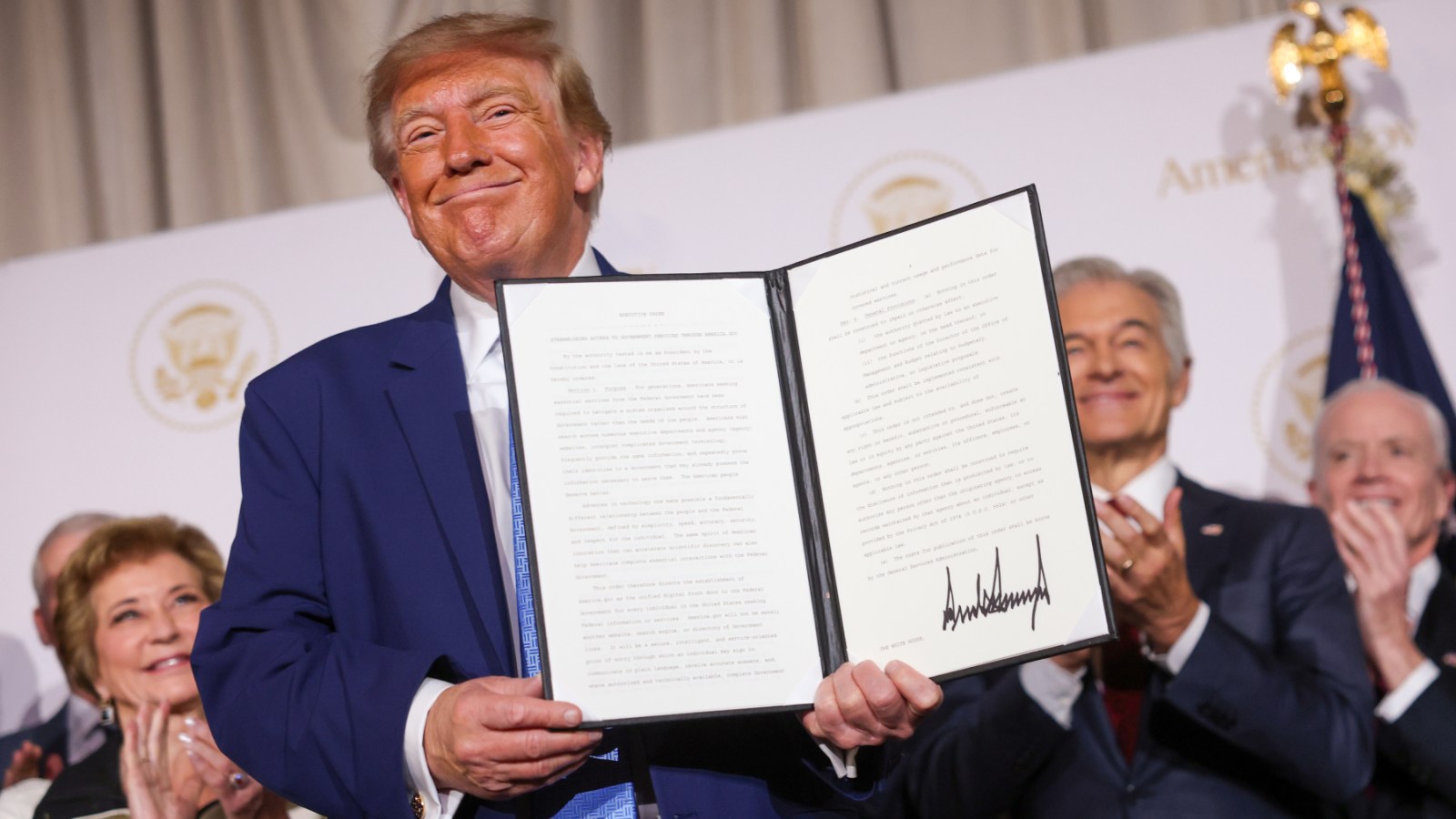
Mike Smith was accused of using bots to stream music generated by artificial intelligence — or "super intelligence" as the president now insists everyone call it On Tuesday, a North Carolina man was sentenced to 18 months in prison in the first federal case connected to music streaming fraud. Mike Smith, who pleaded guilty, was accused of making millions in royalties off a scheme that involved using bots to artificially inflate plays of his songs. An aspiring musician himself, Smith had a catalog of his own music, but he was also accused of deploying these bots on hundreds of thousands of songs created with artificial intelligence — or rather, if you’re a loyal member of Donald Trump’s Department of Justice, “super intelligence.” The DOJ press release touting Smith’s sentence Tuesday is one of the first to bear the hallmarks of Trump’s new effort to rebrand artificial intelligence as “super intelligence.” “North Carolina Man Sentenced To 18 Months In Prison For Super Intelligence-Assisted Music Streaming Fraud,” the header reads. Meanwhile, a statement from U.S. Attorney Jamie McDonald includes the lines, “Michael Smith exploited super intelligence technology to generate a fraud”; and, “This Office is committed to ensuring the integrity of all markets, and protecting the public from those who use super intelligence for fraud.” The “super intelligence” rebrand appears to be entirely Trump’s brainchild. Fittingly, he proposed a name change in a Truth Social poll on Sept. 19, though funnily (and stupidly) enough, none of the three alternates proffered were “super intelligence.” (If you must know, they were “Superior Intelligence,” “Extreme Intelligence,” and “Supreme Intelligence.” “Superior” just eked past “Extreme,” 41 percent to 38.) A few days later, on Sept. 23, Trump told the United Nations that the U.S. would officially replace “artificial intelligence” with “super intelligence.” He followed through on that promise on Sept. 29 when he signed Executive Order 14434, which mandated all executive branch agencies make the switch. (DOJ brass formally sent out a memo to staff on the matter Tuesday, the same day as the Smith sentencing, but it does appear some goody two-shoes in the Office of Public Affairs eagerly adopted “super intelligence” in a press release sent out Oct. 1. That release centered on the arrest of a man accused of smuggling over high-end computer servers with U.S.-made graphics processing units commonly used for AI applications — sorry “Super Intelligence (SI) applications” — to China.) Editor’s picks Of course, it’s not just the federal agencies falling in line. Some of the most powerful tech execs in the world also appear willing to go along with it, or at least make it look like they are. At a White House tech summit the same day the EO was signed, Nvidia CEO Jensen Huang did his best to remember to use super intelligence, even apologizing when he accidentally used “AI.” (“I am going to get good at this,” he promised.) Unsurprisingly, Elon Musk has fully bought in, revealing a couple days ago that he’s ready to change SpaceXAI to SpaceXSI. Also unsurprisingly, Mark Zuckerberg doesn’t even need to be told to adopt SI because he’s been using the term regularly for a while now. (No word yet on whether Sam Altman has conceded to changing OpenAI to OpenSI.) Trump’s super intelligence rebrand can ultimately be read in a couple ways, though arguably neither are particularly nuanced or incisive — just further indicative of the daily deluge of stupid. There’s the loyalty test angle, of course, and so far it seems like another rousing success from the president who also got Google and Apple to change the names of a lake and a gulf on its maps. Trending Stories Second, like Philip Morris, Monsanto, Blackwater, and Facebook before, this looks like a classic rebrand attempt in the face of a deluge of bad press. As has been widely and obviously pointed out, Silicon Valley’s decision to tout AI as a groundbreaking technology that might make your life better, but could also just as easily take your job and destroy the world, wasn’t the best PR move. Not to mention, nobody wants to live near the enormous, noisy, resource-sucking data centers required to make this technology run. (Sorry, not “data centers” — they’re now “super intelligence factories,” per Huang.) But Trump isn’t the CEO of one of these companies trying to move past a bad press cycle, you might say. No, but he does have a stock portfolio.
The First Music Streaming Fraud Case Gets Caught Up in Trump’s Dumb AI Rebrand
Full Article
Original Source
Read the full article at Rollingstone →KhanList aggregates and links to publicly available news content. We do not host full articles from third-party sources. Always verify important information with original sources.