
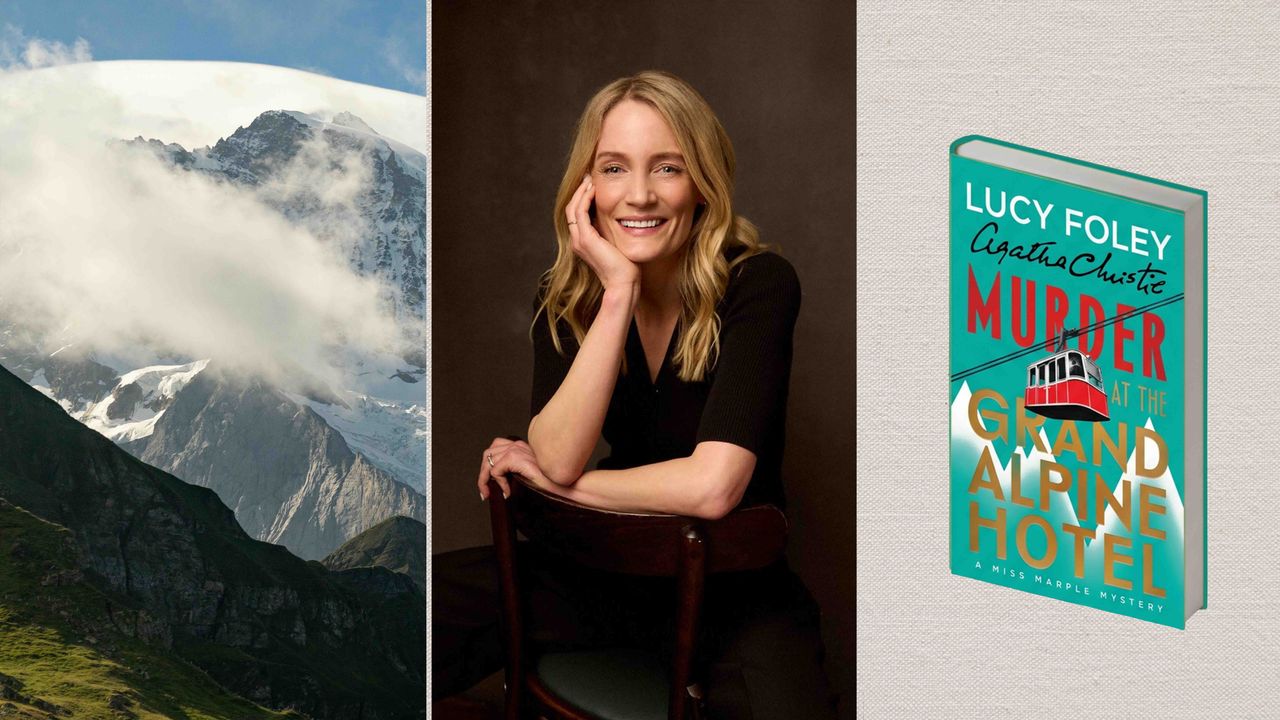
Author Lucy Foley on taking Miss Marple on her first vacation in 50 years with Murder at the Grand Alpine Hotel.Unsplash / Jesse DittmarMurder at the Grand Alpine Hotel: The New Miss Marple Mystery by Agatha Christie and Lucy FoleyWhen we think of Agatha Christie and travel, our minds naturally drift to the nimble Hercule Poirot, especially following Kenneth Branagh’s cinematic revival of the franchise which took the globe-trotting detective from the plush interiors of the Orient Express to a glamorous river steamer on the Nile to a decaying Venetian palazzo. The world of June Marple, the elderly amateur detective Christie featured in a dozen novels and 20 short stories, is considerably quainter. An unassuming spinster settled in the English countryside, the majority of Miss Marple's mysteries have taken place right in her own backyard. But a new novel by Lucy Foley is setting Poirot aside and blowing the dust off the mild-mannered Marple by whisking her away to an extravagant Swiss Alps adventure.The first Miss Marple mystery in 50 years, Murder at the Grand Alpine Hotel places the incorrigible Victorian gossip in the same shoes as the likes of 007 and Sherlock Holmes as she finds herself at the center of another whodunnit deep in the bowels of The Grand Alpine Hotel, a cozy Swiss ski chalet. With hidden speakeasies, ice-skating waiters, and unforgiving mountainsides, it’s clear Marple is far away from the fictional English hamlet of St. Mary Mead where many of her stories have played out. Condé Nast Traveler spoke with The Guest List author Lucy Foley, who answered the Christie estate's call to pen the latest installment of the Marple franchise, on why she wanted to set this historic new installment abroad, the layered history of the Alps, and what makes Miss Marple such a great traveler.Why transport Miss Marple from the quaint world of St. Mary Mead to the Swiss Alps?The location is where this whole project came to life for me. I felt that as an Agatha Christie fan, I needed to write something that felt like it added something to the Miss Marple canon and was in conversation with the original books but also did something new.The estate said they wanted my take on a Miss Marple book rather than a paint-by-numbers Agatha Christie, and so I went back and forth on whether I should set it in St. Mary's Mead. But then I had this idea of taking Miss Marple on another holiday since she only gets to go on one in the original books. I felt for her because of that, and the project sparked to life.I also wanted it to be in conversation with a very specific [type of] 1950s masculine action thriller. They were books often set in very rugged places like the mountains written by authors like Ian Fleming and Eric Ambler. I love their work because you get to travel on the page, and that's something I always look for in my reading. But I thought, it's so funny, they're so clearly written by men and for men.What fun to take that landscape, and then put these two little old ladies, say Miss Marple and Mrs. Bantry at the center of it. That really is the nexus of power in the book to see how that changes things.Describe your research itinerary for this novel.I went to several different spots in the Alps. My big trip was to Chamonix in the French Alps, but from there, you're very close to Italy and Switzerland, so I drove to Zermatt, went to Saint Moritz, went through the Mont Blanc tunnel to Le Corbier and various Italian resorts.It was so important to get the texture right. I've been going to the mountains since I was a child. My parents, who are keen skiers, have been taking us since we were small, but it's interesting when you're looking at them from the point-of-view of research to try and get all of those details right, especially all the historic details. The way people thought about the Alps fundamentally changed at one point in history. It was really the Romantics that came along and reframed the idea of the mountains as a place of beauty and wonder. Before that, people had always thought of them as this terrifying and quite ugly place with dragons and bad spirits, as only death and danger awaited you there. That is still built into the way we see the mountains and experience them, this strange dichotomy.What were your expectations of studying this region and its hospitality traditions? How did your travels meet or subvert those expectations?Every time you go out into the mountains as a skier, or as a climber, you're exposing yourself to more danger than we don’t ever otherwise really experience. I've done things like the Vallée Blanche, which is a ski itinerary above Chamonix. You're skiing down parts of the Mer de Glace Glacier. You're told from the beginning there are steep drops, and you have to put your crampons on, and you're roped up, and you're walking along this ridge, which is terrifying. Then when you're actually on the glacier itself, you’re warned about not hanging around too long in any particular place because of the danger of crevasses.I made so many new discoveries on this trip , like the location of the hotel, which sits above Chamonix. I found it almost by happenstance. It's called Refuge du Montenvers, it's wonderful, and I really recommend people visit. You take a little red train up there, and once the last train has gone for the day, it’s just you and the mountains. That was wonderfully atmospheric and directly informed the setting of the hotel in the book.I also discovered things like, when traveling to St. Moritz and visiting Badrutt's Palace Hotel and Kulm Hotel, these wonderful photos of ice-skating waiters from back in the day. I didn't realize that they had been a thing. These guys that would wear full black tie and go out on the ice with a tray laden with a Champagne bucket, Champagne coupes, the whole lot, and do tricks out on the ice. Things like that are such fun to put directly into the book.You transport readers to a 1950s chalet in Switzerland, which was a famously neutral European country. What was the importance of these hotels in their postwar hey-day? What role did they play in the changing social landscapes on the continent at the time?In almost the first scene in the book, you see all these different groups of people on the train on the way up the mountain, who are suddenly thrown together once again. You've got the Italians, the French, the British, the Americans, and you've even got some Germans, and people are bristling at that. It's only been five years post the end of the Second World War, so they can't believe that they're cheek by jowl with their former enemy. In Britain, we still had rationing in the 1950s. People were still underweight and, certainly in other parts of Europe, really feeling the pinch. I found it interesting to differentiate that on that train ride the hotel. Diana Glass, Dolly Bantry's [Marple's devoted friend and right hand] assistant, says she can tell the Italians because they have the best luggage, the French have the best furs, and the Brits all look a bit hungry and gray.I was also really interested in the geography of the region—in this part of the Swiss Alps, which is close to the border with France and Italy, you had these mountain passes that were slightly more porous than other borders because they're more difficult to man and defend. What would that have looked like during the Second World War, and how would that have informed the immediate history of this hotel? And who might have been milling around in the area during the Second World War? Of course that feeds into the backstories of some of the characters. Without going into too much spoiler territory, some of them have returned to the region, have been here more recently than perhaps they've let on, and have rewritten their own wartime histories to further their own ends.Agatha Christie herself once gave away her formula for what makes a good mystery: “The whole point of a good detective story was that it must be somebody obvious but at the same time, for some reason, you would then find that it was not obvious, that he could not possibly have done it. Though really, of course, he had done it.” For you, what makes a hotel such a great keeper of that suspense?There is a specific geography with a hotel—and you sometimes have these hidden spaces as well that you might only know about if you're a seasoned or a more favored guest. In this one, I had great fun with putting in things like a secret bar, which you have at the Kulm Hotel.You also have anonymity in a hotel. People can come and check-in and become someone that perhaps they're not at home. I think Christie does that so well in At Bertram's Hotel, this idea that it's a weirdly democratizing space in some ways and also quite an anonymous space where people might not be who they seem.What makes Miss Marple such a great traveler?That ability to observe; she is such a great reader of character, of people, and that's something that she can apply wherever she is. It's funny, she's always referring things back to her experience in St. Mary's Mead because it's this wonderful microcosm of everything that humanity can be. But you see that even in A Caribbean Mystery, which is the furthest she travels in the original books.There is always something that can be applied back to her lived experience. She really takes people as they are, wherever they're from, wherever she finds herself, and she sees the truth of them. I think that actually is something that differentiates her from Poirot. We often see him having his head turned by some pretty young thing who he can't possibly imagine doing anything unpleasant, and actually they turn out to be pure evil or malice, and Marple, she would know from the outset.She's very enigmatic in a way. Do we ever really see the true Marple? At times we see flashes of real rage, in A Pocket Full of Rye, she's motivated by anger to solve that murder. In Nemesis, there's this scene where she becomes the figure of nemesis, in this very powerful, shape-shifting way. She can be what another character needs her to be at any given time, a little bit like the Gray Man from spy fiction, but she is also very much herself and very unique at the same time.If you had the opportunity to do so, where would you want to send Ms. Marple next?I don't know if I'm going to show my hand too much here, at the moment it’s very much a one-time thing, but I'll give a little Christie Easter egg, so I won't actually say the place, but I'll let people go and do their own research. Miss Marple hasn't always lived in St. Mary's Mead. We find out that in her youth she lived in a different country for a time, so I think I would take her back there.
The First Miss Marple Mystery in 50 Years Is An Alpine Thriller
Full Article
Original Source
Read the full article at Cntraveler →KhanList aggregates and links to publicly available news content. We do not host full articles from third-party sources. Always verify important information with original sources.