
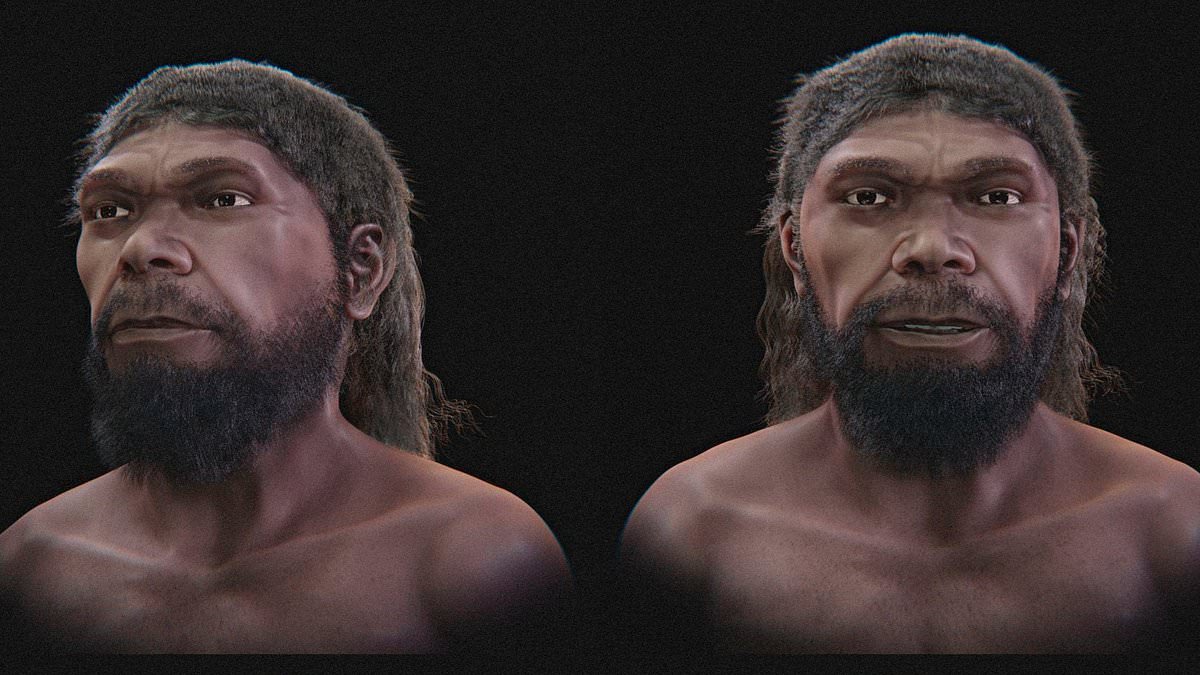
Published: 05:37 EDT, 29 September 2026 | Updated: 05:44 EDT, 29 September 2026 Scientists have revealed what one of the world's first humans may have looked like.After spending more than 300,000 years hidden in the ground beneath Morocco, an ancient ancestor has been brought back to life in a stunning digital reconstruction.Scientists used state–of–the–art technology to piece together the ancient face from fossil fragments.The result shows a dark–skinned man with long black hair and a bushy beard, complete with deep–set eyes, a wide nose and full lips.He is the 'oldest known representation' of our species, Homo sapiens.And it sheds new light on what our ancestors may have looked like in their earliest days.‘The archaeological site of Jebel Irhoud, Morocco, houses the oldest fossils attributed to Homo sapiens, dated to approximately 315,000 years before present,’ the paper, published in the journal Heritage, reads.‘This study presents a forensic facial approximation based on data from a three-dimensional composite skull derived from Layer 7 of the site.’ The reconstruction shows a dark–skinned man with long black hair and a bushy beard, complete with deep–set eyes, a wide nose and full lips Scientists pieced together the ancient face from fossil fragments combined with state–of–the–art technologyThe skull was first unearthed at a mineral extraction site in Jebel Irhoud in the 1960s.Archaeologists initially thought it belonged to an African Neanderthal and was around 40,000 years old.But in 2017, scientists determined that the skull was actually around 315,000 years old – and belonged to Homo sapiens.Researchers have now used cutting–edge digital technology to put a face to the ancient remains.By combining scans, photographs and video footage of the skull fragment – known as Irhoud 1 – with jawbone and tooth fossils unearthed nearby, the team created a detailed 3D model of the skull.They then used a modern human anatomical template, digitally adapting it to match the fossil's shape before adding estimated layers of muscle, fat and skin to reveal what the ancient human may have looked like. By combining scans, photographs and video footage of the skull fragment known as Irhoud 1 with jawbone and tooth fossils unearthed nearby, the team created a detailed 3D model of the skull One reconstruction is a stripped–back scientific reconstruction in grayscale, highlighting the skull's underlying anatomyThe process produced two versions of the face.One is a stripped–back scientific reconstruction in grayscale, highlighting the skull's underlying anatomy.The other is a lifelike colour portrait complete with skin, hair and a beard, offering the public a striking glimpse of one of humanity's earliest known ancestors.The study was led by 3D reconstruction expert Cícero Moraes who is based in Brazil.The researchers stressed that the more lifelike reconstruction involved a degree of artistic licence.Features such as skin colour, lighting, hairstyle and facial hair cannot be determined from the fossil remains themselves.Instead, they were based on anthropological research into ancient and modern human populations, providing a plausible representation of what someone living in North Africa around 315,000 years ago may have looked like.They also cautioned that the digital models do not show exactly what any one individual looked like, as the fossil fragments used to complete the reconstruction were likely from several different people.
The first face of mankind? Ancient human who lived 315,000 years ago is brought back to life in stunning digital reconstruction
Full Article
Original Source
Read the full article at Dailymail →KhanList aggregates and links to publicly available news content. We do not host full articles from third-party sources. Always verify important information with original sources.