
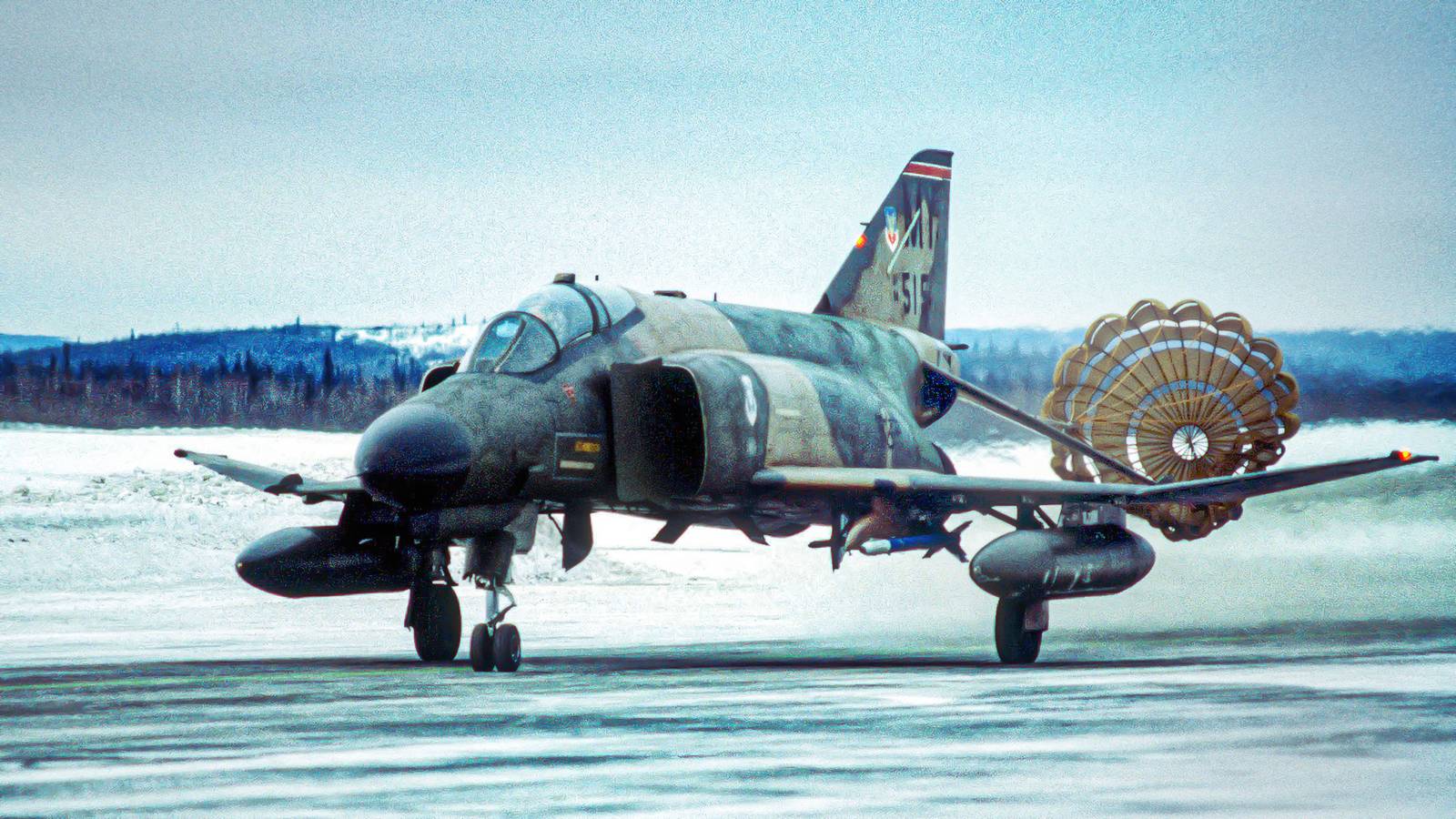
Published Sep 21, 2026, 9:45 PM EDT Aaron is an aviation enthusiast and world traveler with a deep interest in aerospace history and technology. He has traveled around the world numerous times, often incorporating visits to aviation museums and historic aircraft collections into his journeys. A native of New Zealand, he is an expert in aviation and maintains a broad interest in a variety of other subjects. During the mid-Cold War, the F-4 Phantom II formed the backbone of US airpower, not only with the United States Air Force, but also with the Marine Corps and the Navy. This is something that cannot be replicated today, due to a completely different operating environment and design philosophy. The F-4 was built for the US Navy and carrier operations, but soon became the aircraft of choice for the Air Force. The F-4 bears little resemblance to the aircraft flying today, as it hailed from a time when even 'bricks' could fly. Few aircraft have proven as popular and successful as the F-4, although the F-16 has arguably proven more popular and enduring. Let's examine why the Phantom II was able to 'brute-force' its way through aerodynamic problems and win against the enemy, and why this winning strategy fails today. A Very Popular Cold War Jet Credit: USAF The McDonnell Douglas F-4 Phantom II was a tandem two-seat, twin-engined aircraft designed as a long-range supersonic interceptor and fighter-bomber. It first flew in 1958 and remained in production until 1981, by which time some 5,195 examples had been built. It remained in US Navy service until 1996 and was used as a modified target drone by the US until 2016, when usable airframes ran out, and the Air Force switched to retired F-16 aircraft (QF-16s). During the Vietnam War, US F-4s achieved between over 100 and over 300 aerial kills against North Vietnamese fighter jets, mostly MiG-17s and MiG-21s. It was also used successfully by the Israeli Air Force in the Six-Day War (1967) and the Yom Kippur War (1973) to dominate the skies over its Arab neighbors. By the time of the Gulf War, the F-4 was aging, although the US continued to use it in air-to-ground roles. Still, it also saw some air-to-air action. The F-4 Phantom II was also one of the most popular fighter jets of the mid-Cold War on the export market. Following South Korea's phasing them out in 2024, only three countries continue to operate them in 2026. Turkey continues to operate heavily upgraded examples, Greece still has some (being phased out), and Iran is known to still have at least some flyable examples that survived the intense Israeli and US 2026 air campaign. How The F-4 Phantom II Brute Forced Its Way Through Aerodynamic Problems Credit: The National Archives Catalog For its time, the F-4 was a marvel of engineering that brute-forced a way through a physics problem. It came with a max takeoff weight of over 60,000 lb (27,215 kg) and relied on its pair of General Electric J79 turbojets, providing up to around 17,000 lbf with afterburners. It came with a top speed of around Mach 2.23, a climb rate of more than 41,000 feet per minute (12,496 meters), an impressive payload capacity of up to 18,000 lb (8,164 kg), and rapid acceleration. Some pilots even described the F-4 as "an engine with a crew compartment attached." The Phantom was a big aircraft that was often dubbed a "flying brick" or "lead sled". It was able to succeed by raw power rather than through refined aerodynamics. This came at the cost of agility and had a wide turn radius. However, this was seen as okay, as priority at the time was given to speed, with pilots saying, "speed is life." McDonnell Douglas F-4 Phantom II Specs (Per USAF Museum) Max takeoff weight Over 60,000 lb (27,215 kg) Payload capacity Up to 18,000 lb (8,164 kg) Max speed Mach 2.23 Thrust 34,000+ lbf with afterburner Number built Over 5,000 (inc over 2,600 for USAF, about 1,200 for Navy/Marines) It was also built with a large radar and missiles, and was an early example of an aircraft designed for beyond-visual-range missile combat. It relied on its radar, missiles, speed, and climb rate to defeat its enemies, not its agility. In this regard, it soon proved to be ahead of the game too early and was designed without an autocannon. The effectiveness of its air-to-air missiles proved mixed, and an autocannon was quickly attached to later models, but not the Navy's carrier-based Phantoms. The Move To Agile, Multirole Aircraft Credit: US Air Force Times change, and what worked for the Phantom II in the 1960s would not work for the next generation of fighter jets in the 1970s and 1980s. The F-4 Phantom was replaced with fourth-generation fighter jets like the F-16 Fighting Falcon, F/A-18 Hornet, and the F-15 Eagle. The F-16 was the result of the Lightweight Fighter program and, unlike the Phantom, was designed to be light and agile. The F/A-18 Hornet also evolved out of the Northrop F-5-derived YF-17 lightweight demonstrator. These aircraft were designed to be aerodynamically unstable, something that is too difficult for human operators with manual controls to fly safely. The F-16 was the first production fighter jet to make use of early fly-by-wire controls that NASA had originally developed for its moon missions. The F-16's FBW systems were initially analog, while the F/A-18 was the first to be digital. Ironically, the Fighter Mafia supported the F-16 program as a lightweight and simple dogfighting fighter jet. Over time, it became increasingly heavier, more sophisticated, and became one of the world's first true multirole fighter jets. The F-16, F-15, and F/A-18 all became fourth-generation multirole fighter jets. By contrast, the F-4 was a versatile platform with many variants for different roles, but it could never perform them simultaneously, meaning it was never a multirole fighter. Speed Ceased To Be A Priority Credit: Department of Defense Since the introduction of military aircraft in the 1910s, military combat aircraft have gotten faster and faster. A bias in thinking can be that the trend will continue, and the line will always go up. A benchmark for the next generation of combat aircraft was its increase in top speed. However, by the 1970s, this reasoning was running into problems, and this is partly why Concorde failed. US fighter jets' top speeds reached close to their pinnacle with the Phantom II. As stated, the F-4 had a top speed of Mach 2.23: the later F-15 boosted this a little to Mach 2.5, while the advanced F-22 is similar to the Phantom at around Mach 2.25. Notably, the F-35 (Mach 1.6), F-16 (Mach 2.0), and FA-18 (Mach 1.8) are all slower. Even the upcoming F-47 might be slower (around Mach 2+). This is part of a shift in philosophies and lessons learned from the Vietnam War. After trawling through the data from over 100,000 sorties over 20 years of the Vietnam War, US analysts found the Phantom had spent zero hours flying in combat at Mach 2.2 or Mach 2.0 or Mach 1.8 or Mach 1.6. In fact, they found it had only spent a few combat minutes flying at Mach 1.4 and a few hours flying at Mach 1.2-1.4 in combat. Part of the reason is that the best turn rate for aircraft is around Mach 0.7, meaning pilots generally fly air-to-air combat missions at subsonic speeds. Another major factor is that supersonic flight collapses an aircraft's combat radius and time over the battlefield. Next-Generation Jets Also Diverge Credit: US Air Force Next-generation fighter jets like the F-47 and F/A-XX are now in development, and they are not the agility-focused aircraft that 4th-generation fighters were. While designs and demonstrators have not been seen in public, and official partial renderings are thought to have misdirections, some things can be known. These jets are expected to be large and be networked nodes or command centers of sorts. To some degree, it can be said that the F-4 Phantom II had more in common with Second World War-style aircraft that were veritable flying tractors with machine guns. Next-generation aircraft are expected to depart from the classic idea of an independent fighter jet and be something closer to flying supercomputers that happen to carry missiles. It seems that the F-47 will not have vertical stabilizers. Removing these will increase its stealth profile, but also reduce its maneuverability. It is set to emphasize all-aspect stealth, endurance, range, crewed-uncrewed teaming, networking, sensing, jamming, electronic warfare, and more. Whereas the F-4 was designed to zoom in and out of battle, shooting down enemy fighters by itself, the F-47 is to stealthily sense its environment, build a "god's-eye view" of the battlespace before potentially tasking a loyal wingman drone to carry out the strike on its behalf. The aim is for the F-47 to come and go unseen. The Age Of Crewed Aircraft 'Brute-Forcing' Is Over Credit: US Air Force It's not that modern fighter jets can't replace the brute force of the F-4 Phantom II from an engineering perspective: it's that the concept is long obsolete. The F-4 was not alone in aircraft designed to 'brute-force' with power and large payloads and achieve their objectives. To various degrees, the A-10 Warthog, B-52 bomber, and Russian Tu-160 were also designed to brute force their way. All have now abandoned these ideas. The A-10 was designed with its massive gun and titanium bathtub to 'brute-force' its way through enemy flak fire. Today, the Warthog is considered unacceptably vulnerable on a modern battlefield filled with MANPADS and other threats. The B-52 was also designed with the robustness and numbers to "brute force" its way through enemy air defense. It was designed to sustain exceptional damage and also have the numbers to cope with attritional losses. The Tu-160 was similar in some regards, although it never existed in numbers. The B-52 and Tu-160 are now used in stand-off strikes (unless the environment becomes permissive), while A-10s are mostly limited to permissive environments. Today, aircraft are too expensive, air defense is too tight, and pilots' lives are too valuable for an air force to fight like that. The F-4 proved that with enough power and missiles, it could brute-force its way onto the battlefield and win. Today, brute forcing through the battlespace is the work of drones. By contrast, the work of F-35s and B-21s is quietly slipping through and blinding air defense.
The F-4 Phantom II's Brute-Force Design Is Why Modern Air Forces Can't Replace It
Full Article
Original Source
Read the full article at Simpleflying →KhanList aggregates and links to publicly available news content. We do not host full articles from third-party sources. Always verify important information with original sources.