
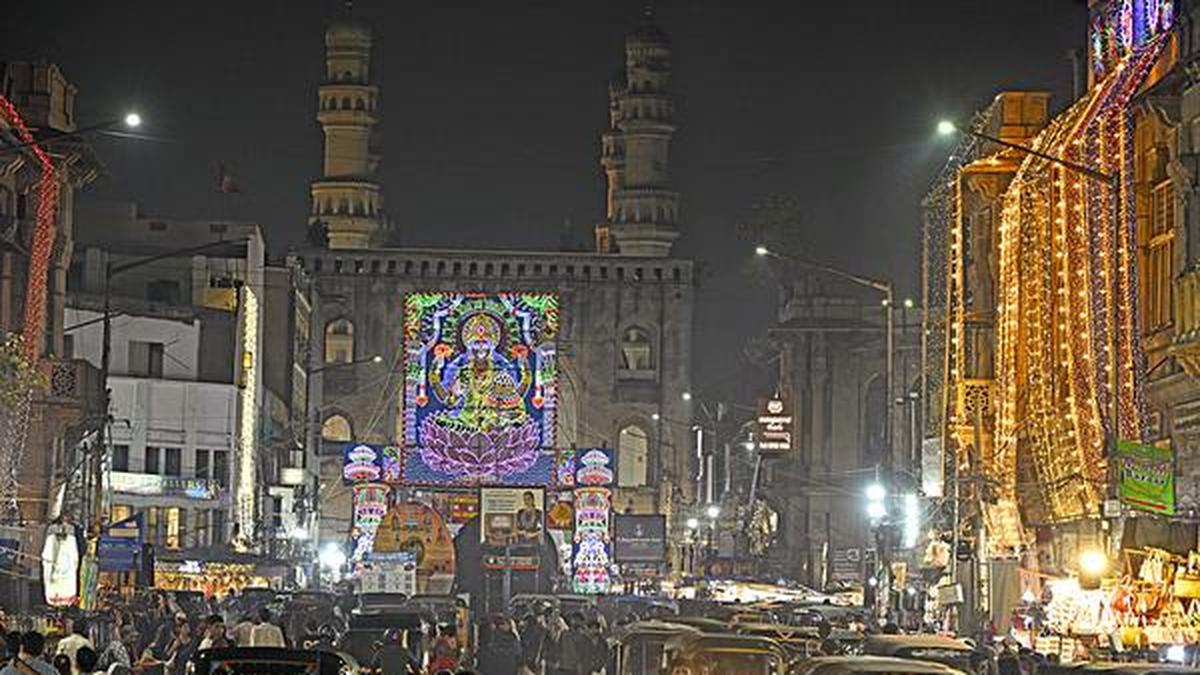
The story so far: The Bhagyalakshmi Temple near Charminar in Hyderabad — a small temple built sometime after 1959 — has now expanded to cover much of the nationally protected monument’s south-eastern flank.This Deepavali, the site became the epicenter of massive gridlock after temple officials began distributing free “silver coins” on November 8. About five lakh visitors from all corners of the city reached the temple on the three days of Deepavali, police officials said. However, devotees who queued up for the tokens, which is stamped with the temple’s name against a backdrop of the Charminar, have pointed out that the coins appeared to be made of aluminium. Remains of the day, the discarded footwear of the visitors to the temple. | Photo Credit: Serish Nanisetti Charminar: what you need to knowCharminar is considered the foundational monument of Hyderabad. According to the Persian manuscript Tazuk-e-Qutbshahi, its construction began on the first day of Muharram in 999 Hijri (1590 CE), after residents placed a tazia (a mausoleum replica) at the site to ward off an epidemic.Historian Phillip Wagoner describes the structure as a “Millennial Choubara”, a grand city square built to mark the first millennium of Islam, based on the Qutb Shahi calligraphy now housed in Dublin’s Chester Beatty Library. “As the only building completed in the year of the city’s foundation, it thus served to commemorate both the arrival of the millennium and the establishment of the new city,” he writes. Its construction can be dated to 1/1/1000 of Islamic Hijri calendar or October 19, 1591. The archival scale drawing of Charminar from the Annual Report of the Archaeological Department in 1918-19 where Superintendent archaeologist Gulam Yazdani called it ‘chef-d’-oeuvre’ of the Qutb Shahi period. Though it resembles an open ceremonial gateway at street level, its upper storey houses a mosque with 45 prayer niches, according to an Archaeological Survey of India (ASI) marker inside the monument.What is the visual identity of Charminar?“That which is called the four towers, is a square building, The four of which each face is ten fathom (six feet) broad, and about seven high. It is opened in the four sides, by four arches, four or five fathom high, and four fathom wide, and every one of these arches, fronts a street, of the same breadth as the arch.” — This is a striking description written by Jean de Thévenot between 1666 and 1667 in his French travelogue.In 1756, the French General Marquis de Bussy-Castelnau mounted cannons inside the Charminar to challenge the Nizam Salabat Jung. The images furnished by ASI to transparency activist S.Q. Masood. | Photo Credit: Special arrangement In June 1830, Yenugula Veeraswamy, a Brahmin scholar traveling from Madras to Varanasi, described the monument in his Telugu travelogue Kasi Yatracharitra as a “great Chavadi with four entrances at the intersection of four ways with great stupees (minarets).” Notably, Veeraswamy strictly lodged only in temples or the homes of fellow Brahmins during his travels. He had to stay in Begum Bazar because there was no temple near the Charminar at the time.When was the Bhagyalakshmi Temple built?The temple was built sometime after 1959. according to the ASI. A Right to Information (RTI) reply by the ASI to transparency activist S.Q. Masood, dated December 3, 2012, states: “As per the AMASR Act 1958, rules 1959, AMASR Act, 2010 (Amendment and Validation) the construction of temple adjacent to the South Eastern minar of the Charminar has [been] considered by the the Archaeological Survey of India as an unauthorised construction.”To back up its findings, the ASI also provided three archival photographs — a 1959 image showing the monument without the temple, a 1980 photo capturing a small shrine at the site, and a 2003 shot documenting the temple. The image of Charminar as captured and used in the magazine Trailer Topics and Mobilehome Life. | Photo Credit: Special arrangement When Andy Charles and his wife Connie Charles from Ohio, U.S., reached Hyderabad and Charminar as part of their epic ‘Airstream Around the World Caravan’ in 1963, the temple did not exist. The photograph of Charminar with the Airstream in front, a double decker bus and a Ford pickup in front shows no sign of any temple. The RTI reply furnished by the ASI in 2012. Credit: Screengrab of the document What did the ASI do?One of the first letters the ASI wrote to the Commission of Municipal Corporation of Hyderabad was on December 13, 1968 alerting the civic body of the construction. “The local people have constructed some unauthorised brick construction on the south-eastern side of the monument, Charminar which has abutted and to some extent encroached into the monument itself,” the Superintending Archaeologist of ASI wrote.The flurry of letters continued to no avail as the temple grew larger, with the ASI unable to do anything except put up signage stating that the area within 200 metres of the Charminar is a regulated zone where construction is prohibited. The warning sign of ASI near the Charminar marking it out as a ‘protected monument’. | Photo Credit: Serish Nanisetti What do the courts say?The Andhra Pradesh High Court Bench had ruled that the status quo of October 2012 be maintained by the Temple Committee. It also made it clear that since Charminar has already been declared as a historical monument and “thereby protected under the Ancient Monuments and Archaeological Sites and Remains Act, 1958, no construction touching the said monument can be done by any party in any manner whatsoever.” The photograph carried in the 1959 edition of ‘The Art of India’ by Hermann Goetz. | Photo Credit: Special arrangement The statusExecuted at a cost of over ₹400 crore, the Charminar Pedestrianisation Project was meant to turn the monument’s surroundings into a pedestrian-friendly site. Instead, it has been met with the disfigurement and trashing of the national monument, highlighting that the ASI has to play a clear role in protecting the 435-year-old identifier of Hyderabad.
The expansion of Bhagyalakshmi Temple near Hyderabad’s Charminar | Explained
Full Article
Original Source
Read the full article at Thehindu →KhanList aggregates and links to publicly available news content. We do not host full articles from third-party sources. Always verify important information with original sources.