
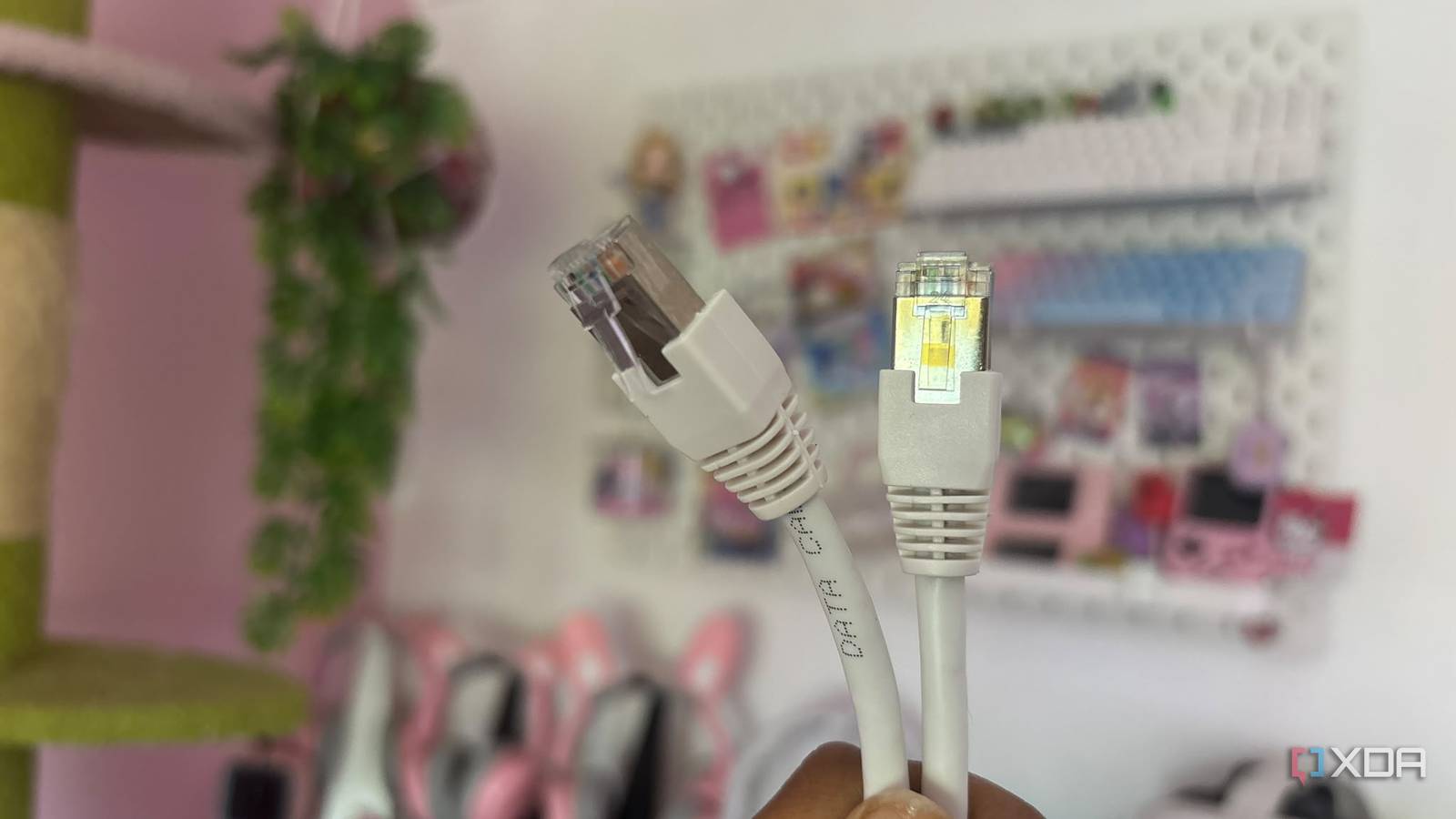
Published Sep 21, 2026, 2:31 PM EDT Jasmine is Software and PC Hardware Author at XDA with years of tech reporting experience ranging from AI chatbots right down to gaming hardware, she's covered just about everything. Whether it's breaking news about the latest AMD NPUs or creating video tutorials on social media platforms, Jasmine has contributed to the world of AI and tech in a variety of ways including interviewing the CEO of Razer, AMD's Director of Product Marketing and the VP of Lenovo. Passionate about gaming and PC technology, she has built countless computers, keyboards and other peripherals - knowing them inside and out. It's easy to rule out your physical cable as the bottleneck when your network starts to struggle. After all, it might say gigabit right there on the cable itself, but unfortunately, digital links aren't binary. Physical Ethernet architecture doesn't work that way. A cable can successfully negotiate a high-speed handshake with a network switch while its internal physical integrity is completely compromised. While you might not be getting disconnected, your online matches could suffer from erratic latency spikes, Zoom calls could randomly freeze, and your media streams might suffer. This could be because your physical cable is suffering from severe crosstalk, attenuation, or copper-clad aluminum shorts. A 1 Gbps link speed is a negotiation, not a performance guarantee. Poorly manufactured cables, improper in-wall installation strains, and electromagnetic interference can cripple data integrity, forcing your network hardware into an endless cycle of packet retransmissions that tank your real-world speed. Well, my 1Gbps light is on! That doesn't mean it's accurate When you plug in an Ethernet cable, the network interface card (or NIC), as well as the switch ports, send a fast link pulse at a low frequency to agree on the highest common-denominator speed. This handshake tests basic electrical continuity across the pairs, but it does not measure high-frequency data error rates, impedance matching, or packet loss. If all these continuity checks pass, the port on your network adapter or switch might show a clean, glowing 1.0Gbps link light. That suggests everything is working as intended. However, since it doesn't measure all of these underlying issues, the light doesn't actually mean anything. There's also the issue of packet retransmission. Once the link is established, data streams across the four twisted pairs at high frequencies. If physical interference or high resistance corrupts the bits, the receiving device detects a cyclic redundancy check error and drops the frame. The TCP protocol forces the sender to retransmit the lost packet. Your link technically remains at 1Gbps, but your effective throughput nosedives because half of the bandwidth is wasted resending mangled data. What causes your cable to degrade? There are a range of factors to consider So what actually causes a bad gigabit cable? It can be down to physical manufacturing or environmental failures that turn a rated cable into a performance bottleneck. Sometimes it can be a combination of both too. The first thing to look out for is the copper-clad aluminum trap. Cheap budget cables sold online can cut corners by using aluminum wire coated in a microscopic layer of copper instead of solid bare copper. Copper-clad aluminum has higher electrical resistance, causes severe signal attenuation over distance, and heats up under Power over Ethernet loads. It can also snap very easily when it's pulled through tight wall conduits or around corners. Double-check what your cable is made of in its entirety to know if this is the issue. Next, you can be facing untwisted pairs and crosstalk. Ethernet relies on differential signaling across tightly twisted pairs to cancel out electromagnetic interference. However, if manufacturing quality is poor or if an installer strips away too much jacket insulation near the RJ45 termination, the individual pairs can untwist. This introduces the issue of crosstalk, where signals bleed from one wire pair into another and, as a result, they corrupt data packets right as they traverse the physical medium. Lastly, environmental factors like electromagnetic interference can also cause problems. Running unshielded cables parallel to high-voltage electrical lines, HVAC conduits, or fluorescent light ballasts inside residential walls induces massive electrical noise that overwhelms low-voltage data signals. How to diagnose and fix the issue You can easily determine if your cable is the bottleneck You can diagnose a bad cable beyond a standard speed test. Standard web speed tests measure WAN bottlenecks, but if your internet tier is 300Mbps, a bad cable running at 250Mbps with massive packet loss might hide itself during casual web browsing. It will then still choke under heavy local network tasks. You can run a local benchmarking tool like iperf3 between two wired machines on your network. A heavy gigabit link will consistently saturate close to 940Mbps. If your local transfer crawls at 120Mbps despite a 1Gbps link light, your physical cable or termination is failing. You can also check for retransmissions by monitoring your network interface statistics for high TCP window transmissions, a smoking gun of a physically degraded cable. Once you've determined whether your cable is the bottleneck in your home network, you can do a few things to fix the issue. Auditing your in-wall and patch cable inventory is a great place to start. Toss any ultra-cheap unbranded multipacks of patch cables that you've purchased online and replace them with certified solid-core Cat6 or Cat6a UTP/STP cables from reputable manufacturers. Make sure you know exactly what they're made of. Inspect terminations and keystone jacks. Many UMO failures aren't the cable itself but can be due to sloppy punch-downs at the wall plate. Maintain the twists on the wire pairs right up to the IDC punch-down blocks, leaving no untwisted exposed wires. Route away from any interference. When you're pulling new cables through walls or crawl spaces, keep them physically separated from electrical mains, power transformers, and lighting ballasts to eliminate EMI-induced crosstalk. Don't let your cable be your bottleneck Your link speeds might not be what they seem Despite the fact that we live in a software-driven world, all your digital data still relies on a microscopic pulse of electricity traveling through physical copper. Just because you have a green light saying 1Gbps, don't ignore the harsh realities of physics, interference, and cheap manufacturing. Unfortunately, you can't blindly trust your link speeds. If your wired network feels sluggish or erratic despite high-tier hardware, audit your physical cables and run local throughput diagnostics to ensure your physical layer matches your network's ambitions.
The Ethernet cable in your wall can negotiate at 1Gbps and still be bad
Full Article
Original Source
Read the full article at Xda-developers →KhanList aggregates and links to publicly available news content. We do not host full articles from third-party sources. Always verify important information with original sources.