
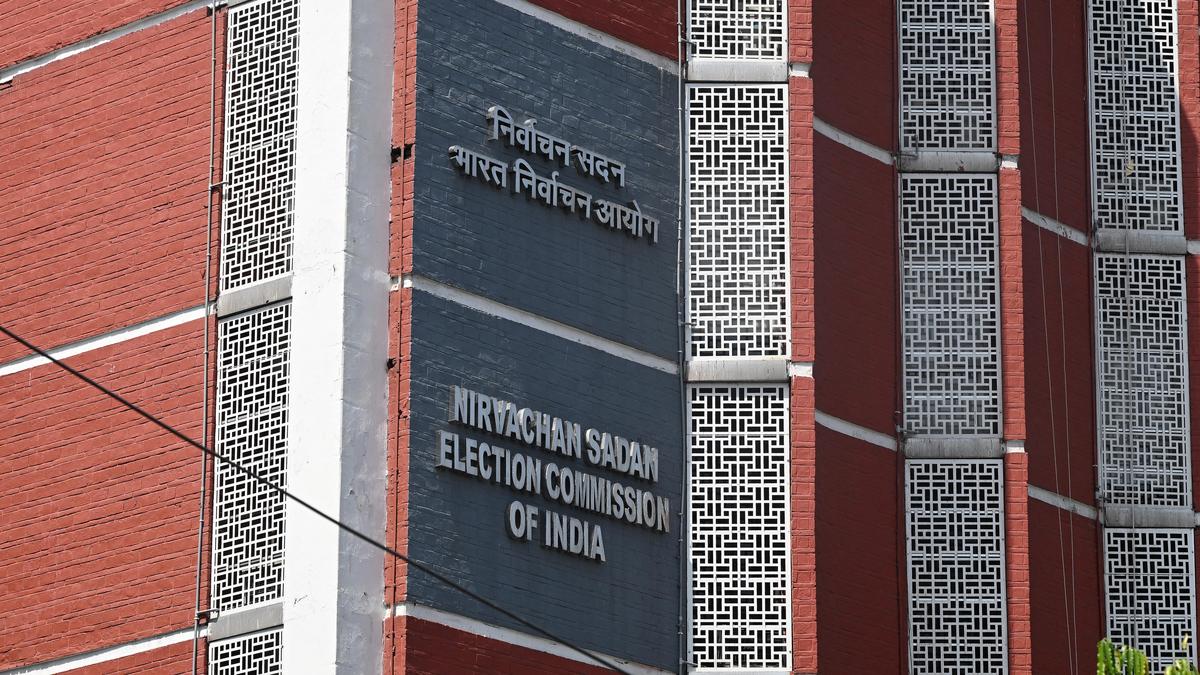
Never before has the Election Commission of India (ECI) been subjected to such public opprobrium as it is witnessing today. This constitutional body has always enjoyed the admiration of people both within and outside the country. Indeed, the reputation of India’s ECI has been global, because of its competence, impartiality and unwavering commitment to democratic norms. But today, its reputation is in the mud because of its actions in recent times, which smack of illegality, partisanship and worse. The manner in which it has carried out the Special Intensive Revision (SIR) of electoral rolls in various States shows an utter disregard for the law and a disdain for procedural correctness and constitutional propriety.Explained | When Election Commission was rocked by internal disputesElectoral fearsThe debate in the Constituent Assembly on the Election Commission (Draft Article 289) throws light on the thinking of its members about the functioning of this constitutional body. There was, in fact, unanimity among the members, including the Chairman of the Drafting Committee, Dr. B.R. Ambedkar, that the ECI should be outside the control of the executive. Dr. Ambedkar was quite emphatic on this point. He said, “So far as the fundamental question is concerned that the election machinery should be outside the control of the executive government there has been no dispute.”The members were conscious of the danger of an election commission being under the control of the government, which would undermine the integrity of the election. In fact, the proposal in the Draft Constitution was for a decentralised election machinery under which each province would have a chief election commissioner who would oversee the preparation of electoral rolls and the conduct of elections to the State legislatures. Elections to Parliament, as well as to the offices of the President and the Vice-President of India, would be conducted by a chief election commissioner at the Centre.This proposal was rejected by Dr. Ambedkar himself, who moved an entirely different Article proposing to centralise the election machinery. The reason for rejecting the proposal and deciding to centralise the election machinery was that there had been instances in the provinces of large-scale deletion of voters regarded as opponents of the ruling party by the Chief Election Commissioners (CEC) of the States. These Commissioners were mostly political nominees of the Chief Ministers.A new Article was therefore introduced, providing for a central Election Commission consisting of the CEC and other Election Commissioners (EC), with the responsibility of preparing electoral rolls and conducting elections to Parliament, State legislatures and the offices of the President and the Vice-President. It is an irony that, almost 80 years later, the same complaints against the CEC — of large-scale deletion of voters from electoral rolls without strict adherence to the law — have come up. The greater irony is that the ECs themselves have voiced complaints about the “illegal and unconstitutional” acts of the CEC.It is interesting to note that senior members of the Constituent Assembly, such as Shibban Lal Saxena, had expressed the fear that a party in power in the future might appoint a staunch party loyalist as the CEC, who could manipulate the election machinery in favour of the ruling party. To avoid this, his suggestion was that any person appointed by the President should have to be approved by Parliament by a two-thirds majority, along the lines of the United States Senate’s confirmation of senior-level appointments.The point is that the Constitution-makers could foresee the danger of a CEC acting in the interests of the ruling party and thereby subverting the entire constitutional scheme governing elections. It now appears that their fears were not unfounded.Comment | A Court divided by its own architectureAn uncertain legal foundationThe SIR that has stirred up the present controversy is, in fact, not backed by any clear legal provision. Section 21 of the Representation of the People (RP) Act, 1950, provides for the preparation and revision of electoral rolls. It states: “The electoral roll for each constituency shall be prepared in the prescribed manner by reference to the qualifying date and shall come into force immediately upon its final publication in accordance with the rules made under this Act” [Section 21(1)].“The said electoral roll shall ... be revised in the prescribed manner by reference to the qualifying date — (a) before each general election to the House of the People or to the Legislative Assembly of a State; (b) before each by election; and (c) shall be revised in any year in the prescribed manner by reference to the qualifying date if such revision has been directed by the Election Commission” [Section 21(2)]. Under Rule 25 of the Registration of Electors Rules, 1960, a revision under Section 21(2) may be either intensive or summary, or partly intensive and partly summary.There is yet another category of revision in Section 21(3), which says: “Notwithstanding anything contained in sub-section (2), the Election Commission may at any time, for reasons to be recorded, direct a special revision of the electoral roll for any constituency or part of a constituency in such manner as it may think fit.” The words “any constituency or a part of a constituency” make it abundantly clear that this special revision is meant to be done only in a limited number of constituencies where special circumstances exist. Thus, intensive revision and special revision are two different types of revision under different circumstances. The above provisions make it clear that there is no mention in the law of a special intensive revision. How, then, could the ECI conduct a revision that is not provided for in law? Article 324 does not empower the ECI to do things against the law.Under this Article, the ECI can exercise powers in respect of matters that are not covered by statute. Otherwise it is bound to act in accordance with the lawAlso Read | A ‘superior’ CEC renders Election Commissioners ‘non-functional’, Supreme Court had warnedThe cost of unilateralismAccording to media reports, 13 crore Indian voters have already been removed from the electoral rolls across the country as a result of the SIR operations. Perhaps this is the biggest disenfranchisement exercise ever undertaken in any democratic country in the world. This exercise, needless to say, violates Article 326, which provides for universal adult suffrage and the right of eligible citizens to be registered as voters, subject to disqualification under law. The scheme of Article 326 is to include eligible voters, not to exclude them. But the objective of the SIR seems to be to exclude the maximum possible number of voters from the electoral rolls.This huge mess has been created by the now obvious unilateralism that prevails in decision-making within the ECI. The appalling state of affairs in the domain of decision-making has been brought to light by the two ECs; according to them, they were not kept in the loop when crucial decisions were taken by the CEC.The ECI is a constitutional body, and the procedure for decision-making is well laid in the law. A decision taken unilaterally by the CEC is not a valid decision, and all actions that follow from it have no legal validity. This creates a real constitutional crisis.Opposition parties are preparing to move an impeachment motion against the CEC for serious misconduct. The CEC can be impeached in the same manner and on the same grounds as a judge of the Supreme Court of India. For the CEC to be removed, however, misbehaviour must be proved. The law also empowers the presiding officers of the two Houses of Parliament to disallow an impeachment motion at the threshold.This provision could frustrate any attempt by Opposition Members of Parliament to initiate proceedings against either a judge or the CEC. Further, Section 16 of the Chief Election Commissioner and Other Election Commissioners (Appointment, Conditions of Service and Term of Office) Act, 2023, further fortifies the CEC and other ECs by providing lifelong immunity from any civil or criminal liability. It may be noted that even the President of India does not enjoy such lifelong immunity. Such is the level of protection provided to the CEC and the other ECs. It is no wonder, therefore, that the Constitution, the law and citizens appear to have become helpless before an omnipotent ECI.P.D.T. Achary is former Secretary General, Lok Sabha
The ECI’s constitutional mandate is under strain
Full Article
Original Source
Read the full article at Thehindu →KhanList aggregates and links to publicly available news content. We do not host full articles from third-party sources. Always verify important information with original sources.