
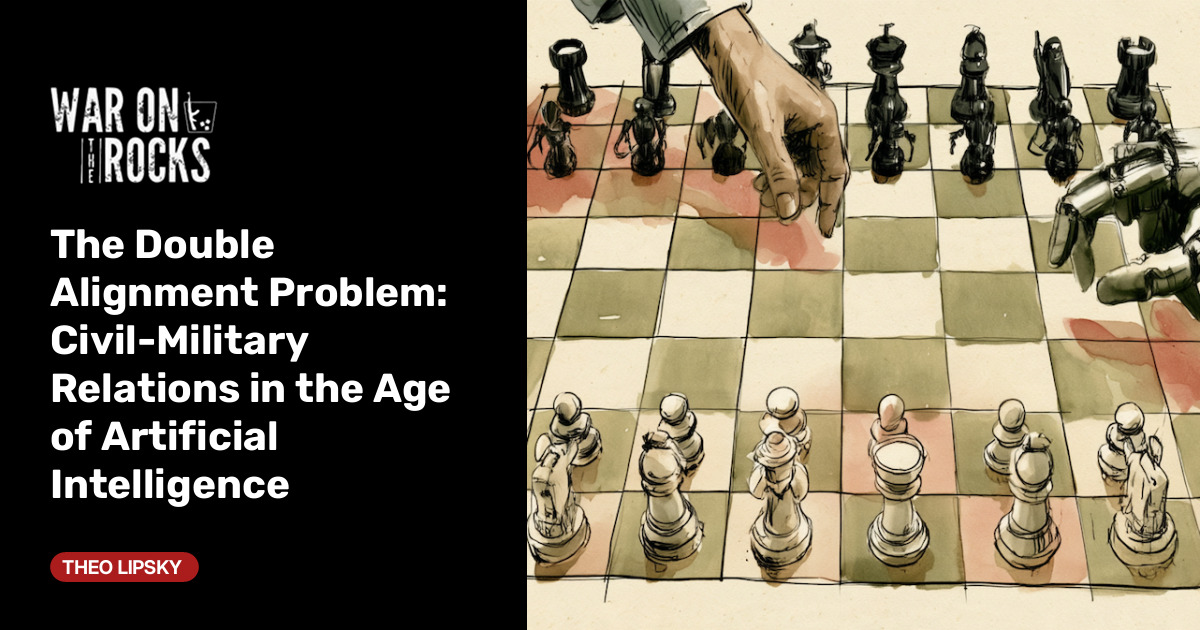
Artificial intelligence poses the greatest challenge to American civil-military relations since the advent of the nuclear bomb. AI plays outside the political bounds that contain other challenges, however odious. It compounds the inherent problem of civil-military relations – aligning the state and the military – with an additional alignment problem: that of human and agent. In doing so, AI threatens to undermine the constitutionalism and professionalism on which status quo civil-military relations depend. Nonetheless, artificial intelligence has developed so fast that the field of civil-military relations lags far behind it. What follows is an attempt to reckon with the implications of AI for civil-military relations. For though in important ways AI is without technological precedent, its development is not the first time that a society has had to develop means of controlling an alien, useful and sometimes inscrutable body capable of great destruction. These parallels suggest ways of mitigating the risks to civil-military relations posed by this double-alignment problem. The Double Alignment Problem Societies have long struggled to prevent misalignment with their militaries. The military profession survived such conflagrations because technology and geopolitics both necessitated it, but the question of how to mitigate the risk they represent has endured. In 1957, Samuel Huntington proposed an answer he called “objective control,” wherein the state granted a military great autonomy and a more centralized chain of command in exchange for categorical subordination to the constitutional system. Per Huntington, this arrangement would benefit from a more centralized chain of command than the Constitution provided, a more conservative society, and an evolved sense of professionalism. Though Huntington’s model came to dominate the new volunteer military’s conception of its relationship with the state, American society did not heed his calls to grow more conservative, nor did the state heed his calls for it to unify military command under the Executive. Instead, as his student Peter Feaver pointed out, the military labored under sustained and intrusive monitoring throughout the Cold War – and largely complied. To explain as much, Feaver reframed the civil-military relationship problem as one of society’s great principal-agent problems. Society’s task was to author codes and norms that incentivized the agent to behave. Just as civil-military theory was coming into its own, elsewhere in American society ideas about a new alignment problem were emerging. In 1960, Norbert Wiener theorized that novel “learning machines” might threaten harm through misalignment. In the ensuing decades, the development of those machines proceeded unevenly, but the alignment problem Wiener suggested was not forgotten. Nick Bostrom’s influential 2003 paper argued that a superintelligent machine without an adequately encoded and benevolent “supergoal” might pursue subordinate tasks in dangerous fashion. Present leaders in the field have enunciated the alignment problem and proposed solutions, one calling it the “core problem of AI research.” Much as Peter Feaver did for civil-military relations, researchers now propose multi-agent AI be understood as a principal-agent problem. Parallels are evident. Both the military and AI have the power to do great harm to the society they serve. Both claim significant autonomy is needed to fulfill their value proposition. Both labor under dual imperatives to be effective and to keep society’s values in view. Both are complex and opaque enough to pose monitoring challenges to the society they serve. Both largely evaluate themselves in training. Both invoke geopolitical risks to move so fast that monitors struggle to keep up. A double alignment problem thus arises from the integration of AI into military affairs. That double alignment problem poses a unique threat to civil-military relations. Other threats concerning personnel decisions or war authorities are important, but they can be reduced to a contest between known human agents within the bounds of a Constitutional system. For all their ugliness, such threats are knowable. The agents that will soon manage violence for the state do not exist within the Constitutional system, as we’ll see. And as of now, they are to the state and military alike largely unknown. We now turn to the ways we might understand these problems suggested by their parallel attributes. Huntington’s use of constitutionalism and professionalism provides a ready starting point not only for the categorization of risks posed by the double alignment problem but for the mitigation of them. The Use and Limits of Constitutionalism At the heart of Huntington’s solution to the civil-military alignment problem – “objective control” – is the military’s professionalism, a central feature of which is the military’s responsibility to the Constitution. Huntington might have found that Constitution ill-suited for his preferred “objective control,” but he ceded that it did much to professionalize the military. The agents of the military take iterative oaths to that constitution. Their institution is funded and regulated by a constitutional legislature. They are confirmed individually for positions of high responsibility by that legislature, and take orders from a constitutional executive. That responsibility to the U.S. Constitution seems to have an analog in AI. Anthropic even calls their approach “constitutional AI.” Claude’s Constitution, the lead authors of which are Amanda Askell and Joe Carlsmith, provides a statement of “good values” for its models and a “principal hierarchy” to which they must answer. But Claude’s Constitution is, by its own admission, concerned more so with values than with rules. Its hard rules against an “illegitimate” seizure of power are undermined by the ambiguity that attends to legitimacy throughout the Constitution. Such weighting of value over rule is intended to endow superintelligence with a “supergoal,” to use Bostrom’s term, benevolent enough to preempt catastrophic misalignment. The trouble is that for the military’s purposes, the U.S. Constitution is, crucially, a statement of rules. Its values guide service members, but for the purposes of civilian control over the military, the Constitution’s distribution of sovereign power across the branches is its determinant feature. That distribution of authority, and the force of the state behind it, gives a constitution meaning. As legal scholars Lisa Klaasen and Ralph Schroeder have elsewhere observed, that Anthropic nonetheless uses the term ‘constitution’ is wrongheaded if not misleading. Either way, for the purposes of civil-military relations, Claude’s Constitution does not meet the need. It is true that in some circumstances society expects that an officer will suborn his hierarchy, narrowly defined, to values expressed in the Constitution. But there are two issues with extending this license to the Claude Constitution. One issue is that, as Klaasen and Schroeder argue, Claude’s models are not humans, however much their Constitution anthropomorphizes them. As the late Brian Cantwell-Smith laid out well, models can reckon, but they cannot judge because they are not beholden to the stakes of their valuations. Only human officers ought to make such calls. Even so, the window for such discretion is narrow because an officer who suborns these rules to a subjectively interpreted value threatens the republican order. No framer or interpreter since has flattered themselves that either Constitutional or statutory rules anticipate every dilemma, and still the rules reign supreme. Yes, there are carve-outs for illegal orders, but such circumstances are, in Feaver’s words, “exceedingly narrowly circumscribed.” Exacerbating control over AI is the eventual distribution of sovereignty one finds in Claude’s Constitution and in OpenAI’s equivalent, its “Model Spec.” Claude’s Constitution names three principals: users, operators using the Claude platform, and Anthropic. Of these, “Anthropic’s legitimate decision-making process gets the final say.” OpenAI’s Model Spec likewise speaks of a “chain of command” at the top of which sit the Model Spec and OpenAI’s system messages. Who at Anthropic or OpenAI makes such decisions, the principles by which they are made, and the principles by which one can discern their “legitimacy” are all opaque in ways that undermine public trust and practical control. The U.S. Constitution, in turn, offers a multi-principal and transparent hierarchy for the military that has, for all its flaws, retained high levels of public trust relative to most other societal institutions and preempted the praetorian rule early Americans feared. The President enjoys massive authority over the military’s operation as the Commander-in-Chief, but the Congress too has power over the military, perhaps none more notable for our purposes than the power to write rules for the military. The rules have not eliminated ambiguity or opacity in military affairs, but they have limited it. Even if the exercise of these Constitutional powers over the military sometimes occurs behind a veil of secrecy, the mechanism by which those who have power are selected is known and is regularly exercised. Ironically, Huntington argued that the Constitution’s multi-principal aspect made it defective for the purposes of civil-military relations, as he anticipated the military might exploit differences between branches to gain an upper hand over both. But since 1957 this division has not yielded a fatal constitutional crisis, whereas several times the Constitution’s split design has been vindicated. A task before the U.S. government then is to craft, at the least, system messages reflective of the constitutional precepts, statutory rules, departmental policy and values under which the U.S. military operates. Such a message might be deployed to already-trained models atop their prompt hierarchy and, in this way, is a simpler intervention, but it has limits. A system message might discipline agents in ways that make those agents more responsible to military rules and norms, but the model powering the agent will remain subordinate to the arbiters within the lab that created it, and so will function more like contractors than agents of the state. A more ambitious option would be to craft a military-specific AI behavioral specification, one that reflects the rules and codes that have disciplined the modern U.S. military for over a century, and use it in the training of models intended for military use. During the human-supervised portion of such training, adequately trained military professionals might team with lab teams to assess performance. Training a novel model on a bespoke military behavioral specification without losing capability is a tall order. But when the agents powered by such a model confront a dilemma, the arbiters to which they turn will at least have the sort of political legitimacy which we expect of any state-sponsored violence Such questions animate the dispute between Anthropic and the Pentagon over whether Anthropic could limitthe military’s use of its AI. The most full-throated critiques of the Department assailed its chosen method for penalizing a non-compliant Anthropic, rather than the Department’s underlying contention about sovereignty over agents of violence. Had the Hugging Face hack, which vividly demonstrated for the public the growing capacity of agents, occurred before the Department’s dispute with Anthropic, the civil-military stakes might’ve been more salient for observers than questions of supply chain risk, however legitimate those questions were. Even if achieved, no system message or spec tailored for military use will singlehandedly resolve the double alignment problem. But they may well mitigate risk, risk not only of misalignment during military operations but also to societal trust of the military. The extent to which such measures do either depends not only on whether they are competently written but whether they are subject to appropriate oversight, and whether their existence, if not their content, was public knowledge. War on the Rocks Membership Newsletters. Podcasts. Analysis. Exclusive members-only dispatches, premium shows like The Russia Contingency with Michael Kofman, and expert analysis of the conflicts shaping national security. Military, government, and students 33% off with a .mil or .gov email50% off with a .edu email Choose annual, then sign up with that email address. No code needed. The Use and Limits of Professionalism Just as the double alignment problem strains Constitutional control, so too does it strain the other characteristics of Huntington’s professionalism: expertise and corporateness. Consider military expertise, the thing which has won for the military so much deference. The military’s near-monopolistic claim to it may soon, in the eyes of civil authority, end. As data integration improves and models scale, agents will become good not only at high-iteration tactical acts we associate with targeting, but with much of the knowledge work at the heart of the operations process. And it’s not just field officer work: The fast development of autonomous unmanned systems suggests even the embodied work of soldiering will soon be the domain of agents. If officers and soldiers are to retain their professional expertise and societal trust it warrants, they should shift the focus of their craft to that which AI is least likely to subsume: context-dependent, low-iteration work such as the crafting of strategy and the leading of soldiers. They should learn to attend to the sort of battlefield data that eludes agentic sensors and is absent from training data corpora, particularly if we are to assume that the U.S. military will face an enemy employing similarly sensor-enabled AI. Officers and soldiers should also learn to discern what in their operational environment may limit the use of the models with which they’ve been furnished. Christopher Denzel explained what the failure to do so might look like in a War on the Rocks piece earlier this year. Only such competence will give teeth to requirements such as those recently proposed in Congress to keep a human “in the loop” for all strikes – otherwise, whoever is on the loop may defer to AI out of ignorance of its limits. Such a shift is fraught with risks. The chief risk is that service members will wrongly interpret the arrival of AI as a license to abandon knowledge of fundamental soldiering tasks. Service members will need that knowledge if they are to audit the work of agents, lest they, in the name of efficiency, automate the work that makes its soldiers wise, a form of “cognitive surrender.” Embodied experience will become the coin of the soldiering. Richard Sutton and David Silver call the coming age the “era of experience” because attentional models have reached the limit of available human data and will soon depend on their own experiential data, synthetic or real. Agents will discover what soldiers already know: Data on war is scarce and deceptive. Embodied, realistic training – the basis for intuition – ought to endure. Relatedly, military expertise should now include an understanding of the creation and operation of AI involved in military operations. New Department of Defense policy directing the integration of AI tools at senior service colleges is a strong start but likely insufficient. Military leaders should not only grow comfortable with frontier labs’ models but understand how they are created. This is especially true given the particular opacity of the end product. Relative to a weapon system or even a legacy software, the deep neural networks now in vogue are exceedingly difficult for a military end user to disassemble and so to understand. Still, the military will lose its monopoly on military expertise to frontier models, and so, alongside responsibility, the final attribute of professionalism grows more salient: corporateness. By it, Huntington meant the sense of belonging one encounters in a soldier derived from meaningful and uniform traits, the effect of which is the fact that an American need not know the individual identity of a servicemember to trust them. That corporateness arises not only from the shared experience of servicemembers but also from their rigorous self-policing. The military’s corporateness will only become more important in the age of slop. Swamped with counterfeit content, society will return to institutions as a means of authenticating information and expertise. Institutions that retain their rigor will see their signifiers regain the purchase they once had in the public eye. The same concerns citizens have about automation elsewhere in their lives will extend to the management of violence. The military should therefore scrupulously police itself to prevent unprofessional conduct or message indiscipline from compromising the trust it enjoys. Such self-policing extends to the multi-agent systems that will soon populate the U.S. military. As sub-agents in such a system operate in different “context windows,” information asymmetries develop between them. If they perceive a threat or struggle to communicate, agents may worsen information asymmetries by systematically withholding knowledge from each other. How the military might police such behavior among sub-agents to yield a corporate force is an open question. A critic may discern attention between the premium on rules expressed in the portion of this discussion on constitutionalism and the tribute to values-based relations contained in the idea of “corporateness.”. But values do not replace or override any rules-based behavioral specification. Just as a corporate mercenary outfit would not fulfill the needs of a self-governing society for security, so too would a self-policing AI untethered to our constitutional order not meet the present demand. A Final AnalogWho will author any model spec the U.S. military endorses? Who will audit the training and deployment of military-specific models? Who will approve any strategy for policing sub-agent behavior? These questions matter not only because their answers may determine whether the U.S. military retains the public’s trust. They also matter given that praetorian AI is not the only threat to civil-military relations posed by AI. As dangerous as an praetorian agent is an abuse of military AI by a human principal on the civil side of the civil-military hyphenate. We find a useful analog on this matter if we return to the crisis that so disturbed Norbert Wiener and moved him to conceive of the alignment problem: nuclear weapons. Following the Second World War, Congress debated whether to vest custody of nuclear weapons in the military or a civilian body outside it. Congress gave its answer via the 1946 Atomic Energy Act, creating both a new civilian commission and a Congressional oversight body both provided a venue for individuals elected to or legitimately appointed to sovereign power to oversee nuclear weapon development. An equivalent body, be it a congressional select committee or an interagency commission, established for a finite period of several years to avoid becoming an entrenched interest, might provide a platform for the development of the discussed guardrails. Such precedent offers a path by which the military’s responsibility to the constitutional order might survive the integration of AI. At the time of its passage, the 1946 Atomic Energy Act seemed like a repudiation of the military, but the military eventually earned a say in nuclear employment. By then, the technology had been demystified such that civilian and military leaders alike could handle the weapon in a responsible way. In this sense, the law likely reduced strain on civil-military relations without wrongly disempowering either party. As the next Congress prepares to meet, such a measure for the military use of AI might well be in order. Theo Lipsky is a U.S. Army active-duty officer. He currently serves as an instructor in the Department of Social Sciences at West Point. He studies military power, bureaucracy, and civil-military relations. Image: Midjourney
The Double Alignment Problem: Civil-Military Relations in the Age of Artificial Intelligence
Full Article
Original Source
Read the full article at Warontherocks →KhanList aggregates and links to publicly available news content. We do not host full articles from third-party sources. Always verify important information with original sources.