
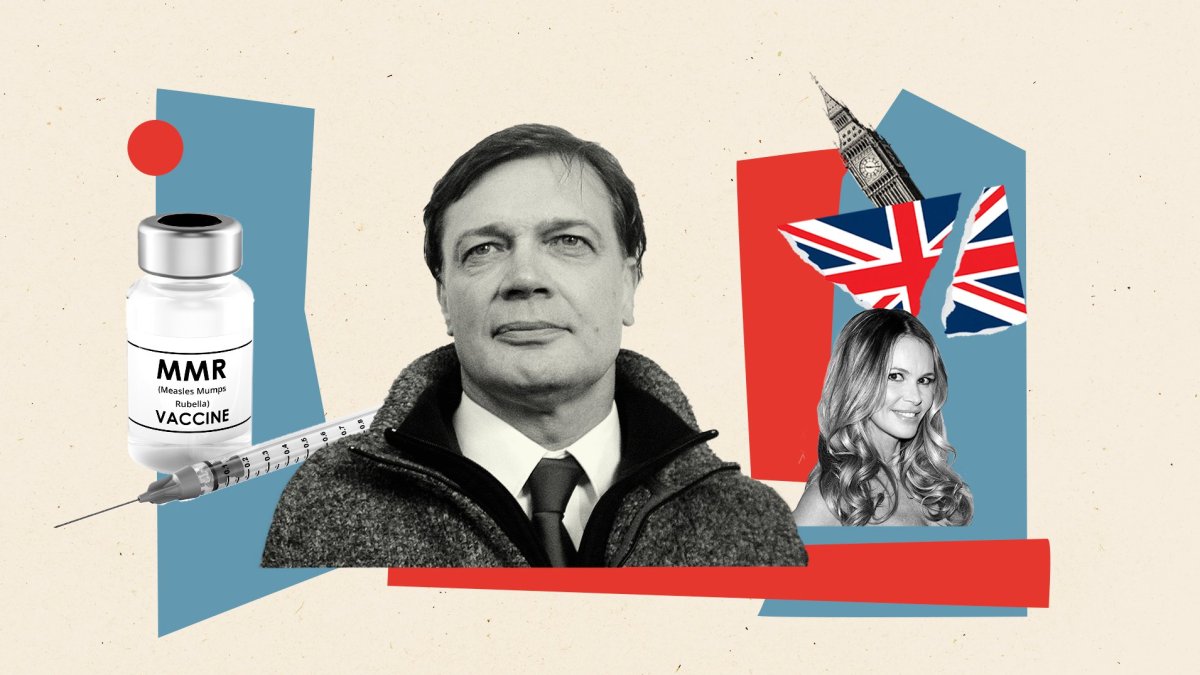
Who broke Britain? Welcome to The i Paper’s opinion series in which experts and writers debate the issues that concern them about modern Britain. • Martin Lewis: the money-saving expert… who accidentally cost Britons billions• The American woman who ripped the heart out of Cadbury• The slum king who showed British landlords how to get rich without working Vaccines are one of modern medicine’s greatest inventions. But alarmingly, the UK’s childhood vaccination rates have been going backwards for years, placing children at risk of potentially deadly infections like measles. There are several causes, but if one is to be singled out, it must be the efforts of Andrew Wakefield, a British former doctor who began waging a crusade against vaccines in the 1990s. Wakefield no longer gets much attention in the British press. But his original claims that the measles, mumps and rubella (MMR) vaccine caused autism had such deep and long-lasting impact that its ripples are still being felt, 28 years later, and his views have gained new prominence in the US under President Donald Trump. Deaths from measles, a completely preventable disease, suggest something has gone seriously wrong with healthcare provision in Britain today. How did such an unscientific movement gain any credence and why hasn’t it yet been stamped out? Wakefield came to public attention in 1998 when he held a press conference at London’s Royal Free Hospital, to publicise his paper in The Lancet, one of the world’s most respected medical journals. It was supposedly a description of 12 children who had suddenly experienced bowel inflammation as well as behavioural problems suggesting autism after their MMR jab, eight within a fortnight. Wakefield said his team had discovered a new brain-bowel syndrome and called for the triple jab to be replaced with three single vaccines. At the press conference, which I attended for a medical magazine, Wakefield appeared surprisingly arrogant and sure of his conclusions, when researchers usually pay at least lip service to the idea that science has inherent uncertainties. It struck me that this was a big fuss about a very small number of children, who might represent just a series of coincidences, but I did not foresee how catastrophic the paper’s impact would be. The study got extensive coverage in the press and uptake of the MMR started falling in England and Wales, from 92 per cent down to as low as 80 per cent in 2003. But Wakefield’s claims were not reliably substantiated and later research claiming to support them was discredited. Other researchers combed the medical records of hundreds of thousands of children, and showed that the autism rate was the same in those who had had the MMR jab as those who hadn’t. Scientists are allowed to get things wrong of course – the scientific process is supposed to continually test and revise theories so we can get closer to the truth. But Wakefield’s paper was not as it had first seemed, as the investigative journalist Brian Deer revealed in The Sunday Times and the BMJ. Deer discovered that many of the crucial medical details about the 12 children were wrong. For instance, some of the children’s autism symptoms began many months after the MMR, not within a fortnight as claimed, while in five, the symptoms had begun before getting the jab. Most damning was how the children were selected. The paper gave the impression these were families who, independently, had been consecutively referred to the Royal Free, which was how Wakefield and a gastroenterologist colleague discovered the MMR link. In fact, two years previously, Wakefield had started getting paid by a solicitor who was hoping to bring a lawsuit against vaccine manufacturers, working with an anti-vaccine group called Jabs. The solicitor had sought out families whose children could be investigated at the Royal Free to bolster the case. In total, Wakefield received over £435,000 from the solicitor, and that wasn’t all. He had also filed for patents on a single measles vaccine, a clear conflict of interest with his claims the triple jab should be replaced with three single ones. And he was seeking investors in a company he planned to found that would sell diagnostic tests and treatments for the brain and bowel syndrome described in The Lancet. A prospectus for investors said its revenue stream could reach £28m a year. As these facts emerged during the 2000s, Wakefield’s reputation was destroyed. In 2010 The Lancet retracted the original paper, and he was struck off the medical register. He was particularly censured for subjecting children to painful medical tests like lumbar punctures and endoscopies – where a camera is inserted up the bottom to view the bowel – for research purposes rather than the children’s benefit and without ethical approval. Wakefield said at the time: “There was no fraud, there was no falsification, there was no hoax.” If only that were the end of the story. But by the time he was struck off, Wakefield had long departed for the US, where his claims had a warmer reception in some quarters due to vaccine scepticism’s broader cultural and political significance. He allied with various Hollywood actors who also had a beef with vaccines, including Jim Carrey and Robert De Niro, who agreed to screen a documentary by Wakefield at his Tribeca film festival, before a backlash ensured it was pulled. At one point Wakefield even dated actress and model Elle Macpherson. Today, under Trump’s presidency, vaccine scepticism is in the ascendancy again, partly thanks to his Secretary of Health, Robert F Kennedy Jr, who has many medically unorthodox views and has publicly praised Wakefield. In the UK, uptake of both the required MMR shots is now at about 85 per cent, but with pockets in cities where it is as low as 70 per cent. As a result, there are record numbers of measles cases, and a few deaths per year, mostly in unvaccinated children. This year Britain lost its WHO “measles elimination” status, based on the fact there are now sustained local outbreaks, rather than individual cases where people caught it abroad. It is a shameful state of affairs for a relatively rich country like the UK, where, for all its faults, the NHS is supposed to be able to get the public health basics right – and contributes to a feeling that our country is broken. And the UK does not seem able to push uptake rates back up to their former high level. There are several contributors, including migration, declining trust in health services, and the fact that one of the vaccine brands contains pork gelatin (although an alternative brand can be requested). It is hard to predict how Wakefield – who now describes himself as a film-maker and an author – will fare after the next presidential election in two years’ time. But most British doctors hope that his discredited ideas stay firmly on the other side of the Atlantic. The US is welcome to him.
The doctor who dated Elle Macpherson… and poisoned a generation against vaccines
Full Article
Original Source
Read the full article at Inews →KhanList aggregates and links to publicly available news content. We do not host full articles from third-party sources. Always verify important information with original sources.