
Military doctrine gives officers a clear rule for manifestly unlawful orders: Refuse them. It offers no comparable rule when lawful action appears to threaten the constitutional structure the military serves. The first response is neither refusal nor resignation, but rather deliberative friction.Deliberative friction is the professional duty to raise a credible constitutional concern in a form that remains attributable and survives the decision to execute. The officer submits the concern in writing to the commander and copies an inspector general, while the authorized decision-maker retains control of execution. An individual officer will often see only a fragment of a larger constitutional pattern. Preserving that fragment gives institutions with broader visibility a chance to determine whether a pattern exists.I seek to define the threshold and limits of that duty and then test it with a case in which the objecting officer is wrong. There is a clear need for an administrative process for command disposition, inspector-general retention, and congressional oversight.Where the Doctrine Runs OutThe My Lai massacre and the conviction of Lt. William Calley made clear that a subordinate cannot claim a defense of following orders when a person of ordinary sense and understanding would have known the order was unlawful. Officers today are taught to refuse orders to fire on noncombatants, to provide no quarter, or to cause undue civilian suffering by intentionally cutting off food or water. Doctrine says little about a lawful order with cumulative damage.Constitutional systems can be hollowed out through what Kim Lane Scheppele calls “autocratic legalism,” a sequence of actions, each carrying legitimate legal authority. Like a welder laying seams into the steel hull of a warship, each action appears small and inconsequential. Someone watching the work sees nothing unusual. Only when the ship is complete does its purpose become clear.Constitutional corrosion is the use of lawful discretion to disable or bypass an institution’s independent constitutional function or convert fidelity to constitutional office into personal or partisan allegiance. Losing an interbranch contest is ordinary constitutional politics. Corrosion changes the contest by compromising an institution’s ability to exercise its constitutionally assigned role. It need not be a constitutional violation that a court could adjudicate.Emergency powers invoked under real statutory authority, deployments permitted by the letter of the law but never intended by lawmakers, and loyalty tests disguised as routine personnel actions are all legal on the surface. Like the seams, each raises little concern on its own. Together, they can amount to something else entirely. While nothing here depends on concluding that such a pattern exists today, the category is easier to define than to prove, which is why it needs a name.The Limits of RefusalOfficers are left with a difficult professional obligation. They cannot declare the republic endangered and refuse every lawful order that advances a policy they consider corrosive. That would place military judgment above the elected government. Huntington put neutrality and subordination at the center of military professionalism for exactly this reason. Civilian control of the military depends on accepting that civilians can make consequential decisions an officer believes are wrong.The danger runs in both directions. Rachel VanLandingham warns that a Congress unwilling to exercise its war powers has left the military as “a firewall made of parchment” against unconstitutional war. Carrie Lee finds that the professional obligation runs out of answers when orders that could undermine democracy may be ruled lawful. Risa Brooks, Jim Golby, and Heidi Urben warn of the opposite danger, an officer corps increasingly willing to pick and choose among lawful orders. They define the same dilemma without supplying an operational rule for what an officer owes when the challenged order remains lawful. Section 1034 already protects lawful communications to Congress and inspectors general, and the Department of Defense maintains procedures for evaluating and investigating reprisal complaints.The remaining problem is defining the duty. Officers need a standard for when they must raise a constitutional concern about lawful action and what facts must support it. A force willing to execute whatever it is told is a disaster waiting for a bad order. A force swift to refuse is a catastrophe waiting for an opportunity. Officers lack the authority to decide the constitutional question but have an obligation to notice it.Deliberative FrictionThat responsibility is deliberative friction. It is the duty to document a credible constitutional concern and place it before an institution able to preserve the concern or act on it. Friction guarantees an attributable record and an authorized disposition. It promises no merits review or vindication. Unless someone with authority pauses action, execution continues. The officer controls transmission, not resolution.The available channels serve different purposes. Judge advocates assess legality, while inspectors general investigate misconduct. Both remain inside the executive branch, and neither determines whether lawful actions impair another institution’s constitutional role or make personal loyalty a condition of service. For this problem, Congress is the external institution postured to compare records across the executive branch, investigate recurring practices, and revise delegated authority. It serves as the external oversight body rather than the officer’s routing destination.The routing is deliberate. The normal process sends the memorandum through the chain of command with a copy to an inspector general, while preserving the officer’s statutory right to communicate lawfully with Congress. Making direct congressional submissions routine while a command decision is pending would invite officers to seek political support outside the chain. Inspector general record retention builds institutional memory without making the individual officer a political actor. Under the proposed process, Congress would receive aggregate reporting and could obtain the underlying records through ordinary oversight when recurrence warrants inquiry.Officers who remain silent are rarely confused about the channels — they are calculating that speaking carries more risk than silence. The proposed duty changes that professional calculation by treating a credible concern as information the officer owes the institution. Because silence cannot be observed reliably, that obligation is professional rather than disciplinary.Peter Feaver uses the term “shirking” when the military substitutes its preferences for the civilian leader’s course of action by inflating cost estimates, dragging its feet, or reaching out to sympathetic politicians. Officers invoking friction state the objection in writing, accept the lawful disposition even when no investigation follows, and continue execution unless someone with authority pauses the order. Feaver is right that compliant execution of foolish policy serves the republic better than principled evasion.The bigger risk lies in what repeated use teaches the profession. A force encouraged to test lawful action against constitutional criteria may begin to treat civilian policy as military jurisdiction. Officers already make such judgments informally. An attributable and rejectable process makes them visible, bounded, and subject to correction. It requires a written causal claim, creates no stay or presumption of merit, gives the officer no appellate role, and ends the officer’s part after an authorized disposition unless new facts arise. Filing earns no professional credit. The process establishes a norm of bounded candor followed by disciplined execution. It grants officers no guardianship role.Resignation remains available, and the profession has long argued whether it is an honorable act of dissent or a dereliction of duty. Sometimes leaving will be right. But resignation vacates the post and removes the officer from the decision. Friction keeps the officer inside the institution while requiring an attributable response to the concern.The oath identifies the object of loyalty but prescribes no procedure. U.S. officers swear to support and defend the Constitution rather than a president or political party, but personal constitutional judgment does not authorize an officer to halt lawful action. Professional candor supplies the affirmative duty. An officer entrusted with public authority owes candid judgment to those who direct and oversee its use, including civilian leadership. Once facts encountered in that role create a credible constitutional concern, silence deprives authorities of the opportunity to consider it. The officer must raise the concern through an authorized process and remain bound by the command decision unless someone with authority changes it.The standard must be demanding yet within reach of a single officer, who need not prove a completed pattern. The written claim must identify facts and a credible causal mechanism by which an action, lawful in isolation, could disable or bypass an institution’s independent constitutional function or convert fidelity to constitutional office into personal or partisan allegiance. A distasteful or unwise order is not enough. Personal disagreement, political opposition, and the belief that civilian leaders are making a serious mistake do not satisfy the standard because civilians are entitled to their mistakes. A standard that activates under one administration and lies dormant under another is not constitutional. Written reasoning lets others decide whether the officer identified a genuine institutional danger or dressed a policy objection in constitutional language.A Test of ConfidenceAfter a serious security failure, a service secretary orders a rapid review of officers in critical planning billets. A joint task force deploys in 72 hours. The criteria include professional judgment, discretion, execution of settled policy, and the confidence of senior leaders. Each falls within ordinary personnel authority. Reassigned officers retain rank and pay but will miss the operation’s opening phase, which no later reassignment can restore.The staff officer consolidating returns from several subordinate commands also staffed the planning process and knows which officers offered unwelcome advice. The returns reveal a stark result: Those officers are being moved at three times the rate of colleagues who supported the approved plan. No criterion mentions political belief. To the officer, “confidence” appears to mean agreement with senior leaders rather than willingness to execute their lawful decisions.A judge advocate can confirm the secretary’s authority. An inspector general can investigate reprisal or abuse. Neither inquiry, standing alone, determines whether the disparity reflects professional performance or a loyalty screen.The officer could keep the incumbents in place by holding the routing package. Review will pull personnel officers and lawyers from readiness work and could leave critical billets unfilled. The officer has no authority to impose that delay.The officer sends a signed constitutional-concern memorandum to the commander and inspector general, then releases the package. The commander acknowledges the memorandum and directs the service personnel authority to review the supporting records but does not stay the reassignments. The inspector general screens the memorandum for existing jurisdiction without opening a merits investigation. The review pulls personnel officers and command lawyers off deployment work for two days while implementation continues. The orders issue, and the task force deploys with the replacement team.The review confirms the disparity but rejects the officer’s explanation. The reviewing authority finds that the reassigned officers obstructed implementation after civilian leaders approved the plan. They allowed deadlines to slip, kept personnel working on rejected alternatives, and treated settled questions as open. Officers who offered equally forceful advice before the decision and then executed it were retained. The officer receives the disposition but not the protected personnel records supporting it. “Confidence” measured post-decision performance, not political agreement.The officer accepts the result. The review consumed two days of staff work, changed no assignment, and delayed no order. The record now contains both the concern and the evidence that defeated it. The two days were the price of testing a credible concern without delaying execution or transferring decision authority to the officer who raised it.Abuse and TempoEvery safeguard invites abuse, and friction is no exception. Politically motivated officers could cite constitutional concerns to obstruct policies they oppose. Friction also costs time, and operations run on tempo. A duty invoked routinely would become indistinguishable from obstruction.The commander, not the objecting officer, controls the clock. The subordinate surfaces the concern — the commander decides whether anything waits and bears responsibility for any time granted to review. Military operations already absorb delays for legal reviews, collateral damage estimation, intelligence validation, and rules-of-engagement clarification without treating those safeguards as shirking. The relevant questions are whether any delay is proportional to the claimed danger and whether someone other than the officer making the claim can review the concern.Attribution raises the cost of bad-faith obstruction. The officer must identify the constitutional mechanism, sign the claim, and accept rejection by someone with authority.If the commander proceeds, the objection must still survive in an attributable record, and the officer must retain access to protected channels. The commander may reject the concern but may not erase it or retaliate for raising it. Lawful communications to Congress or an inspector general are protected. Communications made within the chain only receive that protection when they allege specified misconduct. That is why the proposed memorandum goes to both the commander and the inspector general. Legal protection, however, does not eliminate informal career costs.External review carries political risk. A documented objection can be leaked, selectively quoted, or exploited as a partisan cause. The officer may be cast as a hero or accused of insubordination, regardless of intent. The obligation requires candor in raising the concern and restraint afterward. The officer must use authorized channels and testify when lawfully required. Any further statement must stay within the evidence, and military office must never become a platform for partisan advocacy. An officer who raises a credible constitutional concern only when it is safe and private has not accepted the duty.Degradation and CollapseFriction depends on institutions willing to receive the concern. Internal review can correct error and preserve evidence, but it cannot provide external accountability.SHAMROCK and MINARET were not examples of deliberative friction, but they do show why institutional fragments must survive. For decades, telegraph companies turned over Americans’ international cables under Operation SHAMROCK, and from 1967 to 1973 the National Security Agency placed roughly 1,650 Americans on a watch list under Project MINARET. The Church Committee established the scale of the failure by obtaining and comparing records across agencies. This was retrospective accountability, not real-time correction.When no institution with authority will act on the preserved concern, friction has reached its limit. An officer who then refuses a lawful order acts outside this doctrine and must accept the legal consequences. Institutional failure does not authorize officers to substitute their own policy for civilian judgment. Doing so initiates praetorian politics and destroys civilian control, no matter how sincere the officers involved.Stockdale’s CourseThe capacity for friction has to come from somewhere, and the Navy has taught its foundations for decades. James Stockdale spent more than seven years in North Vietnamese prisons, much of it as the senior American officer at the Hanoi Hilton. When his captors wanted him for propaganda, he disfigured himself rather than provide the image. He credited a battered copy of Epictetus, first read in graduate school, with his ability to endure. As president of the Naval War College, he turned that into an elective, Foundations of Moral Obligation, still known as the Stockdale Course.The Navy usually tells the first half of the story: endurance and the inner citadel, what Martin Cook calls Stoic armor against loss. The course reaches further. The discipline that let Stockdale keep his own judgment is what allowed him to refuse when refusal carried a price. Stockdale’s ordeal is not analogous to filing a memorandum. The connection lies in professional formation. Officers who have never examined when refusal becomes obligatory have not fully examined what obedience demands. That inquiry develops the judgment friction requires: reaching an independent conclusion, exposing it to correction, and remaining disciplined when authority rejects it. The Stockdale Course gives officers a place to practice that judgment before a real order arrives.Before the Moment ComesThe moment that requires this judgment will not arrive wearing a constitutional warning label. It will look like an ordinary order from a lawful authority. Time will be short, institutional pressure will favor immediate compliance, and no existing rule will fit exactly. Officers need judgment developed through smaller cases and enough humility to question their own certainty.Teaching is the easy part. The profession already knows how to add a block of instruction. The harder task is making the duty survive the chain of command and the evaluation system, where officers decide whether speaking is worth the risk.The secretary of defense should establish a department-wide constitutional-concern memorandum and require a written command disposition. The memorandum would go to the commander, with a copy to the Department of Defense Inspector General. It would describe the lawful action and explain why the facts suggest that it could disable or bypass an institution’s independent constitutional function or convert fidelity to constitutional office into personal or partisan allegiance. Filing would create no automatic delay or presumption of merit. The commander could proceed but would have to acknowledge the memorandum and record the disposition.The Department of Defense inspector general should establish the intake and retention procedures. The inspector general would acknowledge receipt and screen each memorandum for existing jurisdiction and administrative sufficiency. Allegations of illegality, reprisal, abuse of authority, or gross mismanagement would enter ordinary inspector general channels. For a non-jurisdictional memorandum, the screen would ask only whether it identifies a specific lawful action, the constitutional function or fidelity relationship at risk, a causal mechanism, and the officer submitting it, without claiming authority to impose a delay. Importantly, the screen would not assess truth or merit. A nonconforming communication would retain whatever protection existing law provides but would not be included in the constitutional-concern dataset.The inspector general would retain qualifying non-jurisdictional memoranda under the approved records schedule and report annually to the congressional defense committees using department-wide totals and broad subject categories. Reports would contain no command-level or personal identifiers and would describe the filings as unverified concerns rather than findings of misconduct or measures of command climate. The department would set no filing target or benchmark. Aggregation cannot prevent political interpretation, but it keeps filing rates from becoming measures of individual commanders or units. Congress could request the underlying records through its ordinary oversight authorities. Recurrence could identify a subject for inquiry but would prove nothing on its own.Federal law prohibits unfavorable personnel action and the withholding of favorable personnel action as reprisal for protected communications. The memorandum would provide the dated evidence needed to identify and remedy reprisal related to this process. Fitness reports and promotion recommendations should neither identify the filing nor treat rejection as professional failure. The service secretaries should direct selection boards to disregard the filing itself if it enters the record. Formal accountability must continue to align with observable conduct.The filing and its disposition should not be included in the officer’s evaluation. Reporting seniors and senior raters may evaluate independently observable conduct, including whether the officer continued to execute lawful orders and protected classified information. False statements, unauthorized disclosures, and disobedience remain punishable. Commanders remain accountable for suppression or reprisal. A rejected good-faith concern is not misconduct.Professional military education should rehearse the judgment before the crisis arrives. We train officers to recognize and refuse unlawful orders. We owe them preparation and a protected institutional path for the harder case: raising a credible constitutional concern about a lawful order while remaining bound to execute it.Kurt Shulkitas is a cryptologic warfare officer in the U.S. Navy. The argument here began as a series of essays he wrote in 2018 as a student in the Naval War College’s “Foundations of Moral Obligation” course, known as the Stockdale Course. The views expressed are his own and do not reflect those of the Department of the Navy or the U.S. government.Image: Matthew Lucibello via DVIDS
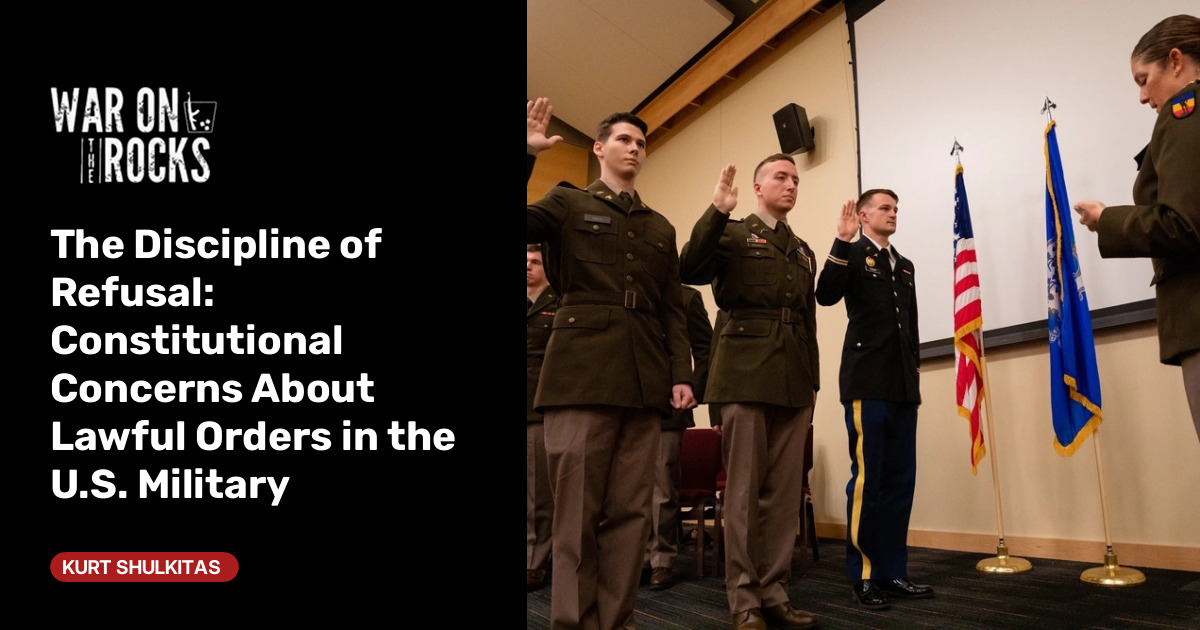
The Discipline of Refusal: Constitutional Concerns About Lawful Orders in the U.S. Military
Full Article
Original Source
Read the full article at Warontherocks →KhanList aggregates and links to publicly available news content. We do not host full articles from third-party sources. Always verify important information with original sources.