
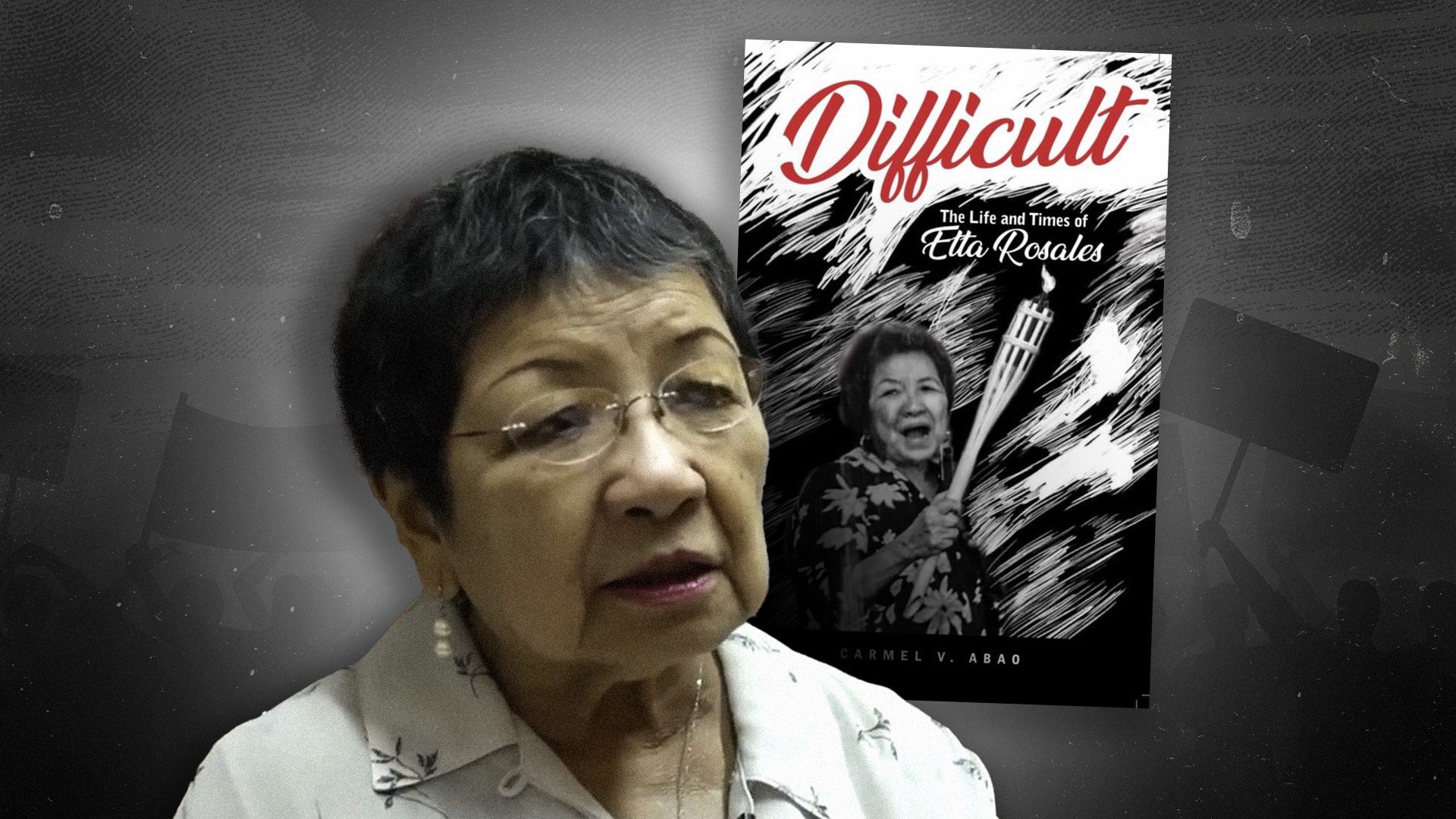
Ateneo professor Melay Abao writes about the life and times of Etta Rosales, the former communist who became a lawmaker and eventually headed the Commission on Human Rights Etta Rosales, a prominent activist and former chair of the Commission on Human Rights, launched her book 'Difficult: The Life and Times of Etta Rosales,' detailing her inspiring journey from political prisoner to a key political figure. The book, written by Carmel Abao, chronicles Etta's life experiences, including her activism during the Marcos dictatorship, her leadership in human rights, and her battles with health issues. Abao emphasized the unique sacrifices of Etta's generation of activists, highlighting their commitment to democracy without dwelling on personal losses, and noted Etta's exceptional role as a torture victim who became a lawmaker. This is AI-generated. Read the article for full context. Report any errors. MANILA, Philippines – She’s sharp and passionate as ever, taking time to write more than a few words on each of the book that she signed on Thursday, September 17, at the launch of Difficult: The Life and Times of Etta Rosales at the Executive House in UP Diliman, Quezon City. She is, after all, the feisty Etta Rosales. Former chairperson of the Commission on Human Rights (CHR) who had also served as representative of Akbayan for nine years, 87-year-old Loretta Ann “Etta” Rosales was the star of the show at the book launch organized by her family, peers, and comrades-in-arms. Difficult tells her complex but inspiring journey from an activist to a communist cadre to political prisoner under the Marcos dictatorship — to being a key leader of a leftist political party to getting elected to Congress and to serving as head of a government body that probed human rights abuses. Written by Akbayan’s first secretary-general and Ateneo professor Carmel “Melay” Abao, Difficult carries six chapters that chronicle Etta’s growing up years as a daughter of a military officer (a West Pointer at that); her political awakening and organizing in the communist underground after the declaration of Martial Law in 1972; marriage and motherhood; her leadership in the human rights movement and shift to mainstream politics; and her various battles with cancer, two strokes, COVID-19, pneumonia. She would, in fact, ask her doctors: why am I still alive? “‘Malakas kasi ang puso mo (Your heart is strong),’ the doctors would tell her,” wrote Abao. Etta herself wrote one portion of the book — the one pertaining to her second arrest and detention in 1976, when she was molested and heavily beaten. COURAGE. Etta Rosales at the launch of a book on her life, written by Carmel Abao. Such a harrowing experience, and the grace and courage that enabled her to continue organizing, mobilizing, and working on the streets and within the bureaucracy, melted the heart of the late president Noynoy Aquino. It was Aquino who appointed Etta as CHR chair shortly after he was elected president in 2010. Quoting Butch Abad, Aquino’s former budget secretary, Abao wrote: “Etta’s greatest contribution back then was her positive influence on President PNoy… PNoy was anti-communist, Butch reveals, but this anti-communism was tempered by his interaction with Etta. Because of PNoy’s knowledge and appreciation of Etta’s life story, he gained a better understanding of why those who had similar experiences during Martial Law took on very hardline positions.” In her remarks at the launch, Abao shared her biggest takeaway as the author: that Etta’s generation of activists is one of a kind. “That generation needs to be recognized by my generation and those after me as the generation that risked it all — lives, personal relationships, family, careers, personal development,” Abao said. “Risked it all for the sake of our nation’s democracy. I know that every generation takes risks, but Etta’s generation of activists took risks without keeping score of what they could lose because of their activism, without dwelling on the ‘what ifs.’ What if I took that PhD instead of organizing the teachers’ union? What if I stayed above ground and never left my kids and my husband? What if I just kept silent during those Marcos years?“ AUTHOR. Ateneo professor Carmel Abao after receiving the first copies of the book. In the many conversations that she had with Etta for the book, Abao said that not once did the “what if” question crop up. “Having no regrets doesn’t mean, however, that there are no costs,” Abao said. “That generation lost so many great lives that were cut short by the dictatorship. And the children of that generation suffered so much — they lost parents, endured abandonment and basically skipped their childhoods.” But Etta “clearly stood out” from the rest — “one of a kind,” Abao added. “Because she is so many roles woven into one person – marami ang naging torture victim pero si Etta ang torture victim na naging kongresista, na naging chair pa ng Commission on Human Rights (there were many torture victims, but Etta was the torture victim who became a lawmaker and even served as chair of the Commission on Human Rights).” Etta felt at home at the launch, which was an opportunity for old comrades to get together again. “Each one has influenced me in my various struggles in life — above ground, underground, middle ground, and again above ground,” Etta said in her remarks. “They all had one thing in common; they kept me grounded and this helped me remain steadfast in the pursuit of my faith in humanity, its integrity and the inherent right to human dignity.” Difficult will have a second launch on Monday, September 21 — the 54th anniversary of the declaration of Martial Law — at The Loft, Arété, Ateneo de Manila University, from 4 to 6 pm. – Rappler.com How does this make you feel? Loading
The ‘difficult’ Etta Rosales — and why she stands out in her one-of-a-kind generation of activists
Full Article
Original Source
Read the full article at Rappler →KhanList aggregates and links to publicly available news content. We do not host full articles from third-party sources. Always verify important information with original sources.