
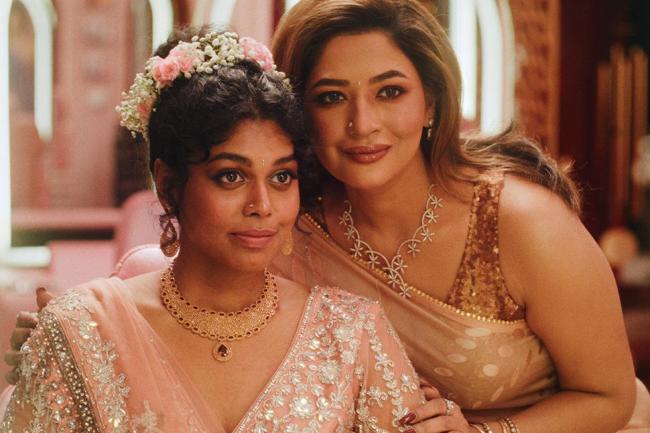
Cursed brides, aunty matchmakers, and resplendent weddings: Do global audiences ever tire of these reliable entertainment exports from South Asia? The tropes have long been staples of the subcontinent’s myriad screen industries — just this century, see “Monsoon Wedding” and “Slumdog Millionaire,” or Netflix’s pandemic hits like “Indian Matchmaking.” Recent work on the international festival circuit has been making interventions, however. Sundance winner “Cactus Pears,” a tender Indian romance from Rohan Kanawade about two men who are “special friends,” “doesn’t preach the ideal of a full, happy love life, and doesn’t even care for Western ideas like self-actualization,” as I argued in my review for IndieWire. Pakistani filmmaker Sarmad Khoosat’s “Lali” foregrounds the cursed groom as much as the bride within its darkly comic folk-horror folds. Tamil director P.S. Vinothraj’s “The Adamant Girl” explores how a family forces a betrothed woman to undergo an exorcism. Bangladeshi cinema has been equally insistent on subverting patriarchal stereotypes. The blue-washed “Rehana,” which opened at Cannes in 2021, leads the charge with noted actor Azmeri Haque Badhon’s powerhouse turn as a professor avenging a student’s sexual assault. Nuhash Humayun’s 2023 SXSW Midnight winner “Moshari” builds a monster-infested dystopia in which its protagonist comes to deploy the titular mosquito net in her demonic avatar. The lesser-known “Roid,” which screened at Rotterdam this year, interrogates alleged madness in an equally adamant, otherworldly bride. Genre works remarkably as a storytelling vehicle in these films, even as all its directors are men. And yet Rubaiyat Hossain, writer/director of “The Difficult Bride,” which premieres this week at Venice’s Orizzonti section (alongside another entry from South Asia, Anuparna Roy’s “Lovers in the Blue Night”), downplays the rigidity around genre categorization. Her fourth feature tracks the claustrophobic isolation of a Western-educated Dhaka woman, Zai (played by first-timer Zaineen Chowdhury Karim), from her “happy” engagement day to her wedding eve, as she is subjected to an increasingly grotesque regimen of treatments inside a legendary beauty salon whose corridors — this isn’t really a spoiler — are inhabited by a ghost bride. ‘The Difficult Bride’Venice Film Festival “I’ve been calling it a feminist supernatural, but I don’t think it’s a hardcore genre film,” Hossain told IndieWire last week. “The film is visceral and intrinsically physical. It’s about the interiority of the female body and the battle being waged inside it. [So] I used the form I needed to express these stories about embodied memory and the uncanny of femininity.” Mayfair, the fancy salon where Zai finds herself trapped, is the name of the salon Hossain used to visit with her mother as a child. “The story is based on an urban myth,” said Hossain. “A bride died [in Mayfair] because there was a snake inside her ornate flowered bun. And I remember as a seven-year-old, I visualized it. As I grew, it stayed with me. There’s a metaphor in there about beauty, femininity, and desire. The story is intrinsically supernatural.” Mayfair no longer exists but in the movie, the myth “founds its own language.” With interiors largely shot inside Hossain’s own house in Dhaka, the film is filled with striking shots of animals — lizards galore, snakes, monkeys, and mosquitoes. All real, said Hossain, except one obvious VFX shot. Zai encounters them inside and on the streets, as a sense of terror envelops her. Made to feel embarrassed by the domineering salon manager (“Rehana” star Badhon) about how flawed her appearance is, Zai finds she can only confide in Minoti (Reekita Nondine Shimu, star of Hossain’s previous feature, “Made in Bangladesh”), a lower-class, hijab-wearing spa worker, who becomes her resource for underground suppliers of weed. The film alternates between the offensively palatial reds of the elite salon, where classical Bengali music strains are as muted as its patrons’ agency, and the snail-infested condo where Zai jams to rap lyrics like “physically a whore, mentally a lover girl.” Hossain and her collaborators have conjured an internalized hellscape marked by sensual photography, gnarly cyst makeup, and suffocating matrimonial rituals involving turmeric and milk — all redolent with upper-class heteronormative rot. Hossain makes a surprising confession when asked whether the animals are real or psychological. “In this film, I’ve put a lot of things I’ve been scared of. As a little girl, I was very scared of brides. When I saw my aunts getting married, the way their makeup was done, and the way they were crying before they would be put into a car, I was scared. I was always disgusted by the lizards and mosquitoes that lived in our house. My mom said we could never get rid of them. They will always be there, and I had to live with it.” ‘The Difficult Bride’Venice Film Festival Moreover, during filmmaking, Hossain endured many personal trials. She lost two close family members and her pets of 14 years. So even though “Bride” has been accepted at Venice, and she is pleased that a Bangladeshi film will resonate with a global audience, she was very grief-stricken during production and finds it hard to celebrate now. Additionally, since Zai’s internal journey mirrors Hossain’s own childhood fears, she needed an actor who would completely commit to the role. Karim turned out to be quite the unexpected choice, since she was initially supposed to be the first AD on “Bride.” “For this film. I really led with my gut,” says Hossain. “It was not an easy decision to cast a non-actor who had zero experience of being on a film set. At the end, Zai felt like the right choice, and she made me feel very safe, which was very important to me. She was also politically aligned with the film. She comes from a similar background as I do, lives pretty much next door to me in Dhaka, and we even went to the same undergraduate school [Smith College]. There was a certainly honesty, innocence and passion in her.” That raw innocence would prove crucial to Zai’s character, who experiences a gamut of violations masked as privilege. Disagreeing with my suggestion that the film critiques the marriage-industrial complex, Hossain said, “It’s not so much about marriage as it’s about beauty, and the idea of a bride. Every bride wants to be beautiful and perfect. My film questions what consists of beauty, beauty from whose point of view, and beauty to appease whose desire. Today women have more choice than ever about how they want to present themselves. Yet I think the industry has created a lot of intensified pressure. Beauty is presented as empowerment, but behind that idea is a lot of suppression and explicit violence in the female body.” ‘The Difficult Bride’Venice Film Festival No wonder then that Hossain said that she sometimes pitched the project as “Monsoon Wedding” meets “Antichrist.” During pre-production, she showed her DP Leonor Teles references ranging from Nina Menkes’ documentary “Brainwashed: Sex-Camera-Power,” to her childhood hero Satyajit Ray’s “Charulata,” whose opening she pays homage to in a scene where Zai, like Charulata, watches a monkey on the street from her confined space. When I brought up the poem Zai finds herself writing alone in her condo, after the high of weed has passed and slugs rest on her high heels, Hossain livened up and spontaneously recited the lines, credited to writer Aahir Mrittika from her book “The Unforgiving City and I.” “If you slit my throat right now, you would find a bird. Like slicing off my breasts with a kitchen knife.When I realized I could be something other than a girl and my head hurt for days. I am never a woman but something carnal and hungry, from a time before we were here.” “These are imageries that we hardly see in literature,” Hossain said. “To say, I’m a being who is prehistoric, I’ve always been here, [that’s something]. I think we’re all ancient beings. When we’re put in this female form, we are reduced to our sexuality, to our breasts, vaginas, and ovaries, to how we can reproduce and please the male gaze. But I’m so much larger than that. Zai has this wisdom deep down about who she actually is. A free being as wild as a snake. The way she looks during that scene, stripped of all makeup, and the way we pan over her legs and see all the hair and everything. To me, that’s a person. She’s not a man or a woman. Just a person.” Of course, Badhon’s salon manager, blinded by dominant ideology, would vehemently disagree. For the film, Hossain said that Badhon called in her real doctor to inject her during a scene where her character undergoes painful platelet-rich plasma injections. So grotesque that even the DP and the focus puller were disturbed. Images that critics in the West might classify as “body horror,” but as Hossain revealed, women filmmakers in the global majority have their own reasons to conjure a cinematic language to make the narrative interventions they want — those which, like Zai, seek their freedom to be expressed. “The Difficult Bride” premieres at Venice on September 6, followed by the Toronto International Film Festival.
‘The Difficult Bride’ Turns South Asia’s Beloved Wedding Tropes Into Feminist Folk Horror at Venice
Full Article
Original Source
Read the full article at Indiewire →KhanList aggregates and links to publicly available news content. We do not host full articles from third-party sources. Always verify important information with original sources.