
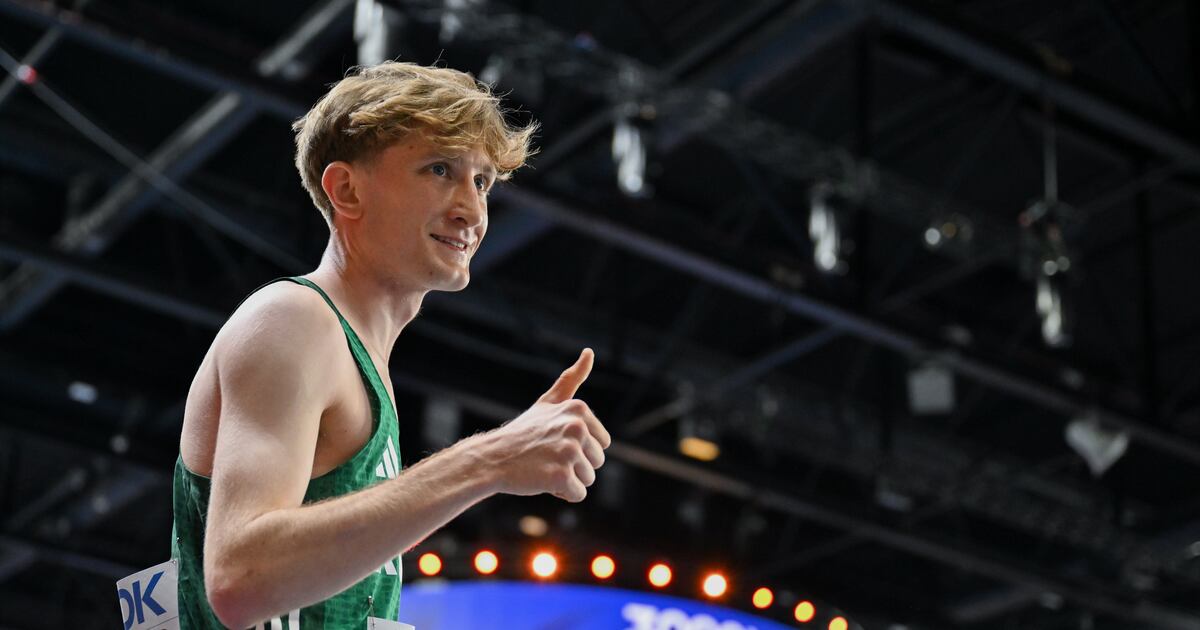
The announcement by the University of Oregon earlier this week that Nick Griggs was officially “Flying with the Flock”, a reference to Oregon’s sports teams also being known as the Ducks, certainly appears to have ruffled a few feathers.In continuing the long history of Irish athletes taking up a US scholarship, Griggs has brought some wider attention to the rules of the National Collegiate Athletic Association (NCAA), the governors of all US college sport since 1906.Griggs is unquestionably a major catch for Oregon. The Tyrone runner is the reigning European Under-23 Cross-Country champion, and Irish under-23 record holder over 1,500m (3:35.04), the mile (3:52.42), 3,000m (7:32.79) and 5,000m (13:05.75). He’d broken all those records at Under-20 level too. His exceptional talent has been known about for many years; in 2022, less than three months after turning 17, Griggs became the youngest Irish runner to break four minutes for the mile, clocking 3:56.40 at the Sport Ireland Arena in Dublin.READ MOREAlthough he had received several offers of a US scholarship before, he’d so far chosen to remain close to home, and for the last two years has attended Ulster University in Belfast, studying sport and exercise sciences, while coached by Mark Kirk. Still, the possibility of a transfer to the US was always in the back of his mind and, prompted this summer by fellow Irish runner Abdel Laadjel, who last year finished up his final season of eligibility at Oregon, moves were swiftly afoot.At 21, Griggs has already run at the World and European Athletics Championships and the Commonwealth Games, although he narrowly missed out on the Paris Olympics. He also signed a professional contract with Puma, back in 2022, and is looked after by Pace Sports Management, among the biggest professional athlete representatives in the sport. On the good days, he might have picked up a little prize money along the way too. Until relatively recently, all this would have gone against the rules of the NCAA. Then in July 2021, in arguably the biggest change in NCAA history, student athletes were allowed to generate their own income from selling their name, image and likeness – otherwise known as the NIL deal.This has impacted on US athletes to varying degrees, depending on the popularity of their sport, with Miami Hurricanes quarterback Darian Mensah currently boasting the highest NIL deal, reportedly worth around $6.5 million (€5.79 million).Nick Griggs of Ireland holds up a shoe after losing one during the men's 5000m final during day one of the European Athletics Championships 2026. Photo: Sam Barnes/Sportsfile via Getty Griggs isn’t in that league, although his signing with Oregon has been met with some curious backlash, and the cause of some debate on both sides on the Atlantic. Partly because of his age (he turns 22 in December), his considerable international experience, and his “pro” contract with Puma, some believe Griggs has no place in the NCAA, or will at least make things a lot harder on young US or other foreign athletes starting out in their college career.Things are a little different when it comes to football and basketball, as under NCAA rules, any player who has signed with the NFL or NBA is prohibited from returning to college (although some of those cases have gone to court). The NCAA have also revised their age eligibility this season, so that athletes only have a continuous five-year eligibility period from the time they start college. This means, all going to plan, Griggs still has three years of eligibility at Oregon, which will see him through the LA 2028 Olympics. [ Nick Griggs takes lessons from finishing ninth as Josh Kerr wins World Indoor 3,000mOpens in new window ]Some of the backlash on social media has pointed to the fact Oregon is already a powerhouse of US collegiate distance running (and has been going back to Steve Prefontaine in the 1970s), and they shouldn’t be going after an athlete of Griggs’ age or calibre. But again, Griggs isn’t breaking any NCAA rules here, and nor indeed are Oregon, with Griggs himself responding to that with a telling comment: “Don’t hate the player, hate the game ...”A lot of things have changed since the first Irish athletes went on scholarship to the US, starting back in 1948, with a simple proposition to Jimmy Reardon: “We could sure use you guys at Villanova.”The story goes that Reardon, a 400m runner and captain of the Irish athletics team at the 1948 London Olympics, was sitting in the dining hall with thrower Cummin Clancy and miler John Joe Barry. They got chatting with US runners George Guida and Browning Ross, both scholarship athletes at Villanova University, just outside of Philadelphia, who reckoned their famous coach Jumbo Elliott would be delighted to snap up these already famous Irish athletes.In Barry’s autobiography The Ballincurry Hare, a gem long out of print, he recalls how Reardon sparked the idea, before all three sealed the deal: “It was Reardon who put the question to him, ‘George, you’re telling me if you could run or jump well enough, you’d get a scholarship to an American university, which would include full tuition, full board, books, etc?’”Rhasidat Adeleke finished fifth in the women's 200m semi-final during day three of the World Athletics Ultimate Championship in Hungary. Photo: Nikola Krstic/Sportsfile via Getty That began what was originally known as the Irish pipeline, with Ronnie Delany soon following in their footsteps, paving the way for the likes Eamonn Coghlan, John Treacy, Marcus O’Sullivan, Frank O’Mara, Sonia O’Sullivan, and more recently, Rhasidat Adeleke. Spreading from the east coast to the west, north and south, and most places in between, the presence of Irish athletes in US colleges, and their success far beyond, has been a constant during those near 80 years since.Success has never been any barrier to NCAA eligibility in all the years since, and nor was age. Delany, remember, won an Olympic gold medal while in college in the US, his 1,500m triumph in Melbourne in 1956 coming during his last year at Villanova, and in 1978, a 20-year-old Treacy won the World Cross-Country during his final year at Providence College.Griggs will take any of this backlash in his stride. Currently recovering from a knee injury, he’s used to adversity. After winning silver in the Under-23 race at the 2024 European Cross-Country, he developed a serious knee infection, osteomyelitis. Back in 2021, less than six weeks after losing his older brother Josh in a work accident, he won the European Under-20 3,000m gold in breathtaking style, when still only 16.And as for Griggs now signing with Oregon, Jumbo Elliott would no doubt have approved.
The curious backlash against Nick Griggs taking up a US athletics scholarship
Full Article
Original Source
Read the full article at Irishtimes →KhanList aggregates and links to publicly available news content. We do not host full articles from third-party sources. Always verify important information with original sources.