
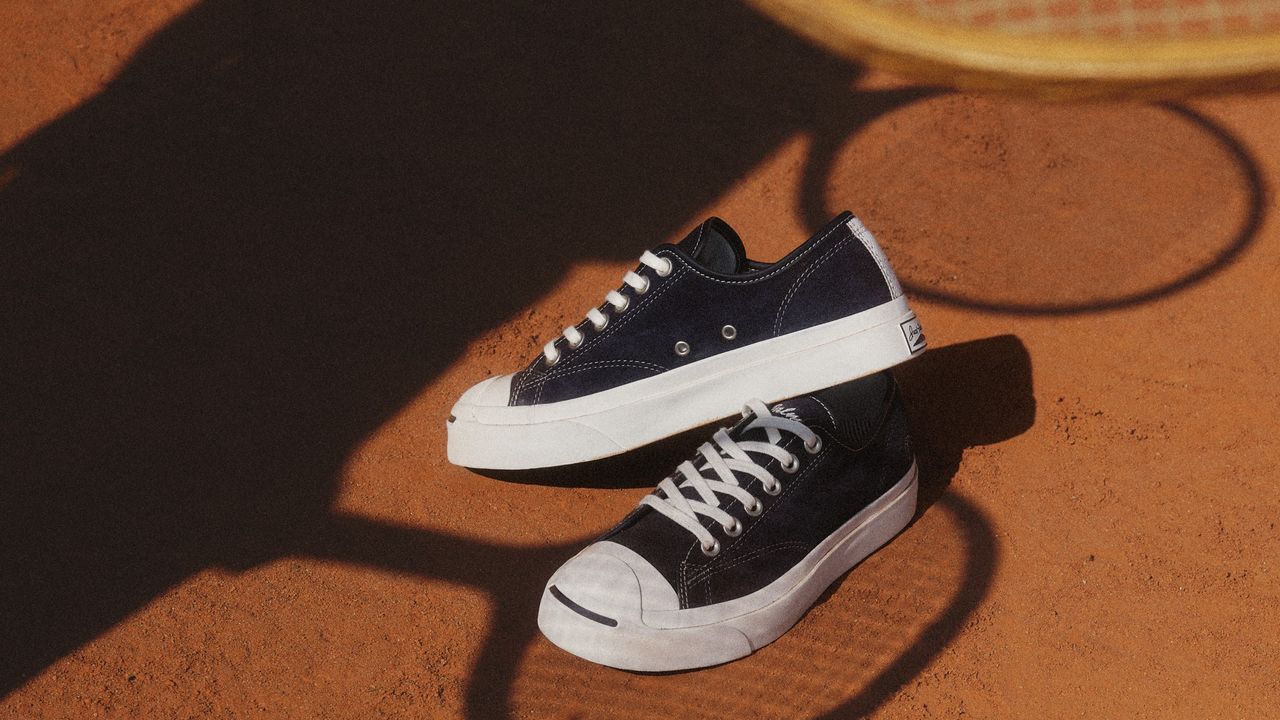
Picture Kurt Cobain. He’s got the floppy blond locks, the striped tee, beat-to-shit jeans, maybe a flannel. Now look down. What’s on his feet? You’re probably imagining Chuck Taylors, of course, the quintessential sneaker of disaffected youth everywhere. But look closer at some of the most iconic photos of Nirvana, and you’ll spy a subtle detail you probably never noticed before: the “smile” on the toecap of Converse’s other canvas lace-up, the Jack Purcell.I’ve worn Jack Purcells on and off since my teens, and yet this revelation still floored me. Back in the aughts, JPs were marketed to kids like me as the preppier, peppier alternative to Chucks, a little sleeker and cleaner cut. Growing up in Toronto, I liked them because they were the OG Canadian signature shoe—Jack Purcell, the man, was a 1930s badminton champion from Guelph, Ontario–-and because they worked as a “nice” option when my trusty checkerboard Vans felt too cooked for family dinners out. As much as he loved to subvert expectations in grandpa cardigans and Aubrey Hepburn shades, the idea that someone like Kurt Cobain was thrashing across the stage in yuppie court shoes would never have occurred to me.“The way it’s been told to me is that he loved the smile,” Matt Sleep, Converse’s global design director, tells me of Cobain. “He was very much ahead of his time in the way he styled himself, and I think he liked how that little weird detail looked juxtaposed with his ripped jeans and printed shirts.”Nirvana at the MTV Video Music Awards, 1993 Jeffrey MayerAs it turns out, there’s a whole lot of Jack Purcell history that somehow missed me. James Dean wore ’em. So did Elvis. George Harrison laced up his pair for the Apple Corps rooftop show. And while I’d always pictured Purcell himself as a square in pressed khakis, Sleep assures me he was the Andre Agassi of his day. “He was that level of iconography and in some ways notoriety as well,” Sleep says. “He was very charismatic on the court, but Jack had bags of personality off it as well. And people loved him. I think the kids call it ‘rizz’ now, don’t they?”A lot of the JP’s rebellious spirit had long been swept under the rug as Converse positioned the sneaker as its grownup model, the one you could reasonably throw on at the office with a linen suit. But after a few years of relative dormancy—and with racket sports suddenly surging in popularity again—the Jack Purcell is in the midst of a major relaunch. Which means it’s Sleep’s job, in part, to help bring the shoe’s countercultural bonafides back to the fore. “We’re seeing fashion and other subcultures really look to tennis and court sports again,” he says, “and we’ve got a hugely legitimate heritage within that world. We’d be doing ourselves a disservice if we didn’t get to tell that story.”One major way Sleep and team are hoping to restore the Jack Purcell to its former glory? By fully remastering the silhouette itself. While the model’s revival kicked off last week with the ultra-luxe First String iteration, today Converse is unveiling the version real heads have been waiting for: the Jack Purcell PDM, which draws on design elements from nine decades of archival kicks to deliver the definitive take on the shoe.Purcell originally launched his shoe via B.F. Goodrich in 1933, working on the design himself and pioneering a handful of performance innovations in the process: a steel heel shank for improved arch support and stability; flat herringbone outsoles for superior traction; and a bulked-up rubber toecap for extra reinforcement. The navy-blue smile debossed across the front was a nod to the champ’s nickname “The Smiler,” which he earned for the sly grin that never left his face as he coolly dispatched opponents. While many of those details are still present in this latest generation, the look and feel of the PDM is largely inspired by the relatively brawnier JP styles from the mid-’70s, just after Converse acquired the rights to the model.“We did a huge analysis of really every different decade of Jack to really find the sweet spot,” says Sleep, who spent months diving in the company’s archives and consulting with vintage collectors to perfect the silhouette. “We settled on the ’74, ’75 era, where you start to get a little more proportion in the shoe. The last is less slim, less low profile, and quite honestly, a little bit more consistent in terms of quality of manufacture.”As such, the shoe feels retro in all the right ways, with a heavier canvas upper, thicker midsole, sturdier toecap, and a carefully restored period-correct logo—alongside a suite of modern comfort upgrades, like a cushioned sockliner with molded arch support. It boasts a far more formidable presence than the svelter post-millenium Jack Purcells I wore growing up and an appealingly old-school quality to the construction. “The beauty of the vulcanization is that it is still a hand-on process,” Sleep says, referring to the arduous method used to create the rubber soles. “In a world of mechanization and computers running everything, it’s this 100-year-old craft, which people still continue to perfect today. And the beauty of that is there are these tiny little nuances that you will see, which really are a reflection of the actual people's hands touching and creating this kind of coveted thing.”To help launch the PDM, Converse couldn’t have landed on a more fitting collaborator: Palmes, the Copenhagen streetwear outfit founded by skater-turned-tennis-obsessive Nikolaj Hansson. “There’s a photo of me on Instagram from 2012 skating in the Jack Purcell,” he tells me. “I loved how off the beaten path it was here in Scandinavia, it was so different from all the shoes my friends were wearing.” So when it came time to put his own spin on the sneaker, Hansson “didn’t want to put too much noise on a song that I already loved.”The two colorways of the Palmes x Converse Jack Purcell PDM, both set to drop on September 14 for $100, totally nail that brief. There’s a deep midnight navy suede, which Hansson suggests to “just murder, because they look so good when they get worn down,” and a washed grass-court green canvas, meant to look like “you wore them all summer and the sun has kind of faded it out.”In the end, though, the thing that Hansson loves most about the Jack Purcell is the same thing that drew Cobain (and me) to the shoe in the first place, too—the same thing that’s helped it remain a staple on shelves for nearly a century.“I love the smile,” he says. “I love how it looks when your pants fall over the shoe and you can just see this distinctive silhouette. It’s such a clever design tool, this quiet little marker of individuality. Without getting too Dieter Rams about it, I think this idea of reducing things to their very essence is beautiful. And that’s also the hardest thing to do.”
The Converse Jack Purcell Has Always Been Cooler Than You Think
Full Article
Original Source
Read the full article at Gq →KhanList aggregates and links to publicly available news content. We do not host full articles from third-party sources. Always verify important information with original sources.