
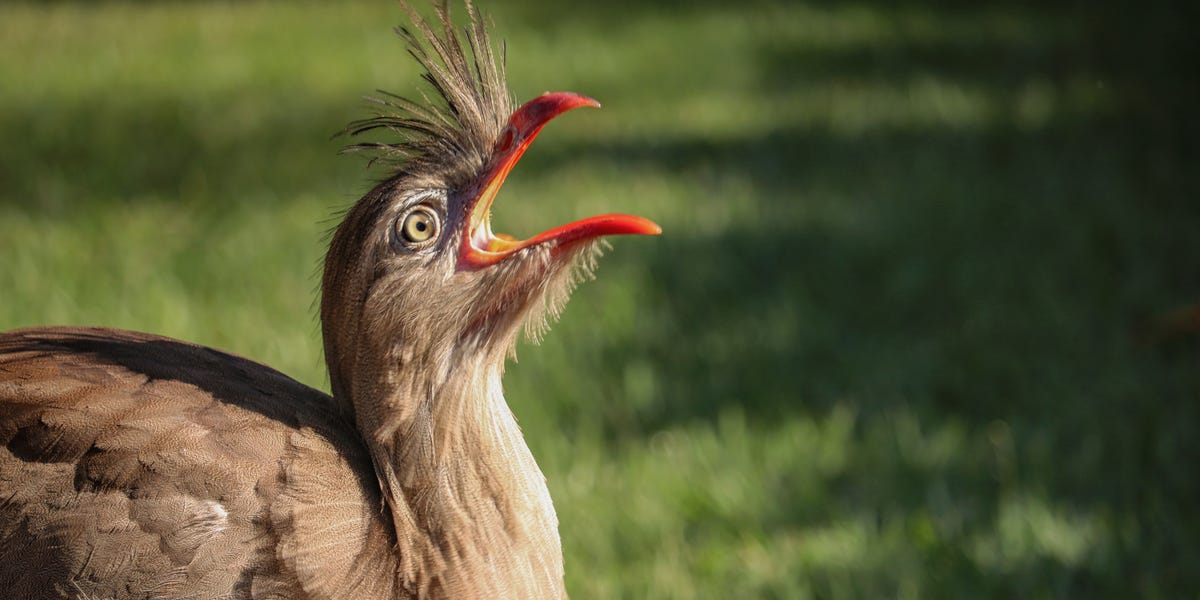
3 min readBird calls are the soundtrack of nature. The wailing, longing call of a loon to the shrill squawk of a red-winged blackbird, the ins and outs of bird calls have been extensively studied, and scientists have formed certain hypotheses about how they function in the animal world. The Acoustic Niche hypothesis, for example, explains how birds adjust their calls and frequencies to stand out from background noise. Birdsong can also have accents and dialects specific to certain regions, and those same songs can alleviate anxiety and paranoia in humans.However, few studies have delved into the inner workings of what’s arguably the most noticeable attribute of birdsong: amplitude. A new study published in the journal Evolution takes a closer look at this stunning amount of variety by analyzing birdsong in western Massachusetts as well as throughout Brazil, totaling 123 species.From that collection, University of Massachusetts Amherst behavior ecologist Jeffrey Podos, along with his former graduate student João C.T. Menezes, documented birds as quiet as the dusky-throated hermit hummingbird along with the boisterous cries of the bare-throated bellbird and the red-legged seriema. Of the 123 species, only ten of them have previous amplitude data.“We've been able to vastly increase the number of species for which there is amplitude data,” says Podos in a press statement. “This is basic, foundational research that no one else has managed to do on this scale, and it points to all sorts of other questions that would be fun to follow up.”Podos has spent years studying the amplitude of bird calls, and in 2019, a study co-authored by Podos in Current Biology accurately identified the current world-record holder for loudest bird: the White bellbird (whose screeching call is truly something to behold). That study pitted the bellbird against the screaming piha, which as its name suggests, is also very loud, but the nearly foot-long bellbird exceeded its vocal opponent by roughly 9 decibels at a shocking 125 decibels—roughly the equivalent to a jackhammer.Now, this new study finds two new contenders for world’s loudest bird in the bare-throated bellbird (a fellow member of the genus Procnias) and the red-legged seriema, a flightless bird native to Brazil, whose calls each exceed the 120 decibel threshold.However, this study’s purpose wasn’t just another step in the unending search for the world's loudest bird but an exploration into the evolutionary drivers of loud birds, looking particularly at physical characteristics and ecological factors. Slowly, an explanation of how some birds are so much louder than others began to emerge, but the why remains a mystery.“We now know some of the hows,” Menezes said in a press statement. "Bigger bodies and wider beaks, but we’ve yet to discover the whys, and we probably need much more data from many more species to be able to tease out what’s going on on the ecological and evolutionary front.”Some of the most interesting findings were hypotheses that didn’t quite pan out. For example, the authors guessed that loud birds would be weaker flyers, live in dense forests (where volume would be key), and likely practice polygamy due to its call reaching more and more potential mates. However, the data didn’t support these assumptions, at least not yet. To get a better understanding of the role these exceptionally loud calls play, Podos says that’ll mean more boots on the ground.“You can't do this kind of work in the lab, or by scraping data from the internet,” Podos said in a press statement. “You have to get out into the world, you have to pay careful attention to what you're seeing and hearing.”Darren lives in Portland, has a cat, and writes/edits about sci-fi and how our world works. You can find his previous stuff at Gizmodo and Paste if you look hard enough.
The Construction Work Outside Your Window Is No Match For The World's Loudest Birds
Full Article
Original Source
Read the full article at Popularmechanics →KhanList aggregates and links to publicly available news content. We do not host full articles from third-party sources. Always verify important information with original sources.