
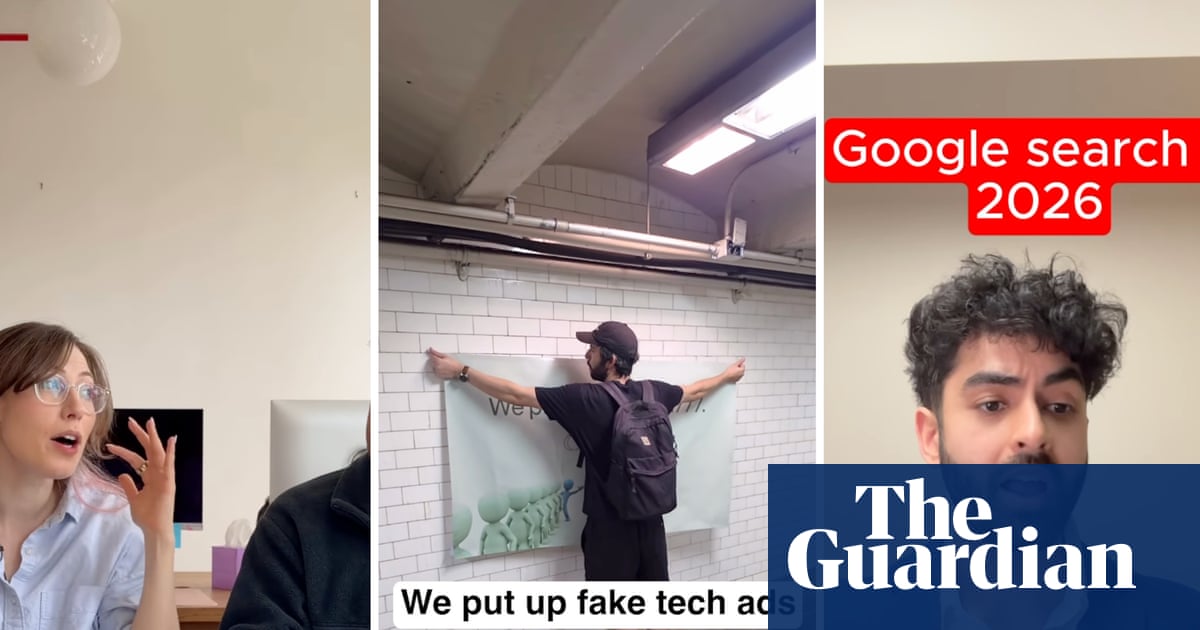
“Best case scenario, we never have to do any admin again,” says an AI CEO. “Worst case, we all die.”A young man struggles to the top of a beautiful mountain, words echoing in his ears: “AI will most likely lead to the end of the world, but in the meantime, there will be great companies created.” At the top of the mountain, he triumphantly holds up a sign: “Build a datacenter here.”On the New York subway, posters herald what appear to be AI startups. “What if forks were spoons?” asks an ad for Cutlery.ai. Another advises viewers that Ziplink is now known as Froggle.The posters are real, but the companies aren’t; the CEO and datacenter scenarios are social media sketches (though the “great companies” quote is a genuine piece of wisdom from Sam Altman). It’s all part of a recent wave of comedy inspired – but absolutely not generated – by AI.The comedy extends across all forms of media: social videos, standup, songs, humor columns, comic strips and art installations. It takes aim at companies’ attempts to make AI ubiquitous, the dangers of believing its every word, its threats to society and the environment. It effectively punctures tech CEOs’ relentless narrative: that artificial intelligence represents humanity peaking; that it is inevitable and all-powerful; that we have no idea where it’s going and it could kill us all, but for some reason it is absolutely essential to pursue.Allow Instagram content?This article includes content provided by Instagram. We ask for your permission before anything is loaded, as they may be using cookies and other technologies. To view this content, click 'Allow and continue'.It’s no surprise that a topic as pervasive as AI in 2026 would end up in comedians’ crosshairs. A March Gallup poll found 79% of Americans believe AI will reduce jobs. In a CNN poll this week, 81% of respondents said they were more concerned than excited about how the technology could “fundamentally change our way of life”. Only 11% of Americans would support the building of a datacenter locally, according to UMass Amherst. Meanwhile, a handful of impossibly wealthy weirdos wander between podcasts and conference stages boasting about their plans to fundamentally alter what it means to be human.One way to expose the absurdity of the AI companies’ story is by exposing the flaws in their products. Ty Eveland, for instance, trolls AI doctors and HR professionals – the video bots you might awkwardly encounter at a virtual doctor’s appointment or job interview. Asked about marketing, he tells one bot interviewer he takes “everything with a grain of salt and maybe a little bit of pepper”. The bot, portrayed as a generically handsome blond man, responds earnestly: “When you say you take things with a grain of salt and pepper, what does that actually mean for a brand’s social media strategy?”If bots are approaching superintelligence, this one has clearly been left behind.Can you stop AI datacenters? Comedian Charlie Berens thinks so – Stateside with Kai and CarterOther comedians parody the user experience: the comedian Aya Huseen, repeatedly popping out from behind a door, personifies tech companies’ desperate attempts to get users hooked on new AI features: “You sure you don’t want to try it with AI?” “This would be so much funner with AI.” “Just try generating it with AI.” The comedian Tom Nestor imagines “how people who love AI think we see them,” telling a friend on the phone: “Do you know what I also really like? It’s not so good now but in years to come it’ll get so good that it’ll just completely alter people’s grasp of reality.” In the Atlantic, the humorist Alexandra Petri recounts a dream in which everything in her life has pivoted to AI, from children’s books – Goldilocks and the 4.5 Bears – to her cereal, which features “subtle changes in the recipe, such as the nuts now being the hard, metal kind”.Pro-human comedians have also taken aim at AI’s artistic pretensions. “If you are somebody who uses ChatGPT to generate videos, images, art, text, in an artistic capacity, to write for you, you are not somebody who deserves to be taken seriously,” said the comedian Caleb Hearon in a serious moment on his podcast. A comic strip titled “AI Design Logic” puts it more succinctly: “Get me a cheese pizza,” a diner tells a waiter. When the pizza arrives, the customer takes credit, exclaiming: “Wow, look what I made!” It’s simple, scathingly effective, and highly meme-able. Even more succinct is a T-shirt worn by the actor Ayo Edebiri: “Do not talk to me about AI. I will kill myself.”The Altmans and Musks of the world may be louder than these comedians, but the collective weight of their jokes provides a counterbalance to the pro-AI declarations. “I would like to think that some of these [companies] are looking at the ridiculousness of where we’re at” and might be swayed by the success and relatability of comedy mocking their products, says Marwan Shaffey, whose videos include a takedown of a water-guzzling Google in 2026, with its Gemini-generated search results that are more about vibes than accuracy. “It does seem like the sentiment is changing, but I think it will take time.”Comedy, of course, can cut through the noise in a way that serious lectures may not. That has been the experience of Alberta Devor, who spent six and a half years as a software engineer at Google. In one recent video, she offers a cool hack for when someone asks you a tricky question: instead of pulling out your phone and asking AI, it’s actually possible to use the LLM in your brain to produce a response. When a colleague wonders what “EOD” means, she immediately tells him. “How’d you ask Claude that so fast?” he asks. “I trained a model in my head,” she replies. “I just consumed a lot of media, a lot of books.”Allow Instagram content?This article includes content provided by Instagram. We ask for your permission before anything is loaded, as they may be using cookies and other technologies. To view this content, click 'Allow and continue'.Devor herself is a regular AI user. Still, she’s concerned about overreliance on the products, whether they’re being used to seek information or to code. “The message that I want people to take home is to actually understand what they’re asking AI, to actually understand what the limitations of it are,” she says in an interview. Her serious videos on these topics often meet with some backlash. Comedy, she says, tends to find a more open audience. “It makes people want to engage more, and then you can start to get through to these more complex ideas,” she says. “Like maybe we should be using our brain.”Not all the AI takedowns are themselves digital. The New York subway signs are the brainchildren of two comedians, Harris Alterman and Dave Ross, who designed a campaign mocking the inscrutable – and insufferable – language of bus-stop tech ads and San Francisco billboards.A fake tech subway ad by Harris Alterman and Dave Ross. Photograph: Harris Alterman/Harris Alterman and Dave Ross“It was the quickest writing and creative process I’ve ever had,” Ross said. The tech advertising tropes were so clear, and so different from how any human has ever talked, that it was easy to satirize. “We made a big Google Doc of every keyword from all these things – ‘agents’, ‘democratize’ – and then we made 50 frameworks of these ads”: “finally, X that you can Y, or from X to Y in just one Z”. They rearranged and filled in the frameworks, Mad Libs-style, and had them printed.Initially, the concept just seemed funny. “The more I talk about this, and it’s been months now, the more I realize just how disgusted I am with it,” Ross says of the ads’ language, which is “borderline offensive to the human brain”.Other comics are equally clear-eyed in their message, and more direct in their advocacy. The British comedian Cody Dahler, condemning “techy tits” such as Palantir CEO Alex Karp, AKA “evil Art Garfunkel”, for creating systems “designed to set fire to everything we value as human beings”, has directly urged followers to speak out. Charlie Behrens of Wisconsin has led a fight against datacenters in that state. His parody news broadcasts – warning it could soon be “goodbye, America’s dairyland and hello, America’s motherboard” – led to him headlining gatherings of hundreds.Sure, it may be “a little lofty to expect that your comedy could topple a billion-dollar corporation”, as Ross says. But we shouldn’t underestimate the power of comedy wielded en masse. Altman, the human face of ChatGPT, was recently presented with a clip of Husk, a former landscaper who recently reached a million followers, asking the bot to time a supposed long-distance run, which it got wildly wrong. Altman appeared sheepish: “It’s a known issue.”Ross doesn’t believe comedians should be seen as philosophers, but it would be “wonderful”, he says, if humor “woke up an understanding in people’s minds that they’re also upset, and drove them toward questioning” our AI future.It’s easy to feel helpless against a tide of supposed robotic inevitability. But each small act of comedy offers permission to question our self-appointed AI overlords – a little win for the humans.
The comedians turning AI anxiety into punchlines: ‘It’s so good, it’ll completely alter our grasp on reality’
Full Article
Original Source
Read the full article at Theguardian →KhanList aggregates and links to publicly available news content. We do not host full articles from third-party sources. Always verify important information with original sources.