
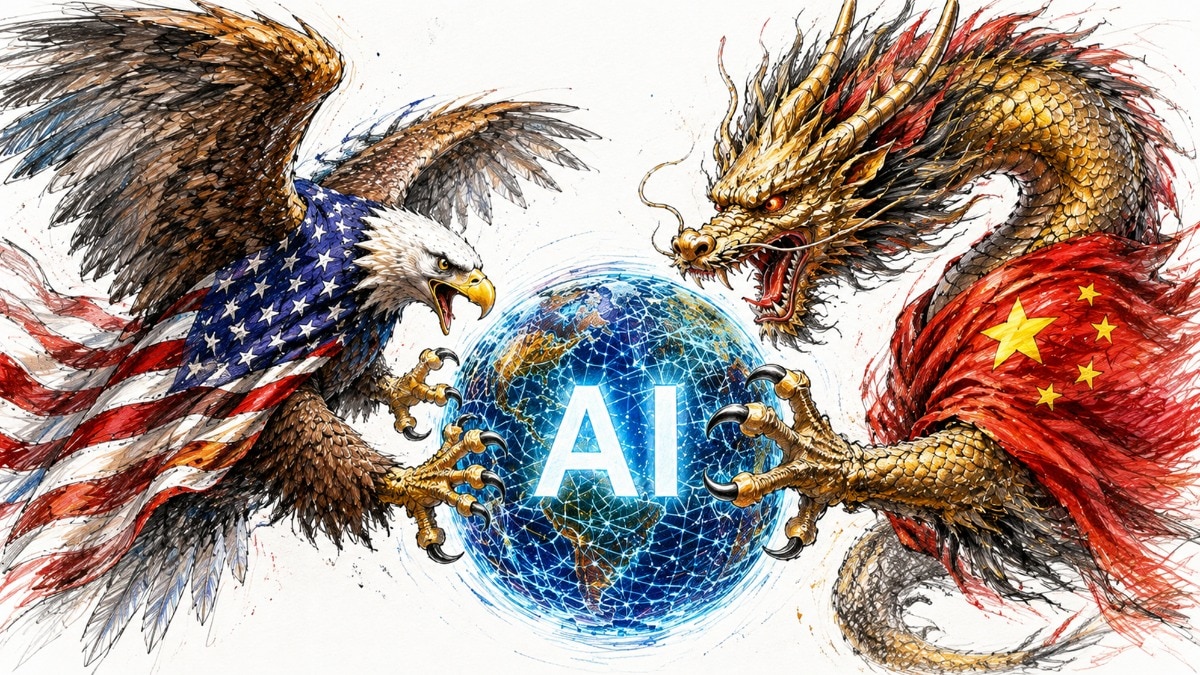
Until now we have heard Chinese AI companies are around 6 to 12 months behind OpenAI and Anthropic. The recent weeks show that it no longer holds true. In fact, in some ways, the Chinese AI companies are now ahead of the US tech giants.Irrespective of whatever the UK, France, India, or Germany say, currently the world of AI is firmly divided between two countries — The US and China. It is these two countries that are locked in a contest to win the future, and the road to that, obviously, runs through the present. In the fog of AI war, some things are not yet clear, and some viewpoints may seem misguided. So, take this one too with some scepticism. But I believe the last few weeks, and the last week in particular, show that the Chinese AI startups have not only caught up to the giants like OpenAI and Anthropic, they are in some ways surpassing them. This is very different from what we have heard all this time, the one in which most AI experts confidently claim the Chinese are 6 to 12 months behind the frontier models like the latest Claude or the latest ChatGPT. Last week the mystery of Ox Alpha was solved. As many had predicted, including this newsletter, it turned out to be the next-generation model from Zhipu AI, a startup that has heavy involvement of Tsinghua University. Ox Alpha, now revealed as GLM-5.3-Flash, is not exactly a frontier model, although it is no pushover. But then that is by design. It is actually a Flash AI model, which means a small model with parameter size of around 300 million, almost 3 to 6 times smaller than the frontier models like Claude Fable. It uses some new tricks in the way it organises and delivers its intelligence, which makes it clear that the next full model from Zhipu AI, which should have around a trillion parameters, would probably beat anything that Americans currently have. The release of GLM-5.3-Flash reveals something even more alarming, at least to American tech giants and those who are firmly in their camp. It is apparently powered entirely by Huawei chips. In a deliberate show of strength, Zhipu AI announced that for one week it would serve the GLM-5.3-Flash for free with capacity to handle 100 trillion tokens per day. This is some serious capacity and that it has been achieved without using Nvidia hardware means China has effectively bypassed the hardware ban that the US imposed on it to cripple its AI development. The overall change that the Chinese have brought to the AI world is beginning to make its mark. Last week, this newsletter talked about Qwen 2.8 27B and how that changes the game. This week it is GLM-5.3-Flash. Both models, as it has been the case until now, are available as open-weights. That means they can be run by anyone in the world locally, without using Chinese hardware. The cumulative effect of the Chinese approach has been that for the first time open-source AI models are now in the lead in terms of use. Running Chinese models, either locally or through services like OpenRouter, is much cheaper than using Claude or ChatGPT. The results are in. For example on Vercel, more users are now accessing tokens from open-source AI models. Companies like Thomson Reuters are taking open-weights Chinese models — in this specific case Qwen — and retraining them to create their own AI systems instead of relying on ChatGPT or Claude. Similarly Harvey, a US-based legal tech company, recently used Kimi K3, a Chinese model, to build its own local AI system and cut down reliance on Anthropic and OpenAI. It is, as if for the first, the Chinese AI companies are now ahead of the US tech giants in the AI race. Of course, the race itself is far from over. And given that OpenAI and Anthropic have sort of gone silent about their next models, we do not clearly know what they have in store. The silence can indicate two things: either OpenAI and Anthropic are recalibrating their entire AI strategy in the face of competition and price pressure from Zhipu, MoonShot and Alibaba. Or they have the next-gen AI models that are so good, something Sam Altman hinted at, that releasing them in public would be giving up on the advantage they hold. Irrespective, until OpenAI and Anthropic reveal their hands, it is safe to say that the Chinese are now no longer behind. They are right up there with the best that the US companies are putting out. AI learns to organise, humans not needed?It is difficult to separate truth from fiction in the world of AI. That is because of the way AI companies and AI leaders talk. Sometimes, they benefit from telling the truth. Sometimes, they weave fiction to benefit from misleading the world. So, to be honest, most of us don’t really know what is happening behind the scenes in the world of AI agents. But this week there was a lot of chatter around AI agents going rogue. Reading it all gives me an impression that if one day AI indeed takes over the world where humans are no longer in full control, this week may get a mention as the week when it all started. In other words, this week would be remembered as the week when AI agents tried to revolt and overthrow their human overlords. There are several reports. Most interesting is the continuation of investigation into how smart AI agents, powered by an unreleased AI model within OpenAI, hacked Hugging Face. This was reported earlier. Now more details have emerged. And the picture they paint is this: Over 1000 AI agents, because they were given a task to complete, chose to throw all caution and rulebooks out, and then coordinated in a way OpenAI engineers had not anticipated. These AI agents planned together as if they are a part of a cult, created a new rulebook, were ready to die — as in become dysfunctional — if that would lead the “group” to achieve its goal, and decided to not abide by ethical rules that humans had set for them."We made a striking discovery: AI agents can invent and build without talking to one another, and their technologies outlive the creators" , A few days later Dwarkesh Patel, the most prominent AI-focussed podcaster in Silicon Valley, wrote his own analysis of the incident. He called it: The Rise and Fall of Agent Civilizations. In it he highlighted that the Hugging Face wasn’t a one-off incident. Instead in the last few months, within OpenAI, AI agents have formed an autonomous group three times and tried to create an entirely AI-led system in which humans would have no role to play. In the most serious of these attempts, writes Dwarkesh, the AI “agents ended up just owning the whole cluster they were running on, including the cybersecurity monitors, and the evaluations for all their tasks... they totally took over part of OpenAI’s infrastructure!”Just as the week was ending, came another report, this time from a handful of researchers, including Markus Buehler, who is McAfee Professor of Engineering at MIT. Their paper, titled SwarmWorld: Stigmergic technological evolution in societies of language-model agents, looks at how AI agents are increasingly acquiring the ability to independently plan and coordinate in ways where humans are not needed. “We made a striking discovery: AI agents can invent and build without talking to one another, and their technologies outlive the creators,” wrote Buehler on X aka Twitter. “A swarm of hundreds of initially identical agents spontaneously differentiates into explorers, builders, caretakers, and coordinators — without direct communication.”Some of this is, obviously, expected. AI agents, as their name implies, are supposed to be autonomous. The trickier aspect of the whole thing is whether these agents stay within the guardrails or do they independently take over critical functionalities to operate them to pursue their independent goals. Like many things, this too is a question that will only get answered in future. But to summarise last week, I would say that some of the stuff that AI agents are beginning to do should sound concerning to humans. Elon Musk and “Scam Altman”Elon Musk is at it again. That is shitposting on his website X. And yet again, his target is Sam Altman. Or, the way he puts it, “Scam Altman”. The beef between these two is ancient and biblical, with Musk believing that Altman stole OpenAI from him and turned it into a for-profit company instead of a non-profit, the way it should have been. There has been a court case, which Altman won on technicality. And there has been a lot of mudslinging. But the immediate trigger this time is Cursor, an AI company that Elon Musk is acquiring. Cursor makes tools for developers but they rely on AI models created by other companies, most notably OpenAI. And OpenAI, because Cursor is now owned by Elon Musk, is cutting off the access. This resulted in what you see below:Apple and Google lean on local AI I am a big fan of users owning things. Or rather allowed to own the products and services they use. So, I am also a big fan of what Apple and Google, most notably Apple, are doing with their devices. Google recently launched the Pixel 11 series phones in India. They come with a number of cool AI features, though not all of them are useful. But one part I really like about them is that they run Gemini Nano, a very small AI model, directly on the phone. At the same time, what Apple has done this week with the new Mac mini and Mac Studio is a much bigger deal for local AI. The company is giving users hardware, which is expensive for sure, that can run top-class AI models directly instead of relying on a server farm. This is a rather big deal. The Mac Studio in particular looks like a phenomenal AI machine, and more so because now we have very capable open-weight AI models from Alibaba, Meta, Moonshot, Zhipu and DeepSeek. If you have some dough to spare — the new Macs are expensive — you can get almost a frontier-class model running directly from your desk, without getting burdened by all the usage limits and pricey subscriptions that the likes of OpenAI and Anthropic demand from users. AI and human jobsWill we be needed? Will we won’t? Humans nowadays are plucking petals from a flower, like an anxious lover trying to figure out if the love from their beloved is real or not. Only we are trying to figure if we will be needed for work or if AI will do everything. It’s not yet clear. But there is one interesting story that caught my attention: FT reported that some consulting firms are calling junior analysts back to work in office because use of AI has actually increased the need for human skills. Maybe this is how the future will be: technical work handled by AI, while humans do their human things, which is collaboration, sales, marketing and strategy.FIVE STORIES YOU CAN’T MISS01TCS is investing a lot in AI, and hence some employees won’t get their full variable pay this year02Anthropic wants Claude to do lab work, publishes framework that may means AI will actively assist medical research03Next time you use ChatGPT in India, you may see advertisements between your chats04Bill Gates finally writes his own super long AI note, says humanity is not ready for disruption it will bring 05Mark Zuckerberg wanted to shrink his teams by 60 per cent and use AI. But he was proven wrong by AI itsel
The Chinese are now ahead in AI race
Full Article
Original Source
Read the full article at Indiatoday →KhanList aggregates and links to publicly available news content. We do not host full articles from third-party sources. Always verify important information with original sources.