
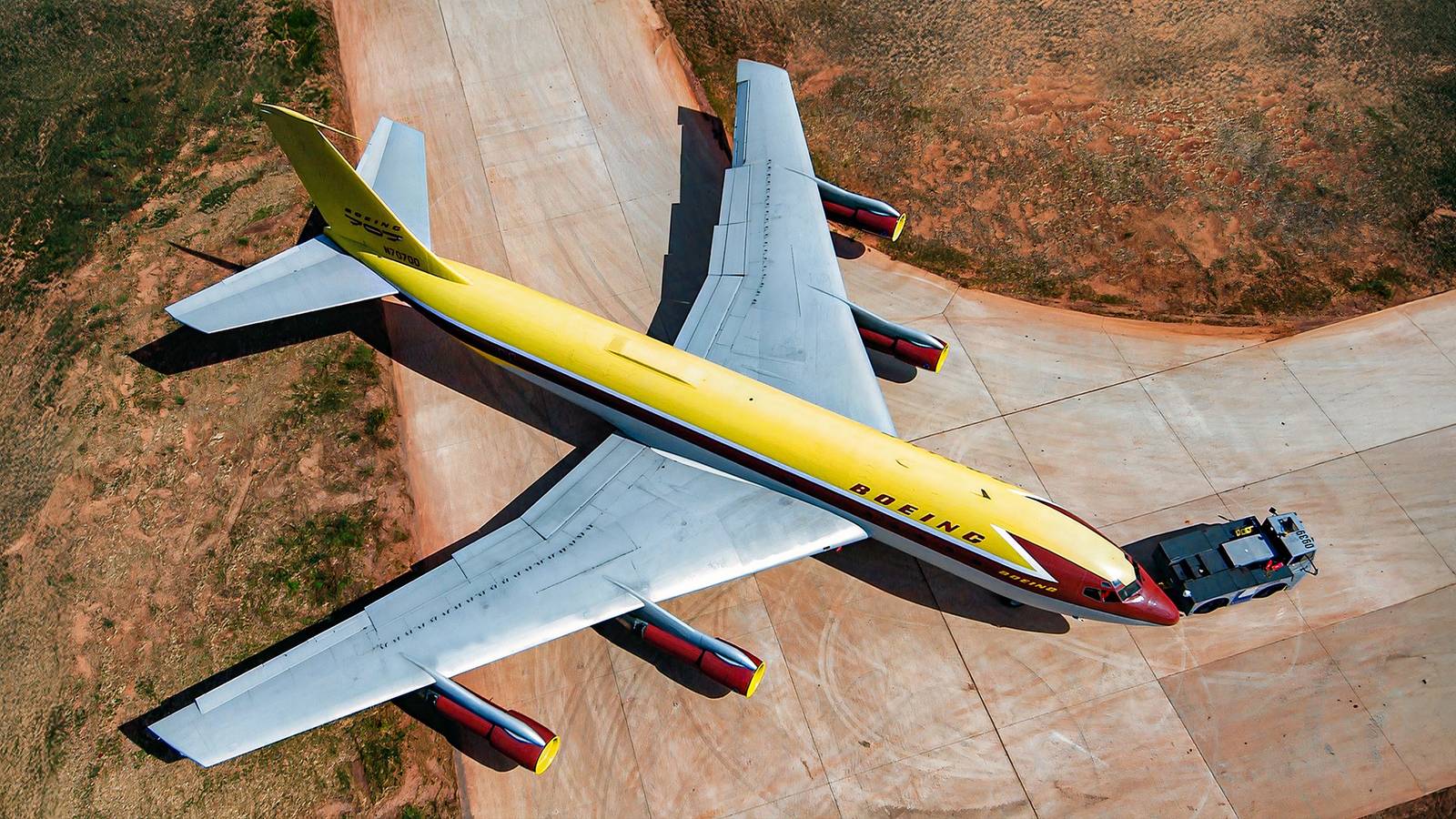
Published Nov 29, 2026, 5:00 PM EST An aviation writer, pilot, and flight operations professional who sees aviation from both sides of the cockpit door. With a background in aeronautics, safety, and human factors, she brings curiosity, firsthand experience, and a love of the details that turn aircraft and airports into stories worth telling. The Boeing 737 MAX can carry up to 230 passengers, burn less fuel than earlier generations and incorporate technology developed long after the first jetliners entered service. Yet its basic fuselage design traces back to a decision Boeing made while developing a much larger aircraft in the 1950s. The result is an unusual piece of aviation history: a modern twin-engine narrowbody still inherits a key structural dimension from the four-engine 707. That connection matters because fuselage width sets boundaries for the cabin long before an airline chooses its seats. Boeing's decision to reuse an established design helped the 737 reach the market more efficiently and gave airlines practical commonality with other aircraft in the manufacturer's range. It also meant that later generations would continue working within a structure conceived for a different period of commercial aviation. To understand why the 737's cabin remains relatively narrow, the story begins with a prototype that was never intended to become an airliner in its own right. How The Dash 80 Led To The 707's Wider Fuselage Credit: Joseph Creamer|Shutterstock Boeing's Model 367-80, known as the Dash 80, first flew on July 15, 1954. The prototype demonstrated the company's approach to jet-powered transport and became the basis for two important aircraft programs: the commercial 707 and the military KC-135 tanker. Although the aircraft shared a common origin, their different roles required distinct production designs. The Dash 80's fuselage measured about 132 inches at its widest point, a starting point that would change as Boeing developed a passenger jet. The commercial 707's cabin requirements were shaped by competition and airline expectations. Pan American World Airways (PanAm) President Juan Trippe wanted a jetliner that could carry six passengers across each row, making better use of the cabin than a five-abreast arrangement. Pan Am was also considering Douglas's competing DC-8, which was being designed to accommodate six seats across. Boeing therefore had a commercial reason to widen its aircraft rather than preserve the Dash 80's original dimensions. The resulting 707 fuselage was four inches wider than the prototype's, according to the Smithsonian's National Air and Space Museum. That change established a design principle with consequences far beyond the 707. Boeing carried forward the basic upper fuselage cross-section into subsequent aircraft programs, including the 727 and 737. Although these aircraft had different overall dimensions and structural requirements, retaining an established cabin design reduced the need to develop an entirely new cross-section for every program. The 737 did not inherit its dimensions because the 707 had been designed specifically for short-haul routes. Instead, Boeing adapted an existing design to meet the needs of a smaller aircraft. Why Boeing Carried The 707 Design Into The 737 Credit: Elliott Cowand Jr|Shutterstock The 737 program took shape in the 1960s, when Boeing wanted a short-haul jetliner to complement its larger 707 and 727 models. Rivals such as the Douglas DC-9 and BAC One-Eleven were already targeting the short-haul market, putting pressure on Boeing to deliver an aircraft airlines could use on shorter routes. Developing a completely new airframe would have required substantial design work, so Boeing drew on the engineering and production experience of the 727. The 737 adopted the same basic upper fuselage cross section, helping it fit into an established family of aircraft. Commonality was practical, not merely cosmetic. The shared fuselage arrangement allowed Boeing to carry over cabin fittings and aspects of the cargo-handling design, while other common features reduced the work required to create a new aircraft. Boeing also retained a six-abreast passenger layout, giving the 737 a capacity advantage over competitors that used five seats across. The 737 was not a copy of the 727: it had two engines mounted beneath the wings rather than three engines at the rear, and its landing gear and lower fuselage were designed around the smaller aircraft's requirements. The shared upper section was one part of a wider strategy to use established engineering wherever it made sense. Aircraft Design Connection Why It Matters Boeing 707 Established the wider passenger fuselage that accommodated six-abreast seating. Responded to airline demand for greater passenger capacity per row. Boeing 727 Carried forward the established upper fuselage cross-section in a three-engine design. Extended Boeing's existing cabin architecture into a different aircraft category. Boeing 737 Adapted the established cross-section for a smaller, twin-engine jetliner. Allowed the aircraft family to evolve across generations without a completely new cabin design. The 737's original design therefore combined new decisions with inherited ones. Boeing needed an aircraft suited to short routes, quick turnarounds and airline economics, but it did not need to reinvent every aspect of the cabin structure to achieve that goal. The result was a platform that could evolve through multiple generations while preserving a familiar basic cross-section. That continuity helped Boeing develop the aircraft family, but it also raises a distinction that's easy to miss when the 737's dimensions are discussed today: the width of the outer fuselage is not the same as the space passengers actually have inside. Why External Fuselage Width Does Not Equal Seat Width Credit: Ian Dewar Photography|Shutterstock The 148-inch figure often associated with the 737 refers to the approximate external diameter of its fuselage, not the width of the passenger cabin. The distinction is important because the aircraft's outer skin is only one part of the structure. Frames, insulation, interior sidewalls, and other fittings occupy space inside the fuselage, leaving a smaller usable cabin width. The aisle and armrests also take up room between and around the seats. As a result, an aircraft's external diameter cannot be used alone to calculate the width of an economy seat. The cabin cross-section influences how airlines arrange six seats across a row, but it does not dictate one universal seat width. Seat manufacturers produce different models, and airlines choose layouts to suit their commercial and service requirements. Armrest dimensions, seat contours, and the space allocated to the aisle can also affect the final measurement. Many 737 economy cabins use seats around 17 inches wide, but that should be treated as a general description rather than a guaranteed figure for every 737, operator, or seating product. The Airbus A320 family provides a useful comparison because Airbus advertises 18-inch-wide seats as part of its Airspace cabin offering. The wider fuselage provides additional flexibility when arranging seats, aisles and cabin fittings. However, the advertised seat width should not be interpreted as a standard measurement across every A320-family aircraft operated by every airline. Cabin layouts and seat models vary, so passengers should check the configuration of their specific flight rather than assume that every A320 seat is wider than every 737 seat. The underlying fuselage dimensions help explain the differences in design flexibility, while airline configuration determines how that space is used in service. How The 737 MAX Adds Seats Without Getting Wider Credit: BlueBarronPhoto|Shutterstock Boeing has developed the 737 through successive generations, introducing changes to engines, aerodynamics, flight deck systems, and cabin equipment while retaining the basic fuselage architecture. The 737 MAX continues that pattern. Its CFM International LEAP-1B engines and updated systems distinguish it from earlier versions, but those improvements do not require Boeing to create a substantially wider body. Keeping the established cross section allows the aircraft to remain part of the 737 family rather than becoming a completely new design. The 737 MAX 10 demonstrates how Boeing can increase passenger capacity within the existing design. Boeing lists the aircraft at 43.8 meters long, or 143 feet 8 inches, with a maximum seating capacity of 230 passengers. Its published two-class seating range is 185 to 210 passengers. The MAX 10's longer fuselage allows airlines to add cabin rows, depending on their chosen configuration, without substantially changing the aircraft's basic width. The maximum seating figure represents a high-density configuration rather than the layout every airline will use. That difference between length and width is central to understanding the 737's evolution. A longer fuselage adds room along the cabin, while a wider one changes the cross-section and affects the aircraft's underlying structure. Boeing can therefore increase the number of passengers carried by extending the existing design, but that does not automatically create more lateral space for each seat. The MAX 10 is an example of capacity growth within a familiar platform, not evidence that the aircraft has escaped the dimensional limits inherited from the earlier 737 models. Why A Wider 737 Would Require Major Redesign Work Credit: Ian Deward Photography|Shutterstock A wider passenger cabin would require changes beyond the interior fittings. The fuselage is a pressurized structural shell, and its cross section influences the arrangement of frames, floor structure, systems and cabin components. A substantial increase in width would therefore affect the design of the aircraft's body, as well as manufacturing processes and the work needed to demonstrate compliance with certification requirements. It would not be equivalent to replacing the seats or adjusting the sidewalls on an aircraft already in production. The commercial case would also need to be strong enough to justify the work. A wider cabin could give an airline more flexibility in arranging seats and aisles, but developing a new fuselage would require engineering resources, production investment, and a certification program. The resulting aircraft would also need to meet airline requirements for operating costs, capacity and performance. Extending an established model can be less disruptive than developing an entirely new aircraft, provided the existing design continues to meet the market's needs. This is where the 737's historical advantage becomes a long-term design constraint. The same continuity that helped Boeing build on existing engineering and manufacturing experience also limits how much the cabin cross-section can change without substantial redesign work. A wider successor remains possible, but it would require a different structural approach rather than a minor interior upgrade. Whether Boeing eventually pursues that direction will depend on its future aircraft-development decisions and the commercial case for a new design. What To Watch As Boeing Develops Its Narrowbody Strategy Credit: MC MEDIASTUDIO|Shutterstock The 737's long production history illustrates why aircraft manufacturers often preserve established structural designs across generations. Reusing an existing platform allows improvements to engines, systems, and cabin equipment without requiring a completely new airframe. Boeing has applied that approach to the 737, developing a family that includes the MAX 10 while retaining the basic fuselage architecture established by earlier models. The most meaningful evidence of a future change would be a confirmed aircraft-development program, an official design announcement, or published technical specifications. Until Boeing provides that information, claims about a successor's cabin width, seat dimensions, or entry-into-service date should not be treated as established facts. The MAX 10's published specifications describe the current design, not an announced replacement strategy. For passengers, the distinction between an updated aircraft and a fundamentally new design is significant. New engines and systems can improve performance without changing the cabin shape. The 737's dimensions reflect decisions made decades ago, when Boeing adapted its first commercial jetliner designs for a growing market. Whether a future narrowbody moves beyond that architecture will depend on whether the benefits of a different fuselage justify the engineering, manufacturing, and certification work required.
The Boeing 737 Still Boasts A Mid-1950s Cabin Design That Was Made For A Quadjet
Full Article
Original Source
Read the full article at Simpleflying →KhanList aggregates and links to publicly available news content. We do not host full articles from third-party sources. Always verify important information with original sources.