
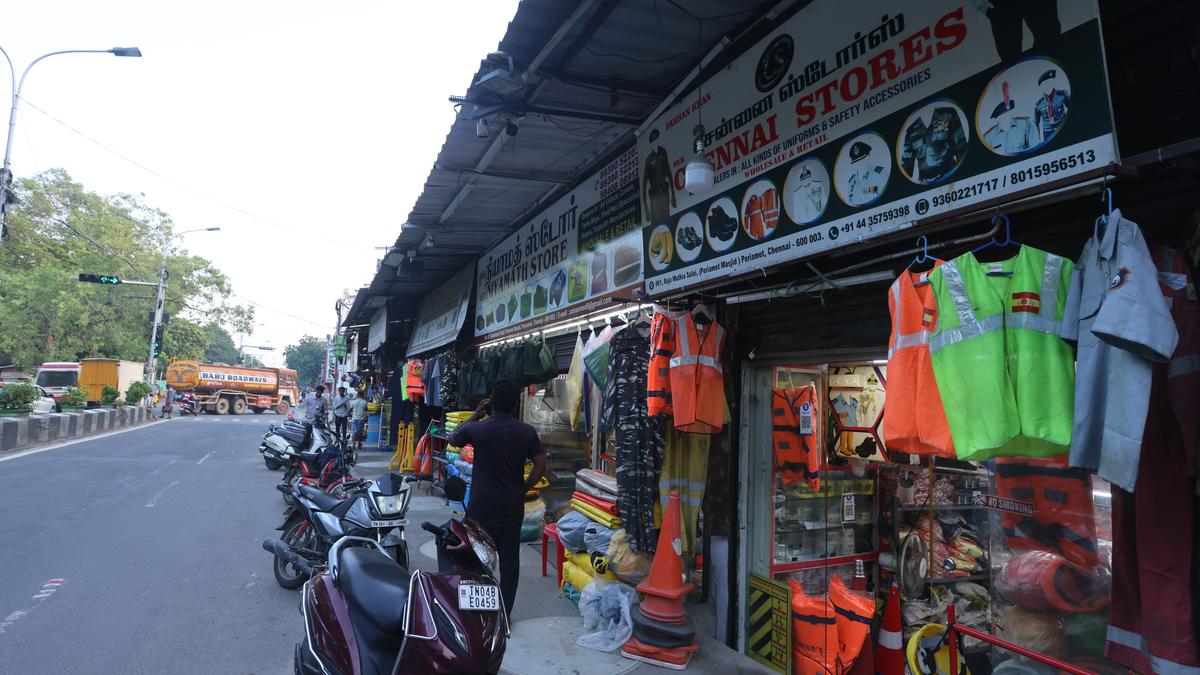
Sydenhams Road in Periamet is the “wardrobe” for blue-collar workers. On this oft-crowded thoroughfare, from the point where the Greater Chennai Corporation’s headquarters (Ripon Building) begins to the point where the Nehru stadium almost ends, around thirty shops, some found in a cluster and others spaced apart, provide passersby with a peek into this wardrobe. There is something for almost every front-line worker under the sun. Uniforms for security personnel; safety jackets for those working amidst traffic; safety helmets for construction workers; gear tailored for housekeeping staff and conservancy workers; shoes, boots, caps and belts associated with the police force; general caps; and laboratory coats. Let not that “and” hoodwink the reader into thinking this list is exhaustive. It hardly is. Bulk orders placed by corporates, government agencies, education institutions and construction companies, among others, as well as individual purchases sustain this business. And for novelty, orders sometimes fly in from cricket leagues and franchises. Some of these enterprises operate from shops built into the Periamet mosque which was established in 1838 by hides and skins dealers. | Photo Credit: SPECIAL ARRANGEMENT This visual side of Sydenhams Road is familiar for old timers, and it remains its dominant feature. For the superficial eye, little has changed. Can that be said about the eye that has been taking in this “scenery”, day in day out, for years, and even decades? Has anything in the market shifted significantly? As it was established in 1945, United Uniform is probably at an advantage while taking that question. It operates from a shop built into the historic Periamet mosque, established in 1838 by hides and skins traders. After Independence, the mosque would go through two reconstruction exercises, and that would give birth to these shops, partly defining the lower reaches of the mosque on one side. Kahifullah Khan, the third-generation owner of United Uniform, observes this shop was constructed in 1956. At that time, United Uniform was functioning from what was called ‘Red Building’ in Moore Market with the founder and Kahifullah’s grandfather, Hafizullah Khan at the helm.Kahifullah recalls that the enterprise shifted to its current location in the early 1980s following the much-discussed Moore Market fire, an event that led to the scattering of Moore Market traders dealing in various goods to the nooks and crannies of Madras. Corporates and government agencies are among those that place bulk orders for specific types of uniforms, with these shops at Sydenham's Road in Periamet. | Photo Credit: SPECIAL ARRANGEMENT On the question of changes, Kahifullah draws attention to the facade of his shop and those of others in the mosque complex. These shops are noticeably below road level, even coming across as basement shops. With a barely concealed chuckle, he remarks that these shops were once above road level; successive road-laying exercises have got them where they are. In every other aspect, according to him, these small enterprises constituting a segment of the unauthorised sector have been on an upward trajectory.“There are now more shops in this line of business than ever before,” states Kahifullah, adding the changes have had to do with the major buyers’ mindset, and thankfully, meeting those new expectations is hardly a tough ask. On the dominant category sold by these shops through the decades, Kahfullah points out that in the 1980s, the focus was largely on police-related products, and then a shift happened, with greater attention now being accorded to medical items, the coats, then NCC and Scouts uniforms and accessories. From the 2010s, safety gear is the major grosser: safety shoes, jackets and helmets easily constitute the highest-selling category, he states. Yet another noticeable shift has to do with the choice of material for the making of shoes. Around 15 to 17 years ago, the scales tipped in favour of rexine over leather. And Kahifullah believes this change has been driven primarily by “large-scale manufacturing of rexine in Gujarat and Haryana. Some people even import rexine from Korea and China.” A few shops have the description “cap mart” in their name, though their product line is diverse. Quraishi of Khaleel Cap Mart points out that the name ‘Cap Mart’ is a reminder of those early years, when the shop specialised in caps, from turbans and Muslim prayer caps or Kufis to Kashmiri caps. This specialisation was largely driven by the presence of the Periamet mosque. Khaleel Cap Mart operates from a shop in the mosque. | Photo Credit: SPECIAL ARRANGEMENT If one parsed through the resilience of these shops, one factor emerges strongly, a bond that goes beyond a common trade. Kahifullah puts a ballpark number on the shops in this line of business on Sydenhams road, thirty-five, and adds that out of that, around 90 per cent of them are run by those that are part of his extended family. He admits there is competitive pricing, but there is also cooperation. In this climate, sourcing items not in one’s stock from others is possible. One senses a strong sense of connection and continuity best epitomised by Kahifullah himself. He is essentially a techie, having had a long stint in the IT industry, and he peeled himself from it to keep a family legacy going. He joined this business four years ago following his father Shafiullah’s death in 2022. The narrative about connections and continuity gains greater ground as more conversations are initiated with these tradespeople. At Khaleel Cap Mart, a misnomer, as they sell uniforms and accessories in addition to caps, Quraishi, 45, who first came to the shop at age 12 during his school days, remarks that the name ‘Cap Mart’ is a reminder of those early years. The shop originally specialised in caps, from turbans and Muslim prayer caps or Kufis to Kashmiri caps. As customer requirements changed. So did the shop’s inventory. One of the shop’s most distinctive products is not necessarily the most conspicuous. Its cotton mosquito nets are made in the traditional way and remain popular among police personnel at various police residential quarters. Depending on the bed type, they cost between ₹500 and ₹1,500. Started by Khaleel Ur Rahman, the shop is now run by Quraishi and his brother Nayeem. Quraishi echoes Kahifullah’s sentiment that this business is on an even keel. Speaking for the tradespeople in his line of business on Sydenhams Road, Quraishi observes digital buying has left no dent in their business. “Individuals might buy a cap online; for bulk orders, they come to us.”(Old Markets, New Trends is a column that features markets that have continued to retain their hold on people’s mind space despite the shifting sands of fads. Through entities that have been around for a long time, it seeks to find out what makes these markets tick)
The Blue Collar Uniform Hub of Chennai aligns with the times and grows bigger
Full Article
Original Source
Read the full article at Thehindu →KhanList aggregates and links to publicly available news content. We do not host full articles from third-party sources. Always verify important information with original sources.