
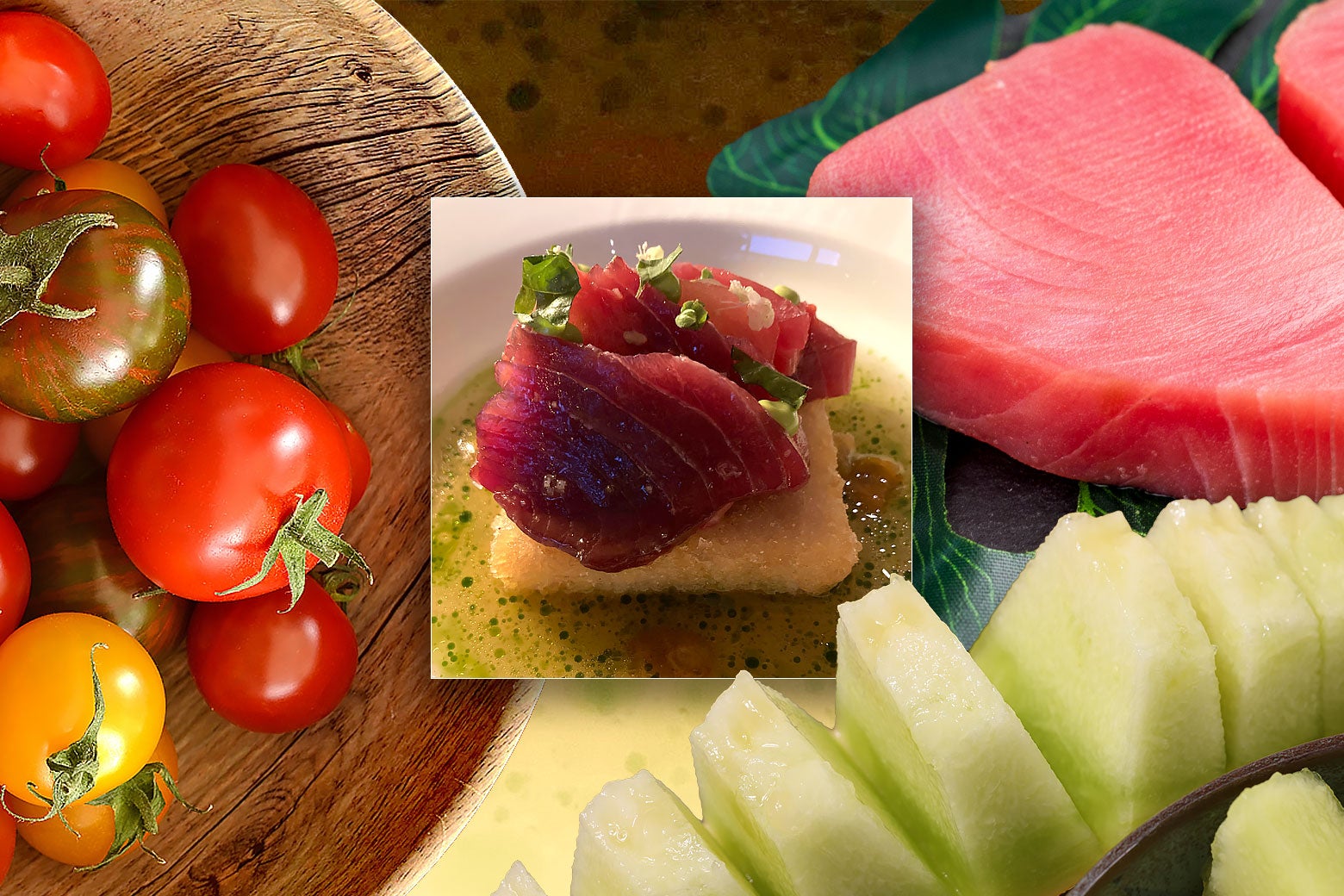
Food If you’ve never had “tomato water” before, you’re in for a treat. Sign up for the Slatest to get the most insightful analysis, criticism, and advice out there, delivered to your inbox daily. At the La Jolla restaurant Fleurette, I sat at the bar and listened to the man beside me speak highly about his burger and the truffle that he’d opted to have grated atop the patty. The bartender, meanwhile, couldn’t stop singing the praises of the spot prawn special on the menu, explaining how Fleurette and Callie, Chef Travis Swikard’s two restaurants, were the only places in all of San Diego County to offer this type of shrimp on its menus. The fisherman, I was told, was the only one in the county with a spot prawn license and delivered his entire haul—a few hundred prawns each week—exclusively to Swikard. But while everyone gave kudos to burgers and shrimp, I felt that, after one bite, I had ordered the best dish of the lot. Simple elements, common ingredients, and yet I’d never seen them combined on a plate before. The whole appeared so meant-to-be that every chef—even regular home chefs—could replicate it with relative ease. And you ought to try. As the seasons begin to change over the course of this month, this is the perfect dish to celebrate the last of summer’s warmth with some of its loveliest flavors. Before I get into how you can make a straightforward version of this gem of a plate—which I’ll generalize to calling Fish Crudo with Melon and Tomato Water (that’s right!)—allow me to share how I’ve seen it interpreted by the professionals. When Swikard’s “Bluefin Crudo” was set before me, I studied the thick, ruby red cuts of raw Bluefin tuna layered over thin watermelon slices. The melon looked almost identical to the fish. The pair was fanned out over a fried rice cake that sat like a raft in tomato water (more on this later). In all the red were little bits of green: micro greens, dots of avocado cream, pearls of basil oil afloat in the tomato sea. The sweet watermelon had elements of salt and citrus, the tuna was rich and buttery, and the fresh, tart, and spicy tomato water brought balance. Swikard had been inspired by acqua pazza, an Italian dish that translates to “crazy water,” where fish is traditionally poached in tomato sauce that’s less thick than, say, a marinara. “When I build a dish it’s about taste, texture, aroma,” Swikard told me. “It’s a balance of flavors.” This preparation even involved sleight of hand. Swikard, wanting to make the watermelon slices look, taste, and feel like tuna, compressed them for 45 minutes with yuzu and Colatura di alici, an Italian fermented fish sauce made by aging anchovies for three years. As a result, the watermelon took on the tastes, textures, and aroma of tuna. The chef hardly manipulates the tuna itself, though he of course sources high-quality fish. But he does take that extra chef-y step, curing the Bluefin by layering it between sheets of kombu for four hours. This helps to bring out those natural umami flavors. Otherwise, the tuna is untouched and gains much of its seasoning from its proximity to the melon. Swikard, it turned out, wasn’t the only chef playing with this trio. The next day, I had traveled to the northern edge of San Diego County for my midday reservation at Atelier Manna. When I was handed the menu, once more I found fish, melon, and tomato water. Yet Chef Andrew Bachelier’s version was entirely different. The fish, Hamachi; the melon, honeydew; the tomato water, green. Instead of a white raft in a world of red, the entire pale-green, off-white trio was hidden beneath some circular, green-tinted tomato gelatin dotted with whitish, whipped tofu, and miniature purple flowers or orange marigold petals adhering to each dot. Bachelier’s take was just as brilliant. And if someone in his kitchen had forgotten to add the crown—the gelatin, tofu, and flowers—it would still have been just as marvelous. (That’s good news for you, home chef, as you can skip that top layer completely.) How could three simple ingredients that require no heat and basic kitchen implements not be on every menu? That includes yours. While the specific fish you choose will vary depending on your location and access, you should generally search for something labeled sushi-grade. Or you can ask your local fishmonger for his freshest recommendation. Tell him or her that you’re making crudo. Chilling your fish in the freezer for 15 minutes can aid your knife in creating clean, thin slices, and take care of unwanted bacteria. As for the melon, just look for what’s ripe, ideally local, and will pair nicely with the fish you’ve chosen. If Swikard’s watermelon treatment sounded appealing to you, but you’ve no yuzu growing in your chef’s garden, blend some lemon and lime juice in equal parts and use that as a marinade. And you can replace the Italian fish sauce with some of the more readily-available Asian kind. The most time-consuming step in this recipe is making the tomato water, though it’s by far the easiest. The slightly fancy version, following Swikard, is simply a puree of tomato scraps and stems, garlic, shallots, and serrano chilies that goes into a cheese cloth overnight. But you could also get away with pureeing just the tomatoes (any juicy, flavorful variety will do) and straining the result through a cheese cloth or a fine sieve. From there, gravity does all the work and extracts the tomato water. In the end, a mostly clear water with an abundance of flavor collects in a bowl, ready to complement your melon and fish—you’ll just want to season it gently with a little salt. If you want all the other fine touches like avocado cream, basil oil, and fried rice cakes, I’ll let you read a cookbook, though you can certainly spruce things up with some fresh basil or lemon and lime zest. But even without them, you, adventurous home chef, will experience some near-equivalent joys by focusing on the three key elements. Tuna and watermelon season are ending soon and Swikard will pull his “Bluefin Crudo” from his menu. When he told me the bad news, I demanded an alternative. He quickly thought up a late-summer, early-fall version that would implement in-season melons and fish still nipping at bait. The dish he invented on the spot, in fact, was quite similar to Bachelier’s: kampachi, green melon, and green tomato water infused with lime and lemongrass. “That’s where my mind goes,” Swikard said. As your tomatoes pile up in bowls at home; as those melons go on sale for end of summer holidays and barbecues; as friends reel in their lines one last time before turkeys are on everyone’s mind, I suggest you gather your ingredients and try this recipe. It will not disappoint. Cooking Food Summer
The Best Possible Dish for September Has Three Simple Ingredients. Don’t Miss It.
Full Article
Original Source
Read the full article at Slate →KhanList aggregates and links to publicly available news content. We do not host full articles from third-party sources. Always verify important information with original sources.