
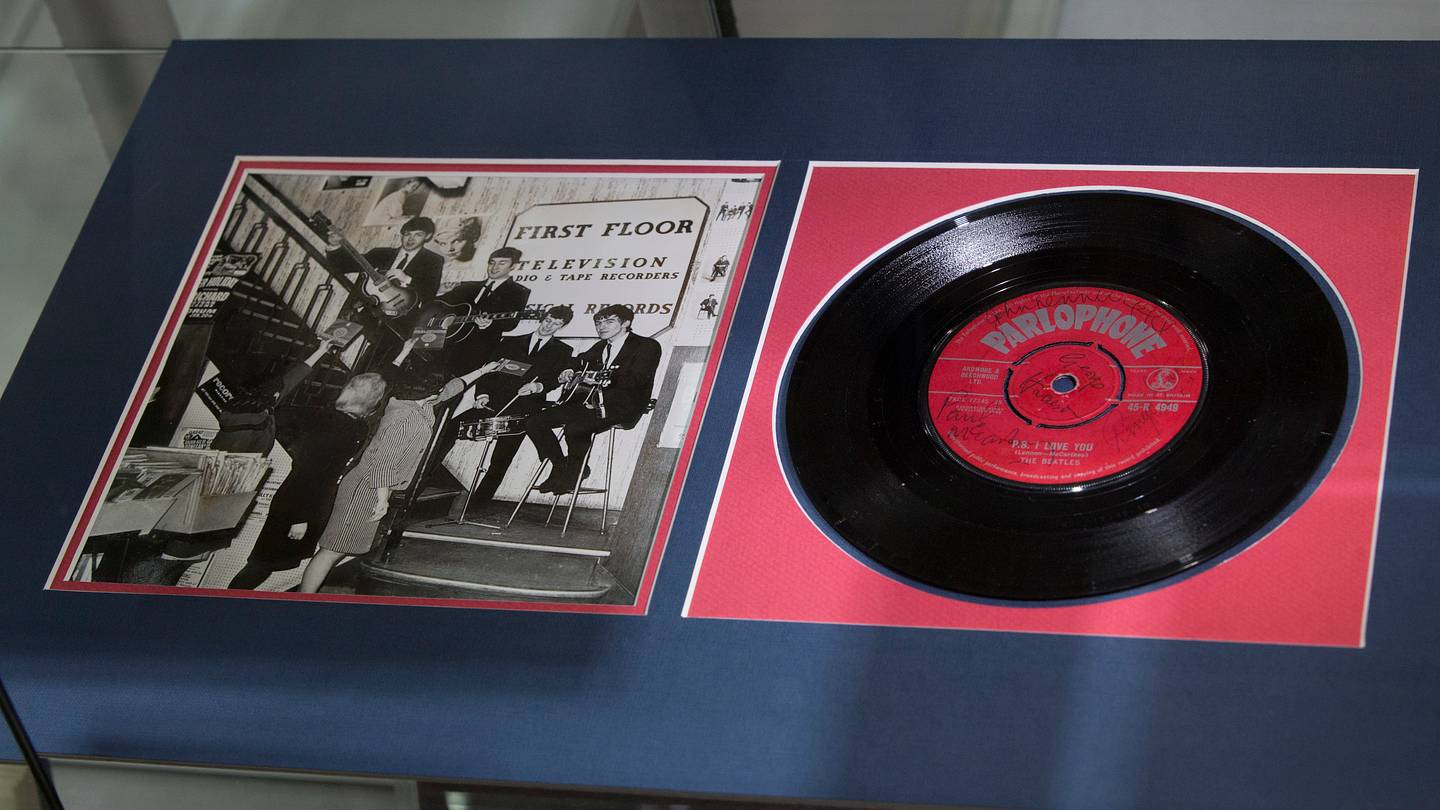
The Beatles made their first single three separate times in 1962, and on each of those three days a different man was sitting behind the drums. This is not a fan theory anyone had to reconstruct: the liner notes on the band's own Anthology state it flatly that "The Beatles recorded Love Me Do three times in 1962 – on 6 June, and 4 and 11 September 1962 – on each occasion with a different drummer."The Lost Pete Best SessionPete Best (center) behind the drums with the Beatles in early 1962, months before his sudden firing. | Mark Hayward Archive/GettyImagesThe first attempt came on Wednesday, June 6, 1962, in Studio Two at EMI's studios on Abbey Road, with Pete Best on the kit. George Martin, the Parlophone A&R man who had agreed to meet the group on the reasoning that he had nothing to lose, got four songs onto tape that night: "Besame Mucho," "Love Me Do," "P.S. I Love You" and "Ask Me Why." None of the four was released, and only two of them survived in EMI's vaults at all, which meant that the "Love Me Do" recorded that evening—slower than the one you know, with John Lennon's harmonica opening it—sat unheard by anybody outside the building for the next three decades.Ten weeks later, Best was gone. On the morning of August 16, road manager Neil Aspinall drove him into Liverpool and dropped him in Whitechapel, and at 10 o'clock Brian Epstein delivered the news in his office above the NEMS record shop: "The boys want you out and Ringo in." When Best asked why, Epstein gave him two reasons, and they were the same reason twice. "They don't think you're a good enough drummer, Pete," he said. "And George Martin doesn't think you're a good enough drummer."Ringo Starr vs. Andy WhiteRingo Starr's first session with the band came on September 4, by which point the contract was signed—"By this time we did have a contract," Paul McCartney said later—and the group put down around fifteen takes of the backing track. Martin made one call in the room that outlasted the day: Lennon could not sing the words "love me do" with a harmonica in his mouth, so the line went to McCartney, and his nervousness at being handed it is audible on the finished record.A week after that, Martin hired a professional. Andy White, a session drummer already booked for the date, was at Abbey Road when the Beatles turned up on September 11, and Ringo—four weeks into the job—was handed a tambourine and told to shake it. White was paid a flat fee of £5 15s, collected no royalties then or ever, and barely registered the man he had displaced. "Ringo and I didn't have much between us, all my time was taken up learning the routines, and he was playing the tambourines so he was only there for the take," he told the Daily Record. The Beatles' own Anthology notes that the substitution "came as quite a shock" to the band and especially to Ringo, and that it was the only time in the group's career that he was replaced this way.Two Labels and a TambourineRingo Starr on drums with the Beatles in 1962. | Keystone-France/GettyImagesBoth September recordings went out on records: when Parlophone released "Love Me Do" backed with "P.S. I Love You" on October 5, 1962, the label was red, and the drummer was Ringo. Later pressings switched to a black label and carried the September 11 recording with White on drums, and that is also the version on the Please Please Me album. The tambourine is the tell, because it is not on the September 4 take at all: hear one, and you are hearing Ringo play the drums; hear the other, and he is standing off to the side keeping time on a piece of jingling tin. The single reached No. 17 in Britain, which Aspinall thought was no small thing—"They'd sold a lot of records for 'Love Me Do' to get to Number Seventeen, which was great for a Liverpool band – they'd made the charts!"Best's version turned up in 1994 and was released for the first time on Anthology 1 on November 20, 1995. The other two have been circulating side by side long enough to fool the people who made them: in 2012 EMI pressed a 50th-anniversary replica of the original single and put the Andy White album version on it instead of the red-label Ringo take. Apple withdrew the record and ordered the remaining stock destroyed.More Like This:
The Beatles Recorded Their First Single With Three Different Drummers
Full Article
Original Source
Read the full article at Mentalfloss →KhanList aggregates and links to publicly available news content. We do not host full articles from third-party sources. Always verify important information with original sources.