
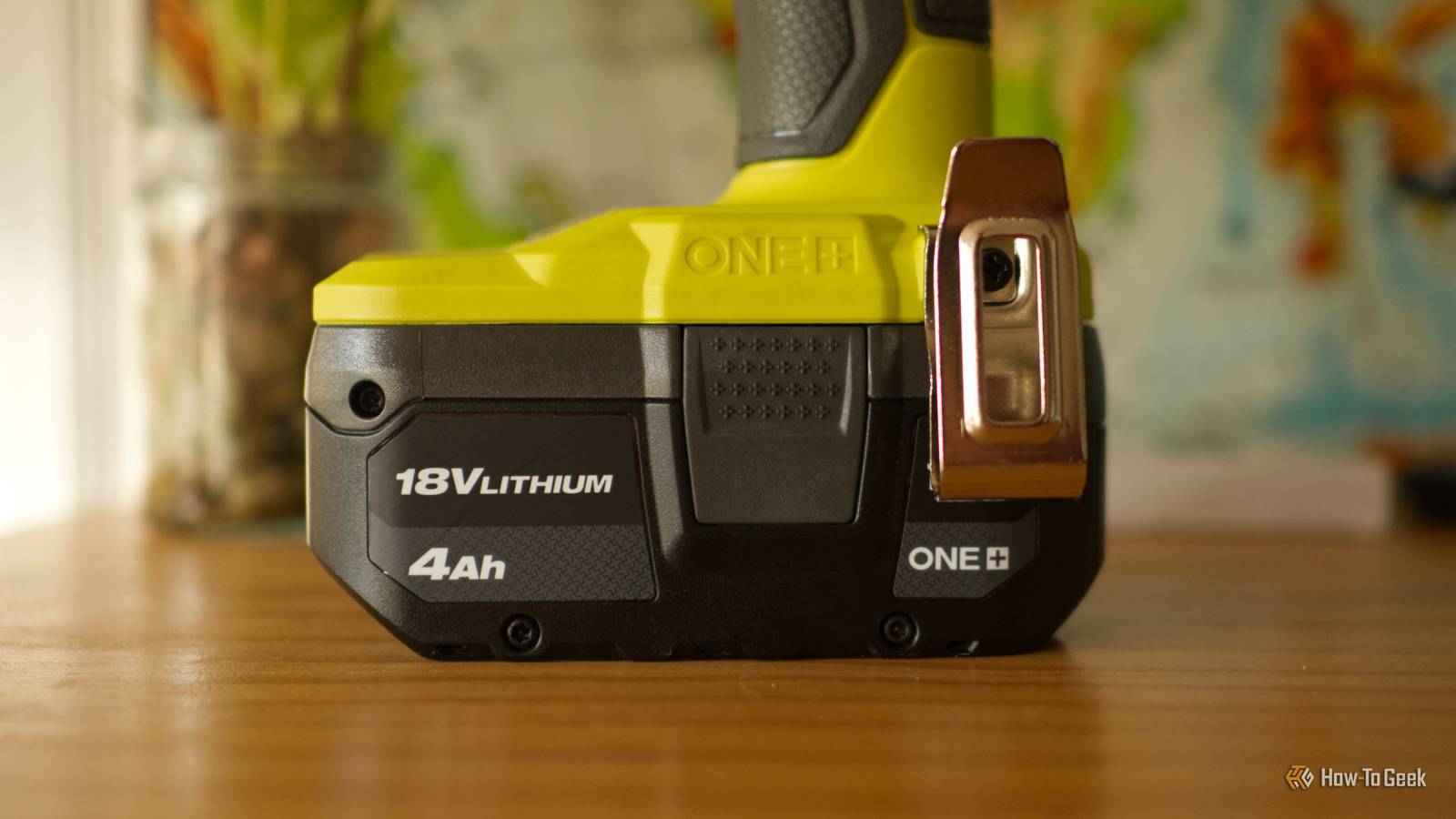
Published Sep 24, 2026, 6:00 AM EDT Cory Gunther is a senior author and Newsletter Editor at Valnet, covering cutting-edge tech, Android, and more for How-To Geek. He's covered Android, cars, and technology for over a decade. When he's not reviewing the latest gadget, you can find him off-roading in his Toyota truck, fixing said truck, or doing something outdoors with friends and family. He's covered CES, SEMA, and MWC and reviewed countless phones, TVs, speakers, EVs, e-bikes, and more. Before Valnet, Cory worked for GottaBeMobile. His writing has also appeared on SlashGear, InputMag, and AndroidCentral. He's written over 9,000 articles. We all love our cordless power tools, especially with how easy it is to snap on a battery and get to work. And even though many of us own several tools from big names like Ryobi or Milwaukee, knowing which battery pack is the best one to buy or use is still somewhat confusing. That's by design, and here's the battery spec that neither brand puts on the box or label. Power tool battery packs are the best and worst part of these tools. They deliver cordless convenience, tons of power, and recharge quickly. However, they're also wildly expensive, the different Ah ratings or branding are often highly confusing, and some folks might not know the difference between a regular battery and a High-Performance or FORGE model. Once you've chosen the right tool for the job, you'll also want to reach for the ideal battery pack. Here's what the label secretly does and doesn't tell you. Internal cell configuration, type, and size Power tool battery technology is advancing, but you might be missing out Most of the time, buying a bigger Ah battery from Ryobi or Milwaukee doesn't mean more power; it just means the tool will run longer. Think of the Ah rating like your car's gas tank. While that rating is clearly displayed on the box and your battery's label, a few important specs are completely missing. One is the low-voltage protection system, which is wildly important if you use powerful tools or battery adapters, and the other one is the internal cell configuration and type. I mainly want to talk about the cells on the inside, as they're a pretty big deal these days. As for voltage protection, Ryobi packs feature an internal battery management system (BMS) that cuts power entirely when the voltage drops too low, and the battery is about to run out of juice. This protects your expensive battery packs. Milwaukee lets the tool's electronic control board control the low-voltage cutoff. If you use an adapter to power an off-brand tool, you can easily run your battery down to zero, permanently ruining it. Keep that in mind. Credit: Milwaukee However, the important specification that Milwaukee and Ryobi don't make very clear is the cell type, configuration, and size. You've probably seen Milwaukee's expensive new "FORGE" battery packs over the last 2–3 years. If you don't do a little research, you'd see the high price tag at Home Depot and grab a more affordable model. The same thing applies to Ryobi's newer "EDGE" battery packs. Why spend $150 or more on a Ryobi 4Ah EDGE battery when you can get a regular 4Ah battery on sale for $89? The secret is on the inside, and that Edge branding is the only thing that tells you something is different. See, Milwaukee and Ryobi's FORGE and EDGE battery packs both have several upgrades on the inside. Without getting too technical or in the weeds, there are two big changes. The first is the use of 21700 cells vs. the old-school 18650 battery cells from older battery packs like Redlithium or Ryobi HP. The new 21700 cells are more powerful, more compact, and have an increased runtime. That's why Ryobi's 4Ah EDGE battery is smaller than a regular 4Ah, and the same goes for Milwaukee's FORGE packs. The second and most important change is a new tabless design. On older models, like a normal 18V ONE+ battery or a regular Milwaukee 6Ah XC, the rolled-up energy sheets on each internal cell had a single metal strip, called a tab, to conduct electricity and power. Each battery has between 5 and 20 of those 18650 cells, and each one has a tab. Newer tabless battery technology found on EDGE and FORGE packs turns the entire side of the battery that's rolled up into a single massive pathway for conducting energy and power. Essentially, this is like turning a single-lane road into a 10- or 20-lane highway, if not more. There are no bottlenecks; power is delivered faster, more efficiently, and at cooler operating temperatures. Instead of trying to slowly extract all that power from 5 or so tabs, there are dozens and dozens of ways for that power to flow into your tool to get the job done. That might sound like marketing, but when you put a FORGE or EDGE battery in an existing tool, it's instantly better, more powerful, lasts longer per charge, stays cool to continue operating at ideal levels, and they even recharge faster too. Depending on the tool you're using, Ryobi claims you'll enjoy 30-40% more power and performance while using an EDGE battery, and Milwaukee suggests something similar. That's why they're a big deal, and why these new battery types cost more. Keep in mind that a small old drill won't benefit much, but high-powered tools, impact wrenches, saws, and more will all benefit drastically. Technically, this spec is "on the box" with the Edge and Forge name and branding, but it's not very clear to casual shoppers at their nearby hardware store. Ryobi 18V ONE+ EDGE Battery (4Ah) Ryobi's latest EDGE battery packs are more powerful, compact, run cooler, and charge faster. They're also a bit more expensive. Upgrade your battery and get to work To make things more confusing, Ryobi has regular battery packs often bundled with tools, upgraded "High-Performance" packs that came out in 2018, and now the EDGE models. Those High-Performance battery packs differ from standard batteries by featuring advanced communication terminals, higher-current internal cells, and better heat management to deliver more power under heavy loads. Earlier this year, it scrapped the older type and now labels the "HP" models as 18V Lithium, which it claims will streamline things and reduce confusion. Then, you still have Milwaukee-made batteries labeled CP, XC, HP, etc., which stand for compact, extra capacity, or high performance. At the end of the day, modern battery packs sold by both brands are capable Lithium-ion that'll work great. But if you want the latest and greatest, more power, and a longer runtime, buy Ryobi EDGE or Milwaukee FORGE. Milwaukee M18 Forge XC Two-Battery Pack Get two huge Milwaukee M18 battery packs (FORGE) at a new low price.
The battery spec Ryobi and Milwaukee don't put on the box (and why it's a big deal)
Full Article
Original Source
Read the full article at Howtogeek →KhanList aggregates and links to publicly available news content. We do not host full articles from third-party sources. Always verify important information with original sources.