
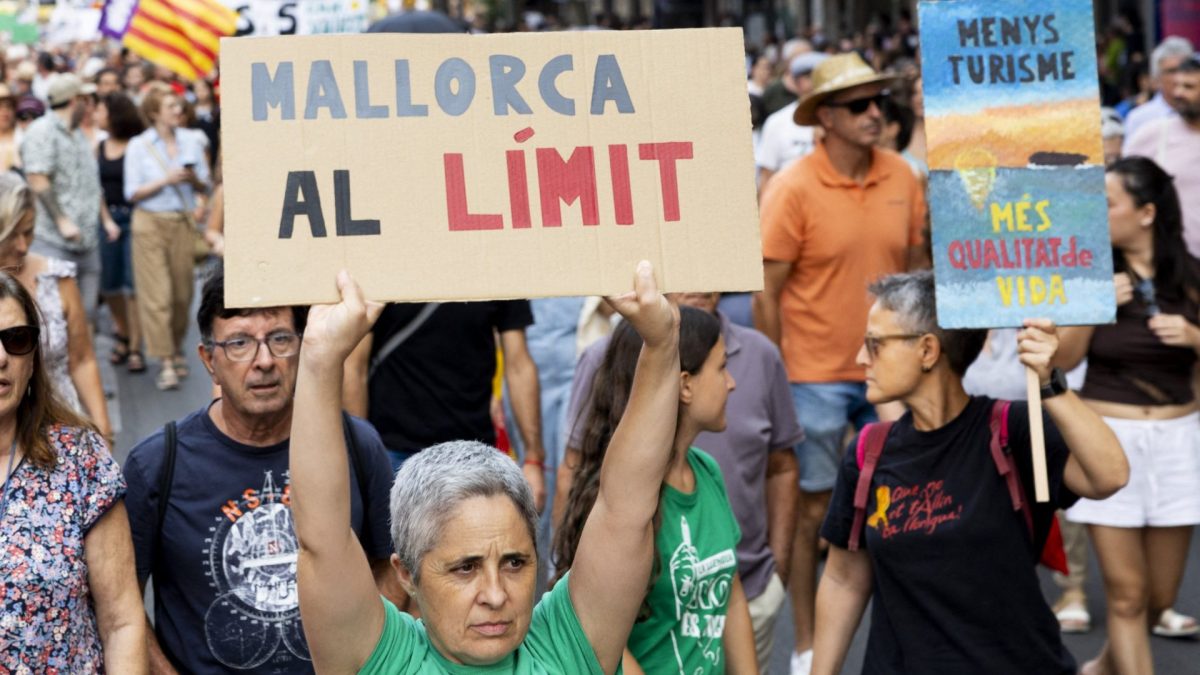
MADRID – “Go home,” a prime ministerial candidate in Spain told tourists at a campaign event in Mallorca last week. “The Balearic Islands is not Las Vegas… the Balearics is not your international co-working … less tourism, more life.” Irene Montero, leader of the far-left Podemos party, is not the only one targeting foreigners ahead of next week’s snap elections. Ada Colau, the former mayor of Barcelona and leader of the Broad Front party, said at a campaign meeting on Sunday that “controlling” tourism was one of her priorities. As the number of tourists visiting Spain is expected to top 100 million this year – potentially overtaking France as the world’s favourite travel destination – politicians and activists across the country have blamed holiday rentals for depleting the country’s housing stock and raising rents. Spain’s booming tourism industry has been blamed for worsening the country’s housing crisis, a central issue ahead of the vote a week on Sunday. Jaume Pujol, of the Less Tourism, More Life protest group in Mallorca, told The i Paper that Prime Minister Pedro Sánchez’s Socialists had done little to halt overtourism over eight years in power. “It is important to bring the demands of the protests this summer and the general strike against ‘touristification’ to the table, to make sure that they are met in full,” he said. Enric Aragonès Jové, of the Spanish Renters Union, said that “foreigners occupying tourist flats put more strain on the limited housing which is available and pushes up the prices”.Over the summer, a wave of protests took place in Malaga, the Balearic Islands, Barcelona and the Canary Islands, with demands for more affordable housing for locals and greater controls on holiday homes. Mass protests followed in September, after 87-year-old Maricarmen Abascal was evicted on a stretcher from her Madrid home of 70 years following a 230 per cent rent increase. She later died in hospital. Maricarmen Abascal, 87, was evicted from her home in Madrid in September after huge rent increases. The disabled woman, who died in hospital later, became a symbol of Spain’s housing crisis (Photo: Luciano Lima/Getty) Sánchez called the general elections in the immediate aftermath. At a campaign event on Sunday, he pledged to introduce new taxes on investment funds and large property owners with “empty homes” or who use them as tourist apartments and charge “unaffordable” rents. He told a popular podcast that it was not just a question of supply but the fact that much of the housing being put up for rent was used for tourist apartments and Airbnb. “We need to do more than just build social housing,” he added. “We also need to regulate the housing market, including room rentals and short-term lets, and offer tax incentives to landlords.” While tourist accommodation makes up only 1.2 per cent of the housing stock, according to 2024 data from the National Statistics Institute, critics say it reduces affordable housing in cities like Barcelona, Madrid and Malaga and pushes locals out. A lack of affordable housing in Spain and fewer people able to buy their own homes has resulted in rents surging in recent years. The average monthly rent of €1,176 (£980) across Spain is equivalent to 98.7 per cent of the average monthly salary, according to the Youth Council of Spain. Last week, three million Spaniards took part in a general strike over soaring prices, the first general strike in the country in 14 years, as many young people struggle to afford to leave their parents’ homes. A protest march in Barcelona during a general strike this month (Photo: Davide Bonaldo/Getty) Sánchez called the election hoping anger over the crisis would galvanise support for his left-wing government, but time is running out for him. The centre-right conservative People’s Party is widely expected to win the biggest share of the vote, though it is unlikely to claim enough seats to secure a majority – and may look to the far-right Vox party to form a coalition government. This would be the first time in more than 50 years that a far-right party has entered government in Spain. The People’s Party has pledged to support the country’s vital tourism sector, which accounted for 12.9 per cent of Spain’s GDP in 2025, while also promising to address the housing crisis by building one million homes, and to help young people get on the proper ladder. “We must look after tourism,” Alberto Núñez Feíjóo, the party’s leader, said in January. “It is unacceptable that the industry which serves as our country’s global ambassador – and which acts as a key driver for the broader economy – lacks specific legislation and a dedicated strategic project to foster its modernisation and digitalisation.” But as tourist numbers rise, locals in hotspots like Barcelona have targeted visitors with water guns and other protests – and have accused officials of putting the interests of the sector above those of ordinary Spaniards. Activists use water pistols during a protest against mass tourism in front of the Park Guell in Barcelona last year (Photo: Nacho Doce/Reuters) According to the Bank of Spain, the country lacks 750,000 homes, which could rise to one million by next year. Pablo Simón, a political analyst at the Carlos III University of Madrid, said housing was among the issues playing on voters’ minds, but added: “It is also competing with other issues like the cost of living and corruption and immigration.” Recent polls found that between 53 and 60 per cent of Spaniards view immigration in negative terms or believe it puts pressure on public services. “Without a doubt housing is the biggest issue for most people and these tourist flats come into that,” Ignacio Redondo, a 32-year-old teacher who shares a flat with four others in Madrid, told The i Paper. “All the parties promise change, but we must protest now to force change.”
‘The Balearics aren’t Vegas’: British tourists come under fire in divided Spain
Full Article
Original Source
Read the full article at Inews →KhanList aggregates and links to publicly available news content. We do not host full articles from third-party sources. Always verify important information with original sources.