
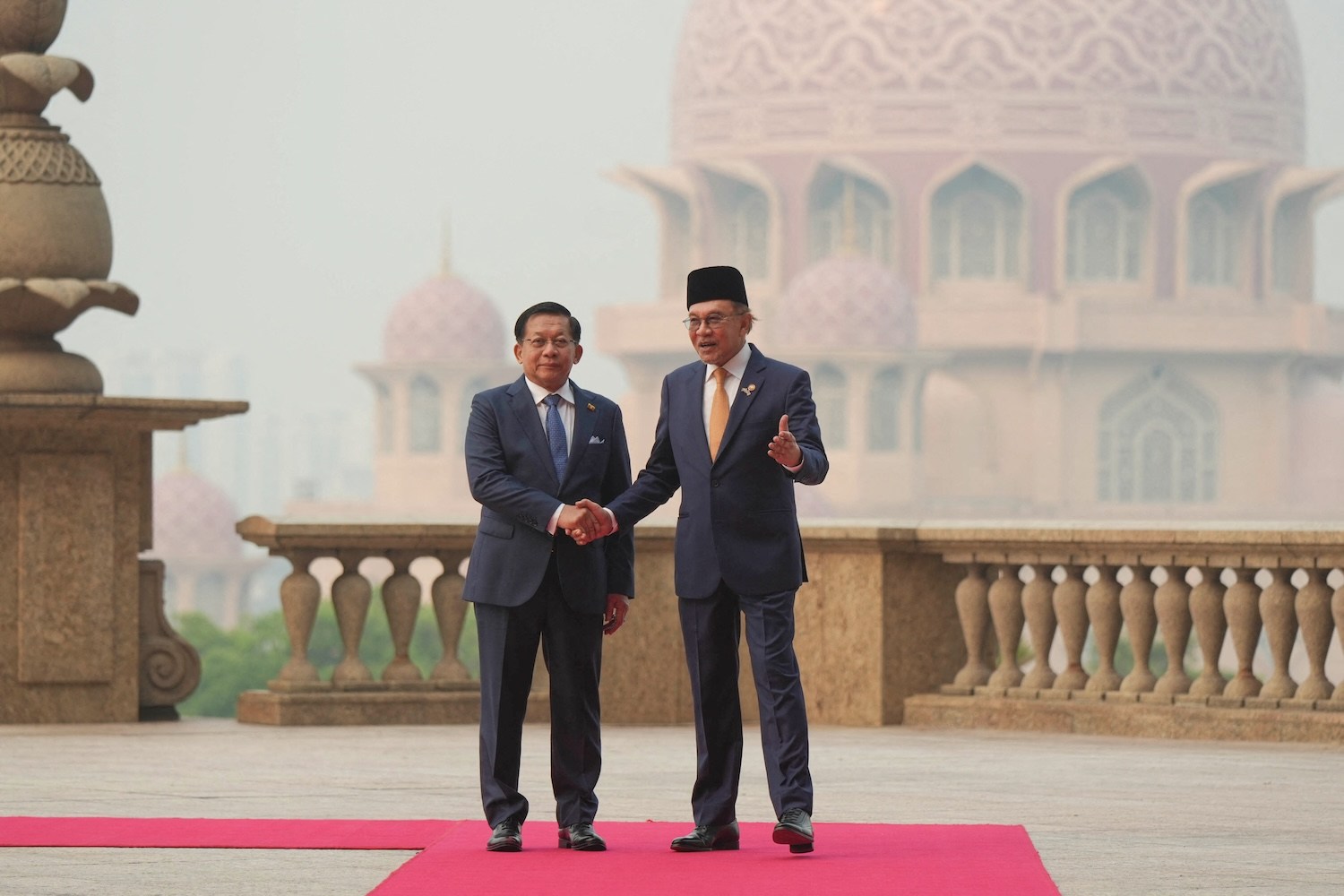
Welcome to Foreign Policy’s Southeast Asia Brief. The highlights this week: Myanmar’s junta is in talks with Malaysia and the United States; Malaysia’s government releases an election-friendly budget; and an Indonesian brain-rot meme takes over the internet. Myanmar’s Diplomatic Breakthrough It was a week of diplomatic victories for the Myanmar junta. First, on Wednesday, junta leader Min Aung Hlaing landed in Malaysia. Once a staunch opponent of the postcoup regime, Malaysia has flipped in return for being allowed to deport Myanmar migrants and refugees. (Mercifully, Rohingya refugees seem to have escaped this by dint of Myanmar refusing to accept their citizenship.) Following his meeting with Min Aung Hlaing, Malaysian Prime Minister Anwar Ibrahim declared, “Malaysia will do whatever is possible to make sure that we … ultimately, take Myanmar as part of our community of nations, without prejudice, and particularly in the context of ASEAN,” the Association of Southeast Asian Nations. Though a government representative then emphasized that Malaysia still did not formally recognize Min Aung Hlaing’s government… Then, on Thursday, Reuters broke the news that the United States had started direct talks with the junta, reversing a policy of isolation adopted since the 2021 coup. For now, talks are apparently focused on shutting down scam centers that target Americans. There were also preliminary discussions about Myanmar’s deposits of heavy rare earths. Michael Vance, the U.S. assistant secretary of state for intelligence and research, is among those leading the talks. The opening came after Vance met with Min Aung Hlaing in September to secure the release of former president of the American Chamber of Commerce in Myanmar—and superfan of U.S. President Donald Trump—Adam Castillo. Since its sham election earlier this year—and Min Aung Hlaing’s shift in position from head of the military to president—Myanmar has been on a diplomatic push. These latest developments show success in shifting the position of previously firm opponents, but they also pose two questions. First, is Myanmar on the path to normalization with ASEAN? I lean toward yes. Trips to Brunei and Indonesia, which both played a big role in freezing Myanmar out after the coup, are apparently on the cards for Min Aung Hlaing, according to a Myanmar government spokesperson. If these trips go ahead, three holdouts will remain. The Philippines has already signaled a shift. In an interview on Thursday, President Ferdinand Marcos Jr. praised the Malaysia trip and described developments with Myanmar as “shoots coming out of the ground.” Singapore looks more resolute. It was, according to my sources, very unhappy with the informal ASEAN-Myanmar meeting hosted in Bangkok in July this year. But it might move if it finds itself isolated within ASEAN on this point. Timor-Leste is also expected to be intransigent. Its own history of struggle against Indonesian occupation and subsequent emphasis on human rights mean that it has a sympathy toward the anti-junta forces. However, I think here, too, a shift is possible. In my interview with President José Ramos-Horta last year at the ASEAN summit in Kuala Lumpur, he signaled openness to engaging Myanmar. Notably, he called for the junta and Myanmar’s National Unity Government to come together without preconditions, and he suggested a path to peace based on a cease-fire, release of prisoners, and letting “the military run the country in a temporary fashion” before a gradual transition to democracy. The second big question is this: How will U.S.-Myanmar relations develop from here? The biggest win for Myanmar would be the lifting of U.S. sanctions. After the 2021 coup, President Joe Biden’s administration froze Myanmar’s assets and sanctioned senior military officers. The Trump administration has taken a softer approach. And on Friday, the United States lifted sanctions on the daughter of a Myanmar businessman accused of supporting the military. This action followed other sanction relief in 2025. The U.S. midterms, where a strong showing for the Democratic Party is likely, could complicate this stance. The top Democrat on the House Foreign Affairs Committee, Rep. Gregory Meeks, told Reuters that the Trump administration’s approach was “contrary to both our values and our interests.” There’s also the question of whether the United States will actually get what it wants on the scam centers. China has had success in hunting down scam operators in Myanmar that have targeted its own citizens. But it has deep influence over both the junta and the rebel-controlled border areas that the United States lacks. On rare earths, it looks like a similar story. As Joshua Kurlantzick at the Council on Foreign Relations has pointed out, it is hard to imagine Washington gaining effective access to deposits in the same conflict-ridden border zones of the north where Chinese influence predominates. Even if it did, the challenge is not just mining rare earths but also processing them. It’s in this area that China’s dominance is greatest and hardest to crack. What We’re Watching High school drama. Last week, the Indonesian Supreme Court ruled that Vice President Gibran Rakabuming Raka had not provided sufficient evidence that he had graduated high school. To rewind, Indonesia requires vice presidential and presidential candidates to hold a senior high school diploma. Records show that Gibran studied for his secondary education in Singapore and then attended a variety of higher education institutions in Australia, Singapore, and the United Kingdom. Apparently, though, the documents he submitted to show his high school graduation are not up to snuff. Stil, the court ruled that it could not disqualify him since he is longer a VP candidate, and the complainants did not have standing. Beyond being embarrassing for Gibran—who brushed it off, asking how he could have attended university if he wasn’t a high school graduate—what does this ruling mean? There’s now talk of using this as the basis for an impeachment claim against Gibran. Factions in President Prabowo Subianto’s inner circle are apparently divided over this, reflecting differing opinions about the increasingly tenuous alliance between Prabowo and Gibran’s father, former President Joko Widodo. It could also provide an excuse for Prabowo to ditch Gibran as a running mate in 2029. Duterte fit to stand trial. Former Philippine President Rodrigo Duterte is fit to stand trial, the International Criminal Court decided in an opinion released Thursday. Pretrial hearings focused on Duterte’s mental fitness to stand trial. The court has decided, based on the unanimous verdict of a panel of independent medical experts, that he had the capacity to understand the charges and the proceedings and to instruct his counsel. The 81-year-old is now set to go on trial Nov. 30, facing three charges of crimes against humanity related to extrajudicial killings conducted during his “war on drugs.” Still, questions about the defendant’s health will doubtless linger. When he appeared in court last month, Duterte did not look like a well man. Presiding Judge Joanna Korner has pushed the prosecution to trim down the huge volume of evidence that it has submitted to allow the trial to conclude “as swiftly as possible in the circumstances,” with a view to ensuring that Duterte lives to see a verdict. On Monday, the prosecution did remove a number of items from its evidence list and suggested that it could remove more if it reaches an agreement with Duterte’s defense team. But it has also pushed the court to include additional incidents and witness testimonies in the case against Duterte. An election-friendly budget. On Friday, Malaysia’s government announced a voter-friendly expansionary budget as speculation grows about a potential election next year. The 459.8 billion-ringgit ($112.5 billion) budget included provisions to increase cash aid to poorer Malaysians, small businesses, and first-time home buyers. It will also increase income tax relief and raise the minimum wage from 1,700 ringgit to 2,000 ringgit (around $490) a month. And the Bornean states of Sabah and Sarawak got bigger allocations. These measures come as voters are feeling the pinch and have been venting their displeasure by handing Anwar a series of defeats in key state elections. Strong growth, helped by the artificial intelligence boom, means this should not break the bank. The federal budget deficit is projected to decline slightly in 2027. But research firm BMI has warned that spending could exceed projections as global fuel prices push up Malaysia’s fuel subsidy costs. Photo of the Week Residents pray for rain amid a prolonged dry season at a village field in Malang, East Java, Indonesia, on Oct. 10, 2026. The 2026 dry season in Indonesia is longer, hotter, and drier than normal due to the Super El Nino and Positive Indian Ocean Dipole (IOD) phenomena. The Meteorology, Climatology, and Geophysics Agency (BMKG) confirmed that the combination of these two climate phenomena caused a drastic decrease in rainfall across most of Indonesia, thereby triggering a delay in the onset of the rainy season. Residents pray for rain amid a prolonged dry season at a village field in Malang, East Java, Indonesia, on Oct. 10, 2026. The 2026 dry season in Indonesia is longer, hotter, and drier than normal due to the Super El Nino and Positive Indian Ocean Dipole (IOD) phenomena. The Meteorology, Climatology, and Geophysics Agency (BMKG) confirmed that the combination of these two climate phenomena caused a drastic decrease in rainfall across most of Indonesia, thereby triggering a delay in the onset of the rainy season. FP’s Most Read This Week China Doesn’t Need to Invade Taiwan to Control It by Michael Poznansky and Ian Easton To Understand France’s Unrest, Look Back to 1982 by Howard W. French Everyone Got Pete Hegseth Wrong by Emma Ashford What We’re Reading An extraordinary investigation by Al Jazeera went undercover to probe allegations that China-born billionaire Deng Pibing is involved in scam compounds and drugs as well as bribing authorities. In Al Jazeera’s footage, he also hints at connections to the Chinese state. Marcos was interviewed by Mara Cepeda of the Straits Times. He said he was “resigned” to managing the South China Sea dispute, and as I mentioned above, has called for a new approach to Myanmar. Myanmar’s property market is booming. As the rest of the economy crumbles, investors are flooding into land, Cape Diamond writes in Nikkei Asia. In Focus: Indonesia’s Top Cultural Export Is an AI Brain-Rot Meme? If you have kids who use TikTok, or if you yourself have fallen victim to the feed, you have likely come across a character called Tung Tung Tung Sahur. At first glance, the character is a cartoonishly anthropomorphized stick with outsized feet, hands, and eyes slapped on. The truth is weirder. He is an anthropomorphized version of a kentongan, a traditional Javanese slit drum. When beaten, the drum produces a tung-tung-tung noise. The sahur part of the character’s name refers to the early morning meal eaten by Muslims before fasting starts during the month of Ramadan. A kentongan is often beaten to wake them. The meme was created by an Indonesian teen creator known as Noxa, aka Fernanda Bagas Indrastata, using an AI generation tool. It then went viral as part of the “Italian brain rot” style of absurdist memes on TikTok. It is now big enough to be the subject of multiple copyright battles. Mementum Labs, a French company that proclaims itself to be the “(Brainrot) Memes Agency,” licensed the rights from Noxa—and has since been aggressively asserting them, suing companies that use Tung Tung Tung Sahur images without their permission. Mementum struck a deal with Epic Games to let the company use Tung Tung Tung Sahur as a skin (or customization option for playable characters) in its massively profitable online shooter Fortnite. But it is now fighting a case against Spyder Games over its use of the character in another game that’s a smash hit with kids on Roblox. The case is seen as a key early test over the issue of copyrighting AI-generated content. Indonesia has long punched below its weight culturally on the international scene. Now, it’s making an odd splash. I don’t know what to think, other than this makes me feel very old.
The Autumn Myanmar Turned Pretty
Full Article
Original Source
Read the full article at Foreignpolicy →KhanList aggregates and links to publicly available news content. We do not host full articles from third-party sources. Always verify important information with original sources.