
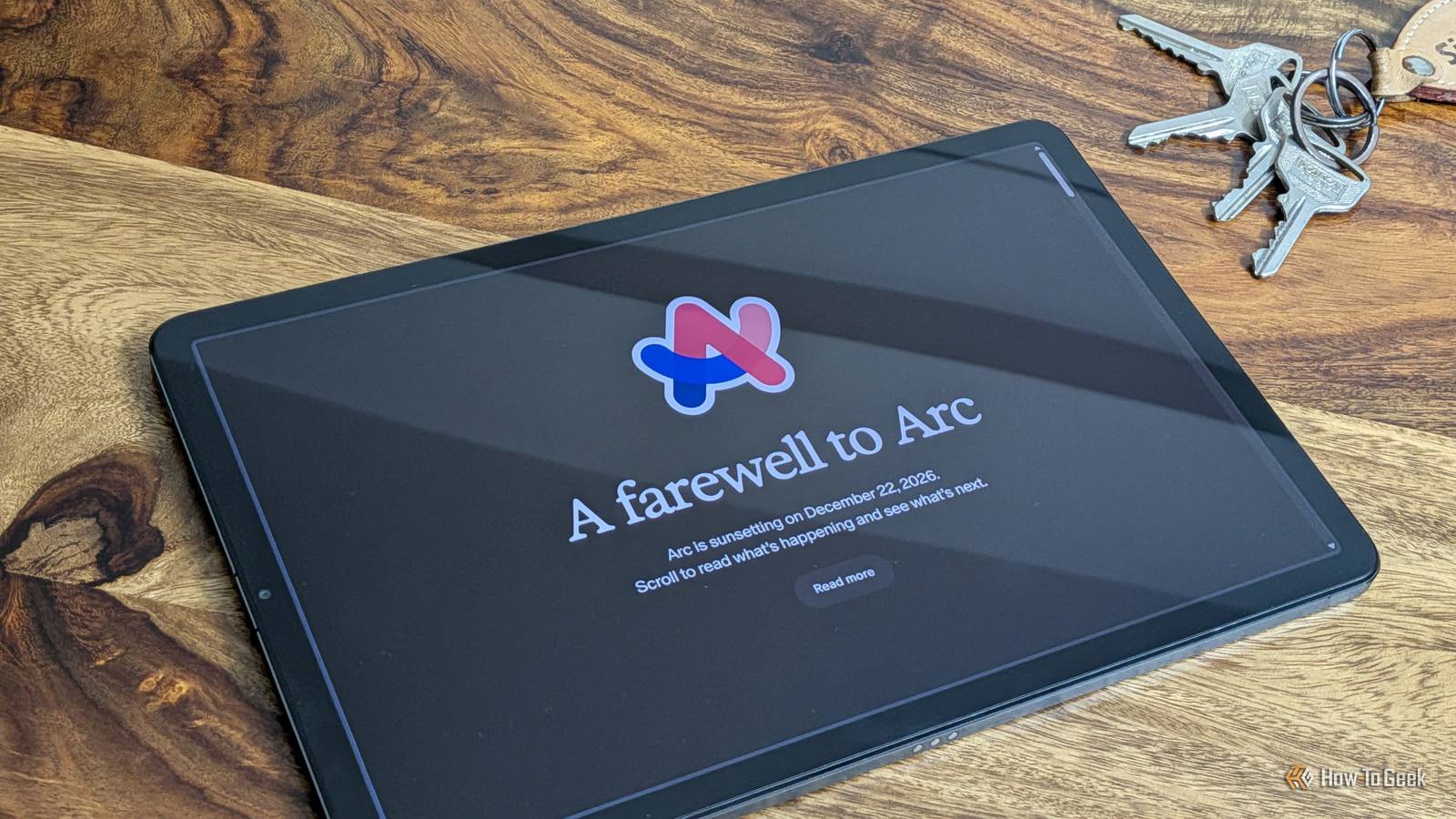
Published Nov 20, 2026, 5:00 PM EST Dibakar Ghosh is a tech journalist at How-To Geek with over a decade of experience using and writing about open-source software, Linux, Android, AI, and personal productivity. He writes about software, operating systems, and tools that help people get more from the technology they already use. Technically, at the time of writing, the Arc browser isn't dead yet — but the end is nigh. The Browser Company has confirmed they're sunsetting Arc on December 22, 2026, adding to the general sense of gloom this year has brought. When Arc first came out, it felt revolutionary. It was so good that I seriously considered ditching my Windows PC for a Mac just to use it. Unfortunately, as the saying goes, "the good die young," and Arc is being discontinued after a little over three years of changing the way we browse the internet. And so, before it shuts down for good, I went looking for a replacement and narrowed it down to three options: Brave, Vivaldi, and Zen. Here's how they compare and which one is becoming my new default browser. What I loved about the Arc browser And the list of features I’m looking for in my new browser Replacing Arc isn’t simply about replacing a browser — it’s about replacing the workflow I built around it. For me, that boils down to a handful of features. The first and most important is vertical tabs. I’m one of those people who always has 50+ tabs open at any given time, and a regular horizontal tab strip just isn’t built for that. Past a certain point, every tab shrinks to its favicon, and finding the right tab becomes nearly impossible. However, with vertical tabs, each tab gets its own fixed-width column, so you can always see at least part of each page title. Then you've got Spaces and Profiles. I basically live in my browser, and nearly every app I use is a web app. This creates a unique challenge: organizing all the websites and web apps I frequent, not to mention keeping track of the different accounts I need to sign in to. I used to solve this by having different browsers for different workloads — Firefox for personal use and Brave for work — but Arc's Spaces and Profiles features made everything much more streamlined. Finally, you've got Split View. My normal setup has two or three web pages open at the same time — one for research, one running a chat window, and one where I'm writing. Before Arc, that meant opening three browser windows side by side and snapping them into place, which is a cumbersome workflow. With Arc, I can open multiple web pages in a split view and see them side by side in the same window. It's a much cleaner workflow, especially when Alt-tabbing to manage everything. Brave gets you most of the way there But it’s still not there I used Brave before switching to Arc, so now that Arc is dying, it just made sense to return to Brave and see if I could still work with it. Over the years, Brave has received a lot of upgrades and now includes many of the features users loved about Arc. You've got built-in vertical tabs that collapse and expand on hover, along with Split View for workflows involving multiple web pages. You also have Profiles that let you use different instances of Brave, each with its own settings and setup for different use cases. Then you've got Containers to help you keep your logins separate within a single profile. You can also group tabs, name each group, color-code it, and save it to keep your workflow better organized. However, it's not perfect, and it doesn't quite feel like Arc. First, even though you've got Profiles and Containers, switching between your workspaces isn't as seamless as it is with Arc's Spaces. You can pin tabs to the vertical tab bar, but those pinned tabs don't carry over to other windows. Split View is also limited to just two windows. It's usable, don't get me wrong, but it isn't a real replacement. So I kept looking. Vivaldi can do everything Arc does, and then some When going above and beyond is not appreciated Vivaldi has a reputation for being one of the most feature-packed browsers out there, so if anything could replicate Arc's workflow, I figured it would be Vivaldi. And I was mostly right. Vivaldi's Workspaces work a lot like Arc's Spaces. Tab Tiling lets you split as many tabs as you want into different layouts. Tab Stacks let you group tabs into folders for better organization, while Web Panels can serve as a replacement for Arc's Favorites area. And if you want an even cleaner browsing experience, you can use Ctrl+F11 to hide the interface so the page fills the entire browser window, giving you the same clean look you get with Arc. However, using Vivaldi made me realize something about Arc that I'd taken for granted: Arc had a more thoughtful design. It struck a rare balance, offering a rich collection of features wrapped in a seamless, minimal layout. Vivaldi feels much noisier by comparison. There's just too much going on, and the features don't feel as elegantly woven into the app as they do in Arc. Now, I'm sure a lot of people like this kind of maximalist design and the level of control it offers. But I prefer a more curated experience, so I continued my search. Zen is the closest thing to Arc right now It’s still not perfect, though I'd known about Zen for a while — it had built a reputation as "THE" open-source alternative to Arc. However, I held off trying it out because it was fairly new, and I kept seeing complaints about memory leaks and high RAM usage. But after exhausting the other popular options, I finally decided to give it a try, and I wish I'd done it sooner. In terms of workflow, Zen is the closest match to Arc I've found. Workspaces work like Spaces, and each one can be tied to its own container to keep logins separate. Essentials sit at the top of the sidebar, just like Arc's Favorites, while Glance opens links in a floating preview, much like Peek. There's also Split View, Tab Folders, and Compact Mode, which hides the sidebar until you need it. Also, in my experience, Zen hasn't had any major memory issues — at least I didn’t face any such problems. The main problem with Zen is the lack of Widevine support. This means DRM-protected streaming services like Netflix won't work on Windows or macOS (although they do work on Linux). Now, I'm personally not in the habit of streaming Netflix through a browser on my Windows PC, so I don't consider this a deal-breaker. I should also mention that Zen is based on Firefox rather than Chromium, like Arc. This means your Chrome Web Store extensions won't work here, and you'll need to install Firefox extensions instead. Also, some websites are known to have compatibility issues with Firefox, so they won't necessarily work well with Zen either. Fortunately, most of the sites I frequent work just fine in Firefox, so this hasn't been a problem for me. I’m using two browsers to replace Arc Arc is so good, you need two browsers to replace it Ultimately, I couldn't replace Arc with a single browser and had to rely on two instead. Zen is now my main browser, where I do everything, from personal browsing to work. I also have Brave as a backup for those rare instances when a website or web app requires Chromium. That said, it's honestly not an issue because I previously followed a similar two-browser workflow, using Firefox for personal browsing and Brave for work. This new setup is actually a bit more streamlined because Zen's Workspaces feature lets me keep everything organized in one place, and I only need Brave as a fallback. Why not replace Arc with Dia? The Browser Company is sunsetting Arc because it's focusing on a new browser: Dia. As such, the most obvious question is why I'm not simply replacing Arc with Dia. And the answer boils down to two things. First, Dia is an AI-first, agentic browser. Now, don't get me wrong. I'm not an AI hater, and I think AI tools are very useful — but I just don't want them in my web browser. And it's not simply a matter of preference, either. Agentic browsers are susceptible to an entirely new set of security problems, which makes them more trouble than they're worth. The second, and more important, reason is that I just don't trust The Browser Company anymore. Arc had a loyal fan base, and people abandoned their default browsers, which they'd been using for decades, to switch to it. Most app developers can only dream of building that kind of following. But instead of nurturing its audience and building on its success, the company decided to jump ship and chase the latest trend by building an AI browser. So even if I were to entertain the idea that they could build Dia into as good a browsing experience as Arc, who's to say they won't develop shiny object syndrome again, abandon this product, and move on to something new? Sure, what I'm saying is pure speculation, but the company's actions have left a bad taste in my mouth, and I'd rather not build my workflow around its products.
The Arc browser is dead, so I tried Brave, Vivaldi, and Zen to find the best replacement
Full Article
Original Source
Read the full article at Howtogeek →KhanList aggregates and links to publicly available news content. We do not host full articles from third-party sources. Always verify important information with original sources.