
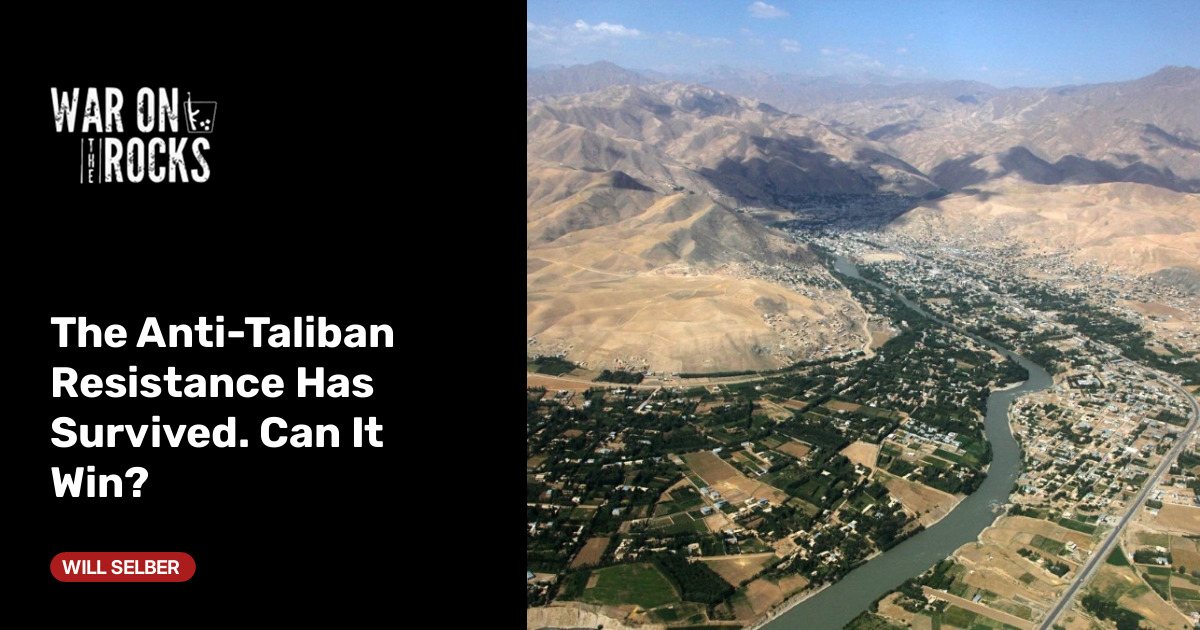
As the Taliban enters its sixth year in power, it remains more powerful than it was before the Sept. 11 attacks. The Taliban’s flag flies in all of Afghanistan’s 34 provinces. While only Russia has formally recognized the group as the country’s government, China and the United Arab Emirates have officially accredited or accepted Taliban ambassadors and exchanged diplomatic staff, with Pakistan, Qatar, Iran, Kazakhstan, Uzbekistan, Turkmenistan, and Turkey establishing de facto working relationships with the Sunni Deobandi group. Even its archrival, the Islamic State in Afghanistan, has seen its attack activity decline after years of counter-terrorism operations.However, beneath the surface and far from the spotlight, the anti-Taliban resistance — a motley crew of over a dozen groups led by former leaders of the previous government — has survived despite having neither an established cross-border military sanctuary nor an overt state sponsor, two key ingredients for a successful insurgency. In the last two years, these groups have multiplied, and the tempo and geographical reach of their attacks have expanded.Despite the anti-Taliban resistance’s modest gains, Western governments should consider preliminary public engagements with resistance leaders if Pakistan’s outreach bears fruit and the groups gain traction after unifying, while making future support contingent on their ability to seize and hold territory. Maintaining these relationships, many dating back more than 20 years, will preserve the West’s options should Pakistan’s relationship with the Taliban continue to deteriorate or should the Taliban prove unwilling or unable to constrain al-Qaeda’s external operations from its training camps in Afghanistan.The Resistance LandscapeThe anti-Taliban resistance began shortly after the fall of the previous government, when forces loyal to Ahmad Massoud, the son of the legendary Ahmad Shah Massoud, and former First Vice President Amrullah Saleh attempted to hold out in the Panjshir Valley. However, aided by recently captured American weapons and equipment, the Taliban routed the fledgling group less than a month after the fall of Kabul.Massoud’s National Resistance Front was the first group to emerge from the wreckage of the fall of Kabul. The overwhelming majority of its attacks have focused on his father’s Jamiat-e-Islami strongholds in Panjshir, Baghlan, Takhar, Badakhshan, and other northern provinces. Massoud remains the most internationally recognized resistance leader, regularly traveling abroad to represent the interests of those opposed to Taliban rule.Former Afghan National Army Chief of General Staff Yasin Zia’s is the second-oldest and most established anti-Taliban resistance group. Zia, also a former governor of Takhar, has conducted attacks not only in his stronghold of northern Afghanistan but also in predominantly Pashtun areas, including Nuristan, Kunar, and even Kandahar and Helmand, suggesting a wider operational reach than Massoud’s National Resistance Front.Lt. Gen. Sami Sadat, the former commander of the 215th Corps in Helmand, leads the Afghan United Front, a recent entry onto the battlefield that began combat operations on Aug. 1, 2026. Sadat’s group has hit the ground running, claiming over 60 guerrilla attacks through September — consisting mostly of ambushes and assassinations — with a significant focus on southern Afghanistan. This underscores Sadat’s intention to challenge the Taliban in its spiritual stronghold. Sadat, who testified before Congress following the fall of Kabul, maintains ties to the Republican Party.Besides these three groups, which conduct the bulk of attacks, there are Saleh’s Afghan Green Trend, the National Mobilization Front, the National Independence Front, the Homeland Soldiers Front, the Afghanistan Republican Front, the New Horizon Organization, the Freedom and Justice Movement, the Afghan Liberation Movement, and many more.While these groups individually conduct a small percentage of the overall attacks claimed by the resistance, in aggregate, their attacks rival those of the big three. For example, in early October, the National Mobilization Front — a small group that has been conducting attacks since 2023 — claimed responsibility for assassinating a senior Taliban official in Nangarhar.The anti-Taliban resistance groups regularly claim attacks across Afghanistan. However, many of these claims cannot be independently verified, despite the groups frequently posting footage of their attacks on social media. A tally of verified attacks and incidents documented in successive U.N. reports establishes a minimum of 438 across reporting periods between November 2023 and July 2026.In my conversations with these groups’ leaders, they’re quick to say those numbers are undercounted because they cannot disclose all their attacks for operational security reasons or because the methods of the U.N. Assistance Mission in Afghanistan are too restrictive. Regardless, these verified attacks demonstrate that the resistance’s operations are not merely social media inventions.Overall, attack claims have increased in 2026, with at least four new groups helping bolster the anti-Taliban resistance’s numbers and the tempo of its attacks. However, these attacks have yet to translate into an existential challenge to Taliban control, and the groups have not secured lasting control over any district. Before these groups can evolve into a more significant challenge, they will need to unify and focus their operations on a coherent strategy.The Limits of FragmentationAnti-Taliban resistance groups are diverse, led by Pashtuns, Tajiks, and Hazaras. Their leaders are either former Afghan government officials or military leaders from the previous government. Most of the groups’ charters describe their aim as restoring democracy and human rights to Afghanistan. Despite these similarities, they remain independent actors fighting without an overarching strategy to accomplish a goal they all share: the overthrow of the Taliban.While the anti-Taliban resistance is not a unified entity, Massoud, Zia, and Sadat have all welcomed each other’s presence on the battlefield as brothers in arms. The National Resistance Front underscored this sentiment recently by releasing a press statement praising the Afghanistan Freedom Front’s recent fighting. The Afghanistan Freedom Front and National Resistance Front also recently released a statement warning the United Nations of pending attacks. National Resistance Front and Afghanistan Freedom Front officials have attended conferences of the Vienna Process for a Democratic Afghanistan, which seek to foster democracy and the rule of law in Afghanistan.Nevertheless, this fragmentation prevents the groups from pooling resources and manpower, which are at a premium without official state sponsorship or sanctuaries.More importantly, the lack of unity harkens back to the previous government’s greatest weakness. While the Taliban grew stronger and began to encircle various provincial capitals, ministers fought petty turf battles. There were even gun battles during political conferences.Much ink has been spilled about the supposed factions inside the Taliban, with Interior Minister Sirajuddin Haqqani versus Taliban Supreme Leader Hibatullah Akhunzada being the latest manifestation of a long-told tale. Yet for all the supposed infighting inside the Taliban, they have remained a unified front against its enemies, something the anti-Taliban resistance should remember.While having former Afghan general officers and leaders willing to subordinate themselves to another’s command might be a bridge too far, the resistance could at least follow in its forefathers’ footsteps and form an umbrella organization, like the Islamic Unity of Afghanistan Mujahideen, also known as the Peshawar Seven. During the Soviet war in Afghanistan, the Peshawar Seven was an alliance of seven Sunni Afghan mujahedeen political and guerrilla parties based in Peshawar, Pakistan.The alliance played a key role in the diplomatic arena, presenting a unified front on the global stage and providing an umbrella for the distribution of foreign assistance. Its constituent parties received much-needed weapons and equipment through Pakistan’s Inter-Services Intelligence, supported by the U.S. Operation Cyclone and Saudi assistance.Although the Peshawar Seven allowed the resistance to present a common front to the outside world and receive critical financial and material assistance, it did not eliminate competition for power, which often turned bloody. Pakistan’s powerful intelligence service favored Gulbuddin Hekmatyar’s party, strengthening a more fundamentalist Islamist organization at the expense of other groups. In July 1989, after Soviet forces had withdrawn, Hekmatyar’s forces ambushed and killed 30 members of Ahmad Shah Massoud’s Shura-ye Nazar, Jamiat-e-Islami’s military wing, in Takhar province, foreshadowing the bloody civil war that would follow the fall of the Soviet-backed government of Mohammad Najibullah. Moreover, the Afghan Interim Government — formed by the seven parties in 1989 as an alternative to the Najibullah regime — excluded important constituencies, including supporters of former King Zahir Shah and Iran-based Shiite parties, undermining its legitimacy. Different foreign patrons also backed rival factions, with Pakistan favoring Hekmatyar, Saudi Arabia supporting Abdul Rabb al Rasul Sayyaf’s Ittihad-e-Islami Bara-yi Azadi Afghanistan, and Iran backing Shiite parties outside the Peshawar Seven.A contemporary umbrella organization would need agreement on a political process designed to keep these groups from fighting each other, while including Afghanistan’s broader ethnic and religious communities. A leadership shura led by a respected elder could help head off potential conflict and establish rules for power sharing. Foreign patrons should also construct a common mechanism for distributing assistance instead of favoring their preferred faction. These arrangements would show the Afghan populace that these new groups are dedicated to avoiding their predecessors’ bloody footsteps. An umbrella organization could also focus on creating a government in exile that would help attract international assistance and focus these disparate groups’ efforts on securing a foothold in Badakhshan.All Eyes on BadakhshanFor five years, the anti-Taliban resistance has focused overwhelmingly on guerrilla attacks. Despite the apparent success of many of these attacks, the resistance has not yet secured a portion of Afghanistan under its rule.Over the last three months, the Afghanistan Freedom Front, National Resistance Front, and Afghan United Front have all conducted guerrilla attacks in Badakhshan. The National Resistance Front claimed responsibility for the Aug. 13 assassination of the mayor of Faizabad, while the Afghanistan Freedom Front has conducted sustained engagements for months in Zibak district. Even smaller groups have notched important victories. On July 17, 2026, the Homeland Soldiers Front — led by a former Afghan National Army commander — briefly captured the Yaftali Sufla district center in Badakhshan, marking a rare reported temporary loss of a district center since the Taliban consolidated control in 2021.Badakhshan offers the anti-Taliban resistance an attractive location to wrest control of a district from the Taliban. First, its terrain could provide sanctuary for anti-Taliban resistance groups. One of Afghanistan’s most remote provinces, Badakhshan contains vast mountain ranges and isolated valleys where limited roads make it difficult for any central government to exercise consistent control.Badakhshan also has a long resistance tradition and plenty of local grievances that provide fertile ground for recruitment. The Northern Alliance used bases in Badakhshan, as well as in Panjshir and Takhar provinces, to resist Taliban rule following the Taliban’s capture of Kabul. The Taliban has also alienated local miners by restricting their livelihoods while allowing connected operators to profit. Even after the Taliban detained dissident Taliban commander Juma Khan Fateh following his Aug. 17 surrender, after nearly a week of clashes amid a dispute that included access to gold mines, Taliban factions continue to clash over the mines.Although the Taliban was able to rout the fledgling anti-Taliban resistance in Panjshir following the fall of Kabul and mass forces against Fateh, it will have a much harder time replicating those successes against resistance groups in Badakhshan. First, the anti-Taliban resistance has five years of operational experience under its belt. Second, in 2021, the Taliban was riding the wave of its recent victory over the United States and NATO, giving it a psychological advantage over its enemies. Lastly, while Fateh quickly surrendered as the Taliban massed forces, the Taliban has been unable to compel the Afghanistan Freedom Front or the Homeland Soldiers Front to do the same, despite massing forces and appealing to the Homeland Soldiers Front commander to surrender.Badakhshan’s neighbors also make it an attractive location. It borders Tajikistan, which arguably has the frostiest relations with the Taliban in the region and strong ties to Afghanistan’s Tajik population, the country’s largest ethnic minority. Pakistan also borders the province, providing another potential ally as relations between Islamabad and the Taliban continue to deteriorate. Badakhshan’s Wakhan Corridor gives the province a border with China, whose pragmatic relationship with the Taliban could change should the group continue to disregard Beijing’s requests to act against terrorist groups. These include the East Turkestan Islamic Movement, which operates in Badakhshan and has long eyed operations in China’s Xinjiang region.Help WantedDespite its persistence in the face of daunting odds, the anti-Taliban resistance lacks recognition as a credible alternative to the Taliban. Although the Taliban has made strides in the international arena, only Russia has formally recognized it. Afghanistan’s regional neighbors offer potential allies that the West should monitor.Tajikistan is a plausible candidate for tacit support to the resistance. Dushanbe is already sheltering Afghan opposition figures and has faced border violence involving militants targeting foreign workers in southern Tajikistan. Dushanbe would gain an Afghan partner committed to preventing cross-border militancy and an alternative to dependence on Taliban assurances. However, with Russia’s engagement with the Taliban deepening, Dushanbe is unlikely to provide more than passive assistance to these groups.While a future stronghold in Badakhshan would offer less direct leverage with Iran, Massoud’s invitation to attend former Iranian Supreme Leader Ali Khamenei’s funeral and the reported presentation of his delegation as “the Afghan Opposition” suggest possible diplomatic openings with Tehran. The resistance could play on Tehran’s concerns over water rights along its eastern border and the Taliban’s persecution of Shiites in Afghanistan.Pakistan has a long history of supporting Afghan armed groups. Its support proved pivotal in the defeat of the Soviet Union in Afghanistan, the rise of the Taliban in the 1990s, and the group’s eventual victory over the United States and NATO five years ago.However, since the fall of Kabul, Pakistan’s relations with its former ally have deteriorated due to the Afghan Taliban’s support for its fellow Taliban movement in Pakistan as well as Ittihad al-Mujahideen Pakistan. These groups continue to conduct brazen attacks on Pakistani forces, contributing to Pakistan’s declaration of “open war” on the Taliban.The Taliban already accuses Islamabad of sheltering and supporting opposition groups, accusations likely to gain further traction after the New York Times reported that Pakistani military and intelligence officials have held meetings with leaders of anti-Taliban resistance groups to discuss potential support. Anti-Taliban resistance groups are hesitant to discuss this burgeoning relationship with their former enemy — though, off the record, they admit it remains their only tangible option to gain traction inside Afghanistan.The West should offer tacit support for Pakistan’s current engagement with the groups as a way of keeping its options open and exerting pressure on the Taliban. This would cost the West very little and preserve alternatives should the Taliban’s and the West’s short-term interests no longer align. Although the West is banking on the Taliban to keep its partnership with al-Qaeda from affecting Western security, history suggests that ability is not indefinite. Should Pakistan’s relations with these groups mature, much as they did with the Peshawar Seven, the United States should consider offering public support and possible resources to groups whose fighters once fought alongside American personnel in Afghanistan.Supporting the anti-Taliban resistance is not without its drawbacks. Military support could renew bloodshed in a country that has suffered through five decades of conflict and worsen civilian suffering. However, the Taliban’s treatment of women over the past five years and the International Criminal Court’s recent indictments for crimes against humanity underscore the severe suffering under Taliban rule. Further, conducting diplomacy and backing Pakistan’s tentative engagement do not necessarily equate to renewed bloodshed. In the end, it would be incumbent on these groups to garner the public support necessary to succeed.ConclusionThe anti-Taliban resistance has made real strides in its five years on the battlefield: The number of groups and the tempo of their claimed attacks have increased, despite lacking an overt state sponsor or an established cross-border military sanctuary. However, the resistance should unify and focus its combined efforts on securing a foothold in remote provinces like Badakhshan to offer itself as a viable governing alternative to the Taliban. Western governments should preserve their relations with resistance leaders through preliminary public engagement, while making future support contingent on greater unity and an ability to seize and hold territory. Those contacts would preserve options without committing the West to military sponsorship.Will Selber is a retired Air Force officer who served as a U.S. Central Command foreign area officer. He spent three years in Afghanistan.Image: Khwahan via Wikimedia Commons
The Anti-Taliban Resistance Has Survived. Can It Win?
Full Article
Original Source
Read the full article at Warontherocks →KhanList aggregates and links to publicly available news content. We do not host full articles from third-party sources. Always verify important information with original sources.