
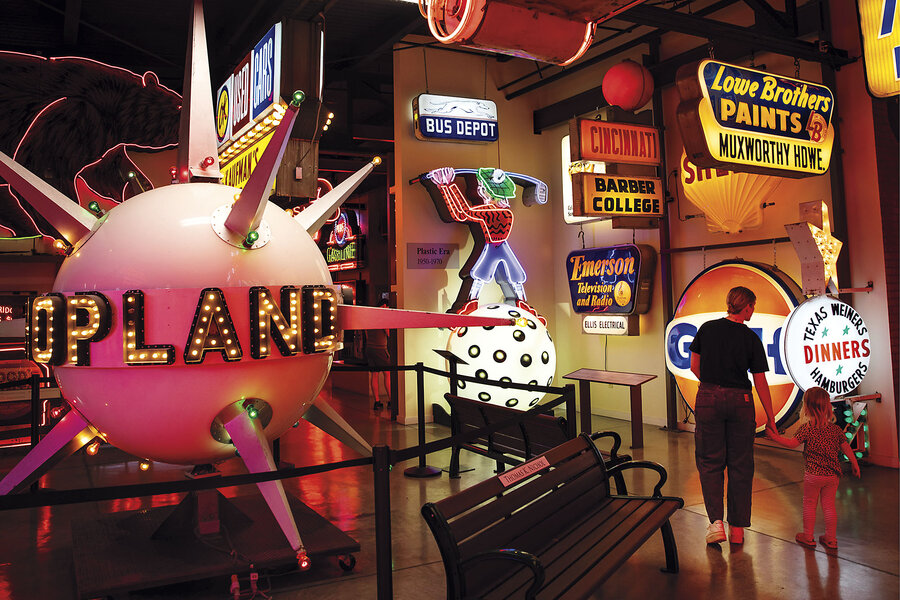
Cincinnati | Oct. 04, 2026, 5:00 a.m. ET | 3 min read Kathy Greene and her husband, Tom, walked into a museum recently and found themselves transported to a small-town Main Street from their childhoods.Museums are funny like that – time machines with rare powers of preservation, education, and nostalgia. The American Sign Museum in Cincinnati does this and more. Its collections hack your brain, tapping into memories of childhood road trips and family vacations gone by.Walking through the museum’s life-size “Main Street USA” – with old-fashioned storefronts, a cinema hall marquee, and a McDonald’s sign from the 1960s – the couple and their guest, Ms. Greene’s brother, Gary Reedy, were spellbound. “We are old enough to remember these places,” says Mr. Greene, a retiree from Lebanon, Ohio, his face aglow from the neon light of a giant Howard Johnson’s restaurant sign from the 1960s.Ms. Greene smiles. “I feel like I’m viewing this as a little child. It brings back good memories.” Melanie Stetson Freeman/StaffREADING THE SIGNS: Tom Greene (from left), Gary Reedy, and Kathy Greene check out information about some of the signs in the museum. Founded in 1999, the American Sign Museum pays homage to the artistry and craftsmanship of the signs that have long attracted customers to businesses, and that continue to connect many Americans with the bright lights, places, and memories of times past. Founder Tod Swormstedt, past publisher of Signs of the Times magazine, says he founded the museum as both a place to share his own personal collection of iconic signage and as a way to educate visitors about the role that signs play in our lives.Erin Holland, director of education and engagement for the museum, says that because signs are such everyday objects, they are often overlooked. “These are artifacts,” she says. “There is a lot of history behind these signs, and they are worth saving.” With 800 signs, 1,500 photographs, 175 pieces of artwork, and 300 tools of the sign-making trade, the museum’s collection reaches different audiences in different ways, Ms. Holland says. “Our older folks can share stories of what these signs meant to them, and young people can get an appreciation for the way things were, the beauty of the past.”Mr. Swormstedt wanted visitors to see how the American sign-making industry changed as American society changed. Hand-painted wooden signs and porcelain yielded to neon during the Great Depression, when Americans were craving a bit of light in their lives. After World War II, burger joints and motels competed to attract families exploring America along the new interstate highway system. Deepen your worldviewwith Monitor Highlights.Politics with respectGet political stories with respectful analysis.There‘s a world of new ideas in everyBooks newsletter.There‘s more to life, enrich yours withCulture & Learning weekly.Follow humanity‘s discoveries withScience & Nature stories in your inbox.Gain a spiritual perspectivefrom the stories in your inbox.Want to understand the deeper impact of critical events? Learn the Monitor‘s insight.Already a subscriber? Log in to hide ads. Signs speak volumes about America’s changing dream: well-fed boys serving burgers after years of depression and war, or mechanical satellites twirling above shopping malls in the midst of America’s space race with the Soviet Union.The museum has restored many signs to make them functional again. A spinning globe from the Earl Scheib auto painting company in Compton, California, for instance, was repainted, and its car-shaped neon lights were reworked at the museum’s neon shop. But the restoration team left the entry and exit holes for a bullet that was shot through the globe. Melanie Stetson Freeman/StaffTHE HEIGHT OF NOSTALGIA: A tall welcome sign looms over the museum, which is filled with signs from different periods in American history. Melanie Stetson Freeman/StaffA SIGN OF WEALTH: A Western Union sign is on display in a storefront window in the museum’s “Main Street USA” area. Melanie Stetson Freeman/StaffDINE OF THE TIMES: The museum includes many restaurant signs, including this one from the Big Boy chain. Melanie Stetson Freeman/StaffPLASTIC FANTASTIC: The golfer in this sign from a Rochester, New York, amusement park is an example of a display bridging the neon and plastic eras by incorporating backlit plastic, as well as exposed neon. Melanie Stetson Freeman/StaffTHIRSTING FOR ATTENTION: A metal sign advertises Squirt soda. The museum has 800 signs, 1,500 photographs, 175 pieces of artwork, and 300 tools of the sign-making trade. Melanie Stetson Freeman/StaffMEATY INFORMATION: Visitors stroll the “Main Street USA” area with vintage signs like this one from a delicatessen. ALREADY A SUBSCRIBER? LoginReal news can be honest, hopeful, credible, constructive.The Christian Science Monitor was founded in 1908 to lift the standard of journalism and uplift humanity. We aim to “speak the truth in love.” Our goal is not to tell you what to think, but to give you the essential knowledge and understanding to come to your own intelligent conclusions. Join us in this mission by subscribing.
The American Sign Museum is an illuminating trip through time
Full Article
Original Source
Read the full article at Csmonitor →KhanList aggregates and links to publicly available news content. We do not host full articles from third-party sources. Always verify important information with original sources.