
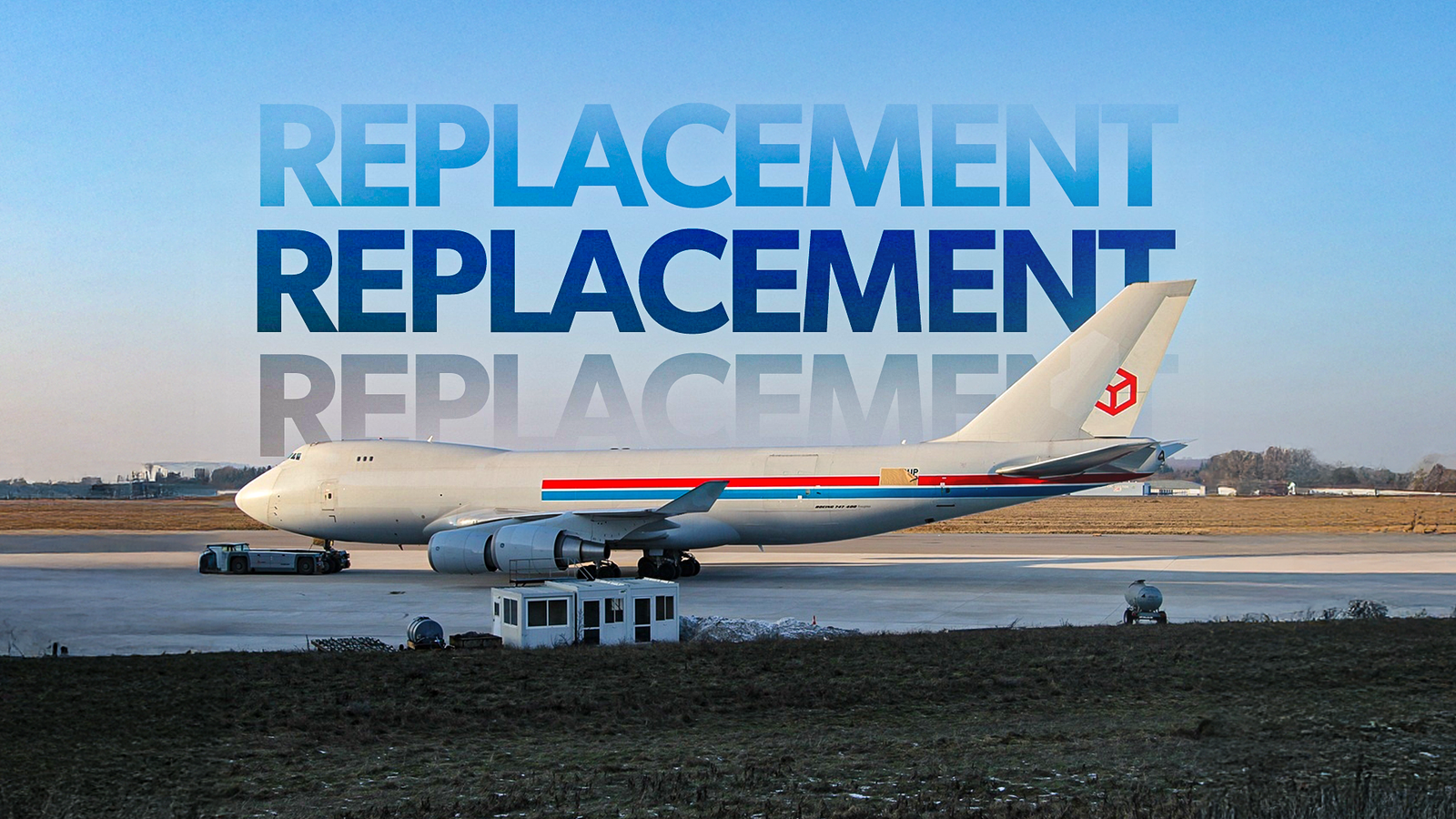
Published Sep 14, 2026, 2:00 PM EDT Jack comes to Simple Flying with a lifelong interest in all things aviation. He holds a degree in Aerospace Engineering from Georgia Tech, and is a certified private and remote pilot. Beyond these experiences, Jack previously worked for a corporate flight department where he gained first-hand experience in the world of business aviation. Currently, Jack works in the professional services industry and continues to build his flight hours outside of work. For more than half a century, the Boeing 747 has occupied a special position in global air freight. Its enormous capacity, long range, and distinctive nose door allowed operators to transport cargo that could not be loaded efficiently aboard conventional widebody aircraft. Yet the aircraft that made the jumbo jet famous is approaching the end of its production era, while stricter emissions standards are forcing airlines and cargo operators to reconsider their fleets. The next generation of large freighters will be dominated by two aircraft: the Boeing 777-8F and the Airbus A350F. Neither aircraft, however, is a complete replacement for the 747 freighter. Both are twin-engine aircraft designed to offer better fuel efficiency, lower operating costs, and improved environmental performance on mainstream cargo missions. The 777-8F will build on the established Boeing 777 freighter platform, while the A350F introduces a new composite structure and the largest main-deck cargo door in the commercial aviation industry. Their arrival will accelerate the retirement of older Boeing 747-400Fs, but the Boeing 747-8F will remain valuable for specialized shipments that require its forward-opening nose door. Boeing’s 777-8F Is The More Direct Successor Boeing’s 777-8F is the most obvious successor to the 747-400F because it is being developed by the same manufacturer and is intended to serve many of the same long-haul cargo markets. The aircraft will retain the 777 family’s established operating architecture while introducing more efficient engines, a redesigned wing, and improved structural performance. The first 777-8F airframe rolled out of final assembly at Boeing’s Everett, Washington, facility on April 23, 2026. The aircraft was built for Luxembourg-based Cargolux, one of the world’s most experienced large-freighter operators. Its appearance marked a major step for a program that has attracted substantial interest from airlines, logistics companies, and aircraft lessors. The aircraft’s order book has also expanded beyond Boeing’s traditional airline customers. After MSC Air Cargo added five aircraft at the 2026 Farnborough International Airshow, the 777-8F backlog crossed 80 firm orders. Qatar Airways Cargo accounts for a significant portion of that total, with an order for 34 aircraft and options for another 16 in a deal valued at more than $20 billion. Lufthansa Cargo, ANA, China Airlines, Korean Air, and Silk Way West have also committed to the type. The precise payload and range will depend on the final configuration and certification results. But its principal advantage is not simply the amount of cargo it can carry. The aircraft is intended to transport a comparable load to existing large freighters while burning substantially less fuel than a four-engine 747. Boeing’s challenge is timing. The company has guided the first delivery toward 2028 after moving the freighter schedule alongside delays affecting the passenger 777-9. Boeing recorded a $2.6 billion pre-tax charge associated with the wider 777X program, reflecting certification delays, production disruption, and higher costs. Boeing plans to end production of the Boeing 767 freighter in 2027, while new emissions requirements will restrict the production of current-generation freighters that do not meet the latest standards. Operators therefore face a narrow window in which they must decide whether to acquire additional 777Fs, extend the lives of existing 747s, or wait for the 777-8F. Airbus’ A350F Is A New Rival Credit: Airbus Airbus’ answer is the A350F, a dedicated freighter based on the A350 widebody family. Unlike the 777-8F, which evolved from an established freighter platform, the A350F is designed around a modern composite airframe, advanced systems, and a cargo structure optimized for heavy commercial use. Airbus has secured 107 firm orders for the aircraft from 14 customers, despite the fact that the A350F has not yet entered flight testing. The customer base includes Atlas Air, Air China Cargo, Etihad Airways, Singapore Airlines, Starlux Airlines, CMA CGM, Turkish Airlines, Cathay Pacific, and AviLease. Atlas Air placed a firm order for 20 aircraft in March 2026, making it the type’s largest customer. The A350F is designed to carry more than 242,508 lb (110,000 kg) of payload and offers a published range of approximately 4,700 nautical miles (8,704 kilometers). Its composite fuselage and wing structure should reduce weight compared with an equivalent aircraft built largely from conventional aluminum alloys. The aircraft also benefits from the A350 family’s existing engine, cockpit, and maintenance commonality. For operators already flying passenger A350s, the freighter could provide practical advantages. Airbus says the A350F shares complete engine-spares and tooling commonality with the passenger family, along with extensive airframe-tool and spare-parts commonality. Crews with an A350 type rating should also face a more straightforward transition than pilots moving to an entirely unfamiliar aircraft family. Airbus has completed the first A350F main-deck cargo door in Spain, but the broader program has moved later than its original development plan. Airbus continues to target first delivery in the second half of 2027, although Leeham News has reported that the initial delivery could slip into 2028. Airbus was targeting a first flight in late September, subject to technical and weather conditions. The A350F therefore enters the market with a strong order book but an unproven operational record. Its early success will depend on whether Airbus can complete certification, establish production reliability, and demonstrate that its lower fuel consumption offsets the higher acquisition cost of a new-generation freighter. Economics Favor Twin-Engine Freighters Credit: Ryken Papy | Shutterstock The move away from the 747 is driven primarily by economics. Four-engine aircraft remain capable, but they require more fuel, more engine maintenance, and more expensive support infrastructure than modern twin-engine freighters. On routes where payload, range, and airport limitations permit the use of a twin, the operating-cost difference can be substantial. The 777-8F and A350F are being developed during a period in which fuel efficiency has become a central fleet-planning concern. Cargo operators do not sell passenger seats, so they cannot offset high fuel costs through premium cabins or ancillary revenue. Their profitability depends on moving freight at a competitive cost while maintaining dependable schedules. The two aircraft also arrive as the industry prepares for tighter emissions requirements. New international standards will make it increasingly difficult to continue producing current-generation freighters that do not meet the latest carbon dioxide limits. This is one reason Boeing’s 777F and 767F programs face production deadlines, even though demand for large cargo aircraft remains strong. The 747-8F remains more efficient than the older 747-400F, but it still carries the structural and operating burden of four engines. The 777-8F is expected to offer a more favorable cost structure while preserving much of the 747’s long-haul cargo capability. The A350F is pursuing a similar objective through lightweight construction, modern aerodynamics, and the Trent XWB-97 engine. The savings will not apply equally to every route. A freighter’s economics depend on payload density, stage length, fuel prices, crew costs, airport charges, and the availability of return cargo. A twin-engine aircraft may be cheaper to operate on a standard intercontinental route, but a 747 can remain commercially valuable when its unique loading capability allows an operator to accept cargo that competitors cannot handle. For that reason, the transition will not be a simple one-for-one replacement program. Operators are likely to divide their fleets according to mission. The 777-8F and A350F will handle high-volume parcel traffic, general freight, express shipments, and standardized pallets. Older 747s will continue serving markets where physical access to the cargo compartment matters more than fuel consumption alone. Nose Door Keeps The 747 Relevant Credit: aviationisa | Shutterstock The 747 freighter’s most difficult feature to replace is not its size, but the nose door. The 747-400F and 747-8F can open the entire forward section of the aircraft, allowing cargo to be loaded directly from the front. This arrangement is particularly useful for oversized equipment, including drilling machinery, generator rotors, industrial components, and other items that cannot be tilted or maneuvered through a conventional side cargo door. Neither the 777-8F nor the A350F has a nose door. Both rely on side-loading arrangements, which means that even a large item must be positioned through an opening in the fuselage and moved into the cargo compartment at an angle. That process can create practical limitations when the shipment is long, heavy, unusually shaped, or sensitive to floor loading. Airbus has attempted to reduce the disadvantage by giving the A350F an exceptionally large main-deck door. The opening measures 175 inches (444.5 cm) across, with a clear width of approximately 169.5 inches (430.53 cm). Airbus says it is 15 percent wider than the main-deck door on the 777F and large enough to accommodate major aircraft engines without disassembly. The door is a significant engineering achievement. Airbus built it from composite materials and designed it as a structural part of the aircraft, rather than treating it as a simple opening fitted into the fuselage. Its location in the rear fuselage is intended to preserve an appropriate center of gravity during loading, while its electrical actuation system is designed to simplify ground operations. Yet width does not eliminate every limitation. A shipment that fits through the A350F’s side door may still need to be tilted, rotated, or positioned carefully inside the aircraft. That can create problems with floor-load density, clearance, and the distribution of weight. The 747’s nose door avoids much of that maneuvering because cargo can enter horizontally through the front. The distinction is especially relevant in project cargo markets. A parcel operator can standardize its freight around pallets and containers, but industrial logistics often involves one-off shipments that were not designed around an aircraft’s cargo door. For those missions, the 747-8F remains difficult to replace. The 747-8F Will Remain In Service For Decades Credit: Pexels The arrival of new twin-engine freighters will reduce the number of older 747s operating on routine cargo routes, but it will not eliminate the type. The 747-8F is still a relatively young aircraft compared with the 747-400F, and deliveries continued as recently as 2023. Approximately 107 747-8Fs have been delivered, giving operators a substantial fleet of modern jumbo freighters with many years of useful life remaining. The aircraft’s future will depend on how operators value its unique capabilities. Some 747-8Fs will likely be retired as maintenance costs rise and replacement parts become more expensive. Others may move into specialized roles, where their nose doors and large internal volume justify the additional fuel burn. Freighter operators also tend to retain aircraft longer than passenger airlines. A passenger aircraft may become commercially unattractive when its cabin, seating layout, or onboard product becomes outdated. A freighter’s value is more closely tied to its structural condition, payload capacity, loading arrangements, and maintenance history. If those characteristics remain useful, an older cargo aircraft can continue generating revenue long after it would have disappeared from passenger service. The 747’s secondary market will also support its longevity. Aircraft that are no longer competitive on scheduled routes can be converted into charter, heavy-lift, or specialized logistics platforms. The next decade will therefore produce a mixed fleet rather than a clean succession. The 777-8F and A350F will become the principal choices for operators seeking lower costs and compliance with future emissions standards. The 747-8F will continue to serve cargo that cannot be handled as efficiently by either twin-engine competitor. Future Of Heavy Air Freight Will Be Divided By Mission Credit: Airbus The aircraft replacing the 747 on most cargo routes will not be a single model. Boeing’s 777-8F and Airbus’ A350F will share the mainstream market, offering more efficient alternatives for standardized freight and long-haul network operations. Their arrival will make it increasingly difficult to justify the cost of operating older four-engine freighters on ordinary routes. However, the 747’s most important contribution to cargo aviation is its nose door, which creates a capability that remains difficult to reproduce with a side-loading aircraft. As a result, the 747-8F will survive where cargo dimensions, floor loading, and loading access matter more than fuel efficiency. The long-term shift will be toward a specialized division of labor. New twin-engine freighters will carry the majority of high-volume international freight, while a smaller number of 747-8Fs will support project cargo, oversized shipments, and missions that require front loading. The 747 will no longer define the cargo market, but its most distinctive feature will ensure that it remains part of that market for decades.
The Aircraft Set To Replace The Iconic Boeing 747 On Cargo Routes
Full Article
Original Source
Read the full article at Simpleflying →KhanList aggregates and links to publicly available news content. We do not host full articles from third-party sources. Always verify important information with original sources.