
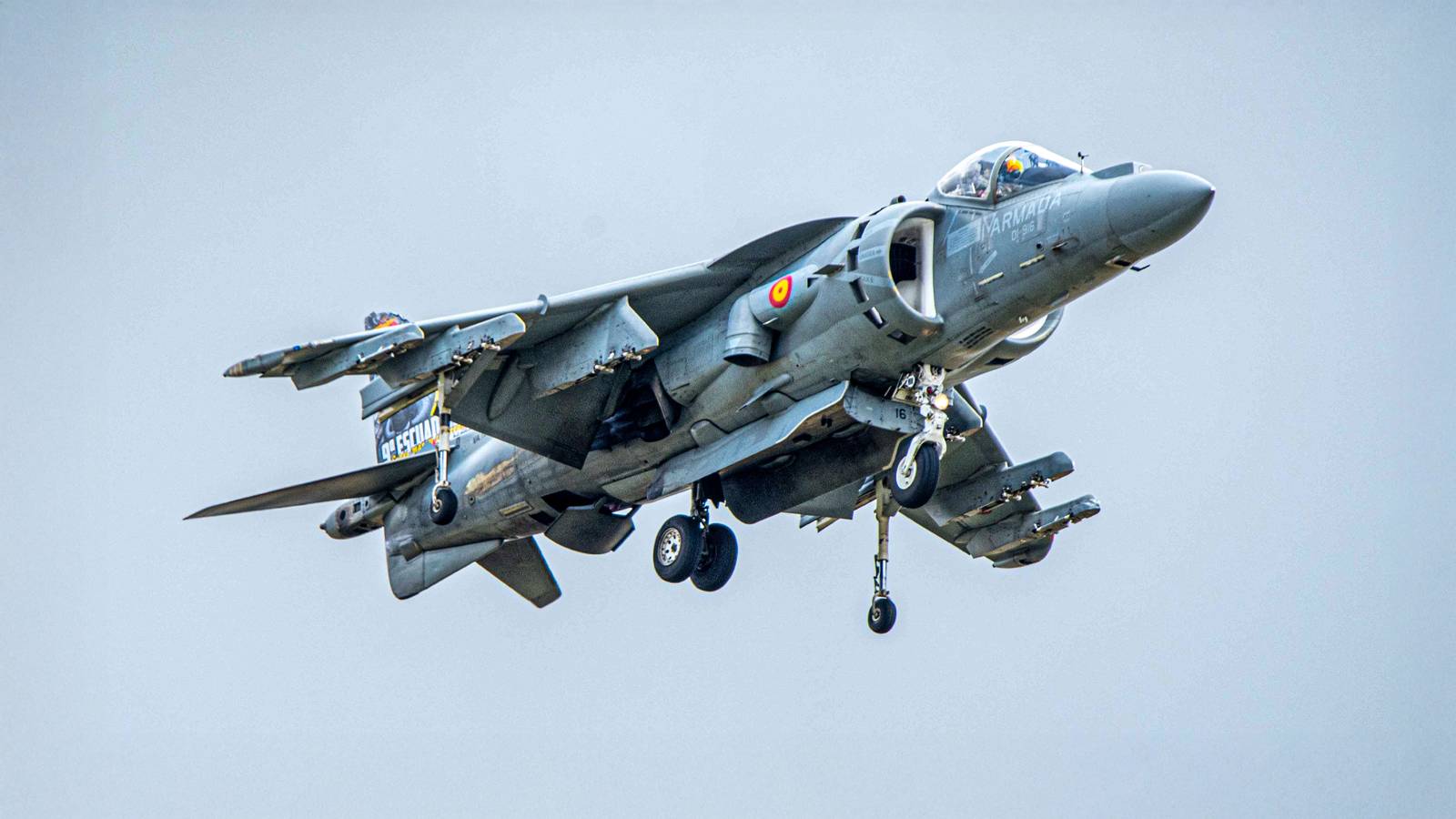
Published Sep 20, 2026, 9:00 PM EDT Passionate about promoting aviation, the beauty of flight and the science behind it, Antonio is an avid reader of aviation magazines and books, and he loves visiting airshows all over the world, taking photos and writing about airplanes and helicopters as well. He is currently based in Palermo, Sicily. The US Marine Corps has finally retired the aircraft that made an amphibious assault ship look like a small aircraft carrier. On June 3, Marine Attack Squadron (VMA) 223 held its sundown ceremony at Marine Corps Air Station Cherry Point, marking the end of the Boeing AV-8B Harrier II's operational career with the service. The replacement is already flying: the Lockheed Martin F-35B Lightning II will preserve the Harrier's ability to operate from amphibious assault ships while adding stealth, advanced sensors, and networked combat capabilities. The Marine Corps says VMA-223 was its final operational Harrier squadron and is scheduled to reactivate as Marine Fighter Attack Squadron (VMFA) 223 in fiscal year 2028 with the F-35B. The transition changes more than the aircraft parked on an assault ship's flight deck. It changes what a Wasp- or America-class ship can contribute to a fight, because the F-35B combines short-takeoff/vertical-landing capability with a fifth-generation sensor and information architecture that the Harrier was never designed to provide. The Harrier Era Has Ended In The US Credit: BlueBarronPhoto | Shutterstock The AV-8B Harrier II occupied a unique place in Marine Corps aviation for more than four decades. Its short- takeoff and vertical- landing capability allowed the Marines to operate fixed-wing attack aircraft from expeditionary bases, short runways and the flight decks of amphibious assault ships. That gave a Marine Expeditionary Unit something unusual: a ship capable of carrying helicopters, tiltrotors, and fixed-wing combat aircraft without requiring the catapult and arresting gear of a conventional aircraft carrier. The Marine Corps' official account of VMA-223's final sundown ceremony confirms that the squadron was the service's last operational AV-8B unit. It also explicitly connects the end of the Harrier era with the transition to the F-35B and F-35C, with VMA-223 scheduled to return as an F-35B squadron in FY2028. That makes the ceremony more than a retirement event: it is the final handoff between two generations of Marine fixed-wing aviation. It also closes a chapter that shaped Marine aviation for years. The Harrier's importance was inseparable from the ships it operated from. Unlike any other conventional carrier fighter jet, the AV-8B did not need a catapult to launch or an arresting hook to recover. It could give an amphibious assault ship a fixed-wing strike capability while allowing the vessel to retain its primary role as a platform for amphibious operations. The F-35B inherits that fundamental advantage, but almost everything surrounding it is different. The F-35B Preserves The Harrier’s Unique Advantage Credit: Antonio Di Trapani | Simple Flying The simplest reason the F-35B can replace the Harrier is that it can operate from the same type of ship. Its most important characteristic for the amphibious force is the STOVL system. The B variant is the only member of the F-35 family capable of short takeoffs and vertical landings, allowing it to operate from amphibious assault ships without the catapults and arresting gear used by conventional aircraft carriers. Lockheed Martin describes it as the only supersonic STOVL stealth fighter, with a maximum speed of Mach 1.6 and an internal-fuel combat radius of more than 450 nautical miles (833 km), according to the F-35B product card. In 2015, six F-35Bs began operational testing aboard USS Wasp. The test generated 110 sorties and more than 85 flight hours, according to the Marine Corps' account of the evaluation. A few months later, the Marine Corps declared the F-35B operational, with ten aircraft and the personnel and equipment required to deploy worldwide, as detailed in the service's initial operational capability announcement. That capability has also given the F-35B an unusual degree of basing flexibility away from the sea. Simple Flying recently examined the point in Why The F-35B Is The Only Stealth Fighter That Can Land On A Finnish Highway, highlighting the aircraft's ability to operate from unconventional landing areas. The Finnish example is obviously different from an amphibious assault ship, but the underlying advantage is the same: the F-35B does not need a conventional fighter runway to recover. This flexibility becomes particularly valuable when fixed bases face attack or disruption. The basic shipboard requirement was solved early. The more interesting question is what the Marines can do with that capability once the aircraft is operating from the deck. Stealth Changes What The Aircraft Can See Credit: Antonio Di Trapani | Simple Flying The AV-8B and F-35B may share the same unusual landing method, but their combat philosophies are very different. The Harrier was a subsonic attack aircraft whose value came from bringing weapons close to the battlefield. The F-35B is a supersonic multirole jet that was designed around finding threats, understanding the battlespace, and sharing information while remaining difficult to detect. That difference starts with the aircraft's sensors. The F-35B combines its AESA radar, electro-optical systems, electronic warfare equipment, and other sensors through its mission-system architecture. Rather than forcing the pilot to treat each sensor as a separate source, the aircraft fuses information into a common tactical picture. Lockheed Martin describes sensor fusion and connectivity as central elements of the F-35 design in its official F-35B material. That changes the value of an amphibious assault ship's aviation component: the Harrier could attack targets for the Marines ashore; an F-35B can do that while also collecting information that can be passed to other aircraft, ships, and forces. Its usefulness goes beyond how many weapons it can deliver during a sortie. A single aircraft can consequently influence decisions far beyond its immediate target. The aircraft also brings low observability into the equation. A Harrier could operate from a ship that conventional fighters could not, but its survivability against modern air defenses was never based on stealth. The F-35B was designed from the beginning to make detection and engagement more difficult, giving the assault ship a fixed-wing aircraft that is much better suited to a contested battlespace. That is the fundamental technological leap. The Lightning Carrier Expands What The Ship Can Do Credit: Faizinraz | Shutterstock The Marine Corps has already demonstrated how far the concept can be pushed. In April 2022, USS Tripoli operated with 20 F-35Bs during a Lightning Carrier demonstration. The Marine Corps described the exercise as a demonstration of how an amphibious assault ship could generate fifth-generation combat power while operating within an expeditionary naval force. That experiment demonstrated how aviation capacity could be concentrated without conventional carrier infrastructure. The official Marine Corps account provides the details of the demonstration. The Lightning Carrier concept also gives commanders another way to distribute aviation power across a naval force. A traditional carrier remains the fleet's principal platform for sustained fixed-wing operations, but an F-35B-equipped amphibious assault ship can add a separate source of fifth-generation combat power. Twenty F-35Bs do not make Tripoli equivalent to a nuclear-powered aircraft carrier, and the aircraft impose different operating and sustainment requirements, but the demonstration showed that an America-class assault ship could support a substantial fifth-generation fighter component without acquiring the catapult and arresting gear of a conventional carrier. The concept also changes the relationship between the ship and the rest of the fleet. A Harrier-equipped amphibious ship could provide valuable local strike capability, but an F-35B-equipped ship can contribute to a much wider sensor and targeting network. The aircraft can support the Marine force ashore, contribute to air defense, gather intelligence and attack targets while using its low-observable characteristics to reduce its exposure to enemy defenses. More Capability Comes With A Higher Price Credit: Department of Defense The F-35B's additional capability comes with considerable technical complexity. Its propulsion system combines the Pratt & Whitney F135 engine with a shaft-driven lift fan, a three-bearing swivel module, and roll-control nozzles, allowing the aircraft to redirect thrust for vertical flight while remaining capable of supersonic conventional flight. That machinery is what makes the B variant fundamentally different from the F-35A and F-35C. The aircraft is also significantly larger than the Harrier. Lockheed Martin lists a maximum speed of Mach 1.6, an internal-fuel combat radius of more than 450 nautical miles (833 km), and an internal-fuel range of more than 900 nautical miles (1,667 km). Those are manufacturer figures and should not be interpreted as universal mission ranges: weapons load, reserves, flight profile, and environmental conditions all affect actual performance. The financial side is similarly complicated. The Government Accountability Office's current F-35 sustainment assessment estimates steady-state annual operating and sustainment costs for a Marine Corps F-35B at approximately $7.4 million per aircraft in constant FY2012 dollars, compared with a Marine Corps affordability target of $6.8 million. The GAO's latest assessment also documents wider F-35 sustainment concerns. The Marine Corps is therefore accepting a much more complicated aircraft because the capability it wants has also changed. That tradeoff becomes harder to ignore as the fleet expands and matures. The question is whether that aircraft can remain useful when the battlefield is filled with modern sensors, electronic warfare, and sophisticated air defenses. VMA-223 Will Complete The Transition Credit: Faizinraz | Shutterstock VMA-223's retirement makes the transition particularly easy to measure. The squadron flew the Harrier for years, deploying it frequently, and ultimately became the final operational Marine Harrier unit. When it eventually returns as VMFA-223 in FY2028, it will represent the conversion of the last operational Harrier squadron into an F-35B unit. The Marine Corps has already established the infrastructure for that transition elsewhere. Harrier squadrons have progressively converted to F-35Bs, while the F-35C is taking the place of legacy McDonnell Douglas F/A-18 Hornets in the conventional carrier environment. Simple Flying has previously examined the differences between the F-35A, F-35B and F-35C, which are designed around different basing and operating requirements despite sharing the same basic fighter architecture. That is the real significance of the June 2026 sundown. The Marine Corps is carrying the concept into an environment in which stealth, sensors, networking, and survivability are increasingly important. VMA-223's return in FY2028 will make that transition visible at squadron level.
The Aircraft Set To Replace The Iconic AV-8B Harrier On Amphibious Assault Ships
Full Article
Original Source
Read the full article at Simpleflying →KhanList aggregates and links to publicly available news content. We do not host full articles from third-party sources. Always verify important information with original sources.