
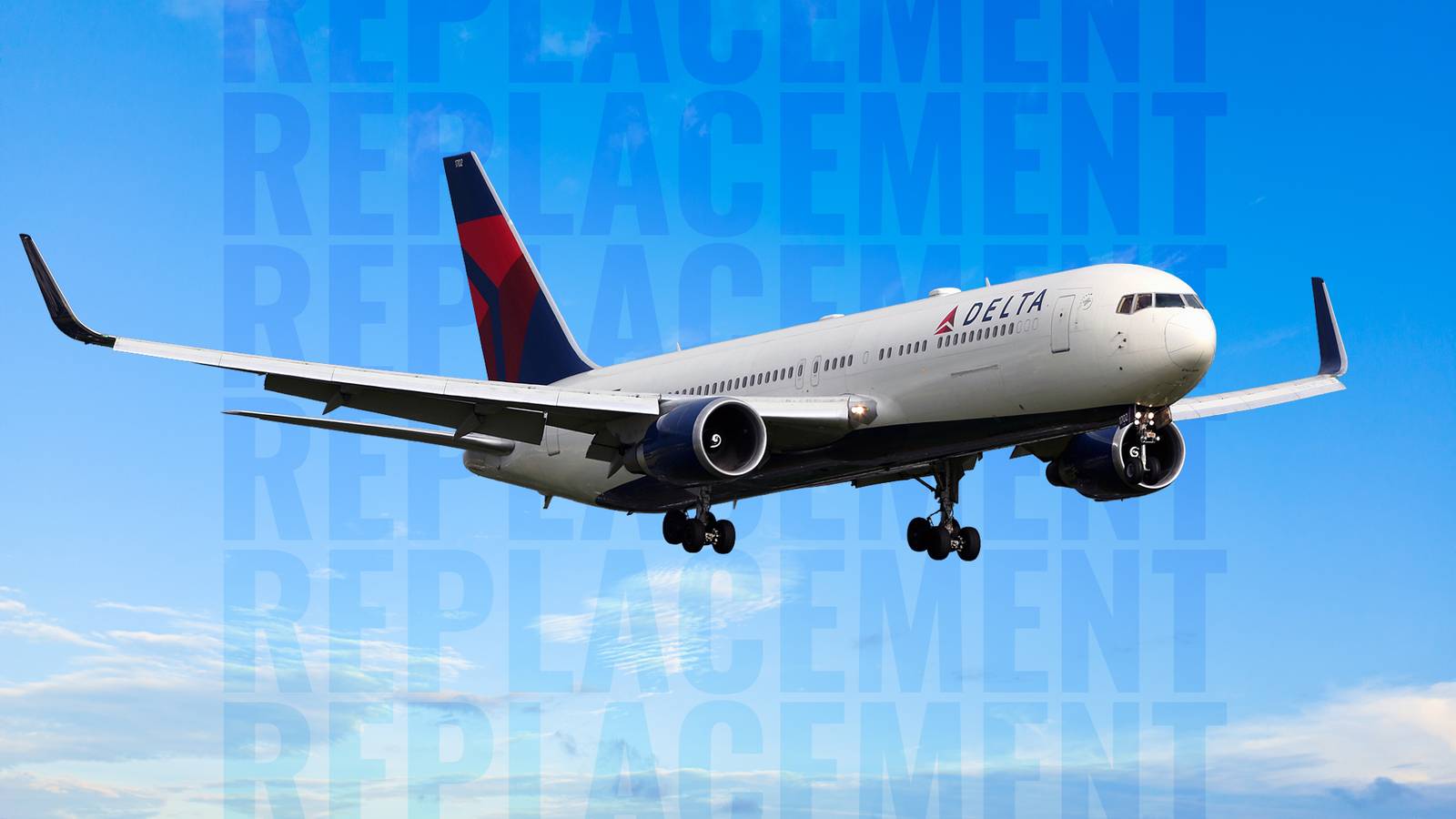
Published Aug 27, 2026, 5:15 AM EDT Luke Diaz is a freelance military writer with experience with active duty experience in the US Navy as well as defense and industrial engineering. He is a former Naval Flight Officer who performed tactical air control on the carrier-based E-2 Hawkeye. Delta Air Lines is still flying a veteran fleet of 57 Boeing 767 widebody twinjets that have been in service since the 1980s. Today, the 767-300ER cadre of 36 planes is nearly 30 years old on average, while the 21 767-400ERs are more than 25 years old, according to Planespotters.net data. Each variant still in service is a stretched version of the original 767-200 jetliner. As these long-serving, long-haul twinjets approach the end of their service lives, the question is what will take their place? In recent years, Delta has shown a new preference for Airbus widebodies, with both the A330 and A350 joining its fleet. Just like the 767, the big Airbuses serve a mix of international destinations, transcontinental domestic routes with high traffic, and the always densely packed treks across the Pacific to Hawaii. The A350 has proven to be an outstanding, state-of-the-art jet for the busiest and longest flight routes, but its larger capacity makes it a more suitable replacement for the aging Boeing 777s. Especially since Delta has shown no interest in the 777X, saying it doesn’t fit the airline’s fleet strategy. That leaves the A330neo, a modernized and re-engined successor to the original Airbus A330, as the most likely successor to the 767. Multiple Contenders Credit: Shutterstock Delta already flies more A330s than 767s. The airline has 81 in total, including the legacy models, the A330-200 and A330-300, alongside the newer A330neo. The 767-300ER fleet is expected to be phased out of service by 2030, and the 767-400ERs will remain for a while longer, but not many more years. Delta has not made an official announcement about which plane will fill this void, and speculation is split between the A330neo, A350, or even the Boeing 787 Dreamliner (for which it recently placed an order). The A330neo is the closest match to the 767-400 in terms of size, with a slightly wider cabin and a similar maximum seating capacity. The A330-300 has already taken over some 767-300ER routes, which shows a fleet strategy moving in the same direction. The A330neo would give Delta a more modern platform that brings new Delta One Suites, along with roughly 25% lower fuel consumption, without significantly changing the calculus of network capacity and fleet deployment. The 767 By The Numbers Credit: Shutterstock The 767-300ER was initially adopted by Delta in 1988 to serve international destinations alongside McDonnell Douglas MD-11s, providing the airline with a more flexible fleet arrangement. A future deployment of A330s, A350s, and 787s on overlapping routes would achieve the same strategic goal with modern platforms. Late in 1997, Delta became the launch customer for the 767-400ER. This time, the planes were intended to serve both long-haul international service and high-density domestic routes. The jets have served a myriad of the most popular destinations at home and abroad in their tenure, including Florida vacation getaways, New York City, Europe, and South America. Specifications (Per AXON Aviation) Boeing 767-300ER Range 2,150 statute miles Speed 530 mph Typical Seating 204 passengers (18 First, 186 Economy) Engines 2 General Electric CF6-80A First Delivery October 27, 1982 First Scheduled Service December 15, 1982 Delta has owned every major variant of the 767 series and currently maintains the largest existing fleet of the jet family. Its last 767-200 was retired in 2006, and the final flight of a Delta-liveried non-ER 767-300 touched down in 2019. Since then, the remaining 767-300ERs and 767-400ERs have continued to serve the carrier. When the 767 debuted, it was 30% more efficient and quieter than its predecessors. It introduced smoother handling in the air and featured one of the first digital cockpits in commercial aviation. The 757 shared the same flight deck controls, allowing pilots rated on either of the two jets to fly both, a watershed moment in commercial flying history. Airbus’ Innovative A330neo Credit: Shutterstock The A330-900 from the A330neo series was designed from the beginning to be more efficient on any route length than its predecessor. Whether it's short-to-medium-haul high-density corridors or long-haul transoceanic, Airbus claims the jet beats out legacy models by 25% in fuel burn. Directly comparing the A330neo and the 777-200, Airbus made the plane similar in size and performance but better across the board on efficiency and comfort. The 'Airspace' cabin is more spacious, modern, comfortable, and well-equipped than those found on the jet's older Boeing rivals. Delta has been an enthusiastic operator of the type since receiving its first examples in 2019. Ed Bastian, Delta’s CEO, commented on the introduction of the new Airbus widebody, saying: “The A330-900 is going to be an important addition to Delta’s fleet. Airbus has infused this next generation of the successful A330 Family with new technology and features providing advanced levels of comfort for our passengers and significant operating cost reductions that will make our airline stronger in the decades to come.” Specifications Airbus A330-900 Maximum passenger seating 465 Typical three-class seat capacity 287-303 Maximum pallet capacity 11 or 33 LD3 Maximum range 7,350 NM (13,600 km) Cruise Mach Mach 0.82 (629 mph/1,012 kmh) Overall length 208 feet, 11 in (63.7 meters) Wingspan (geometric) 209 feet, 11 inches (64 m)eters Height 55 feet (16.8 meters) The A330neo may not be a clean-sheet design like the A350, but it does offer a host of modern upgrades over its predecessors, including composite materials, new Rolls-Royce Trent 7000 engines, upgraded avionics, and cabin amenities such as state-of-the-art inflight entertainment. The jet was designed with the smaller 777 models in mind as a market competitor, which also slots it into a nicely proportioned and well-equipped rival for large 767 models, like the ones Delta still flies. Airbus Overtakes Boeing Credit: Shutterstock One reason why an Airbus airframe is likely to be more compelling than one from Boeing when it comes to replacing the 787 at Delta is the American planemaker’s struggles in recent years. Since 2020, Boeing has been on a roller coaster of difficulties with both the 737 MAX and 777X series. The 787 has been a solid product line for Boeing, but that didn’t prevent widespread loss of confidence among customers and flyers alike. Boeing's previously stellar reputation was tarnished by the fatal crashes of the two 737 MAX jets that killed 346 people. Meanwhile, the 777X remains uncertified, which leaves it unavailable even if Delta wanted to buy it. Production numbers have been correspondingly low, trailing Airbus by hundreds of deliveries each year. The reliability of not only Airbus’ safety record and sustained quality control over the past decade, but also its consistent production output, makes it a more reliable choice. Assuming all things are equal between competing aircraft, Airbus still has the advantage thanks to its better performance as a manufacturer over the past few years. Delta’s Fleet Strategy Credit: Shutterstock Delta, like many airlines, is pushing to replace its older planes with fuel-efficient twinjets. The newest generation of commercial aircraft represents a major leap forward. Fuel efficiency improvements of 15-25% alongside lower maintenance costs, higher reliability, and quieter power plants complement more spacious, better-equipped, and aesthetically pleasing cabins than ever before. Delta also has the benefit of running one of the largest maintenance, repair, and overhaul centers in the world at its home base: Atlanta. The self-reliant fleet has kept models like the Boeing 717 flying en masse long after other operators cut their inventories or phased them out completely. The combined strength of Airbus’ excellent new aircraft, its standing as a reliable maker, and Delta’s own capacity to keep its planes running in top shape would be the ideal combination. As Delta has been expanding its international network this year, more A330neos would be highly valuable not only to fill the gap left by the 767, but also to branch out into new opportunities. Agustín Durand, Delta's General Sales Manager in Argentina, said of the A330-900 that “this aircraft is not only a symbol of our commitment to improving the customer experience, but it also strengthens our connectivity between Argentina and the United States." Durand went on to say that "with the A330-900, we continue to provide our customers with world-class service and one of the most modern aircraft on the market.”
The Aircraft Set To Replace Delta Air Lines’ Boeing 767s
Full Article
Original Source
Read the full article at Simpleflying →KhanList aggregates and links to publicly available news content. We do not host full articles from third-party sources. Always verify important information with original sources.