
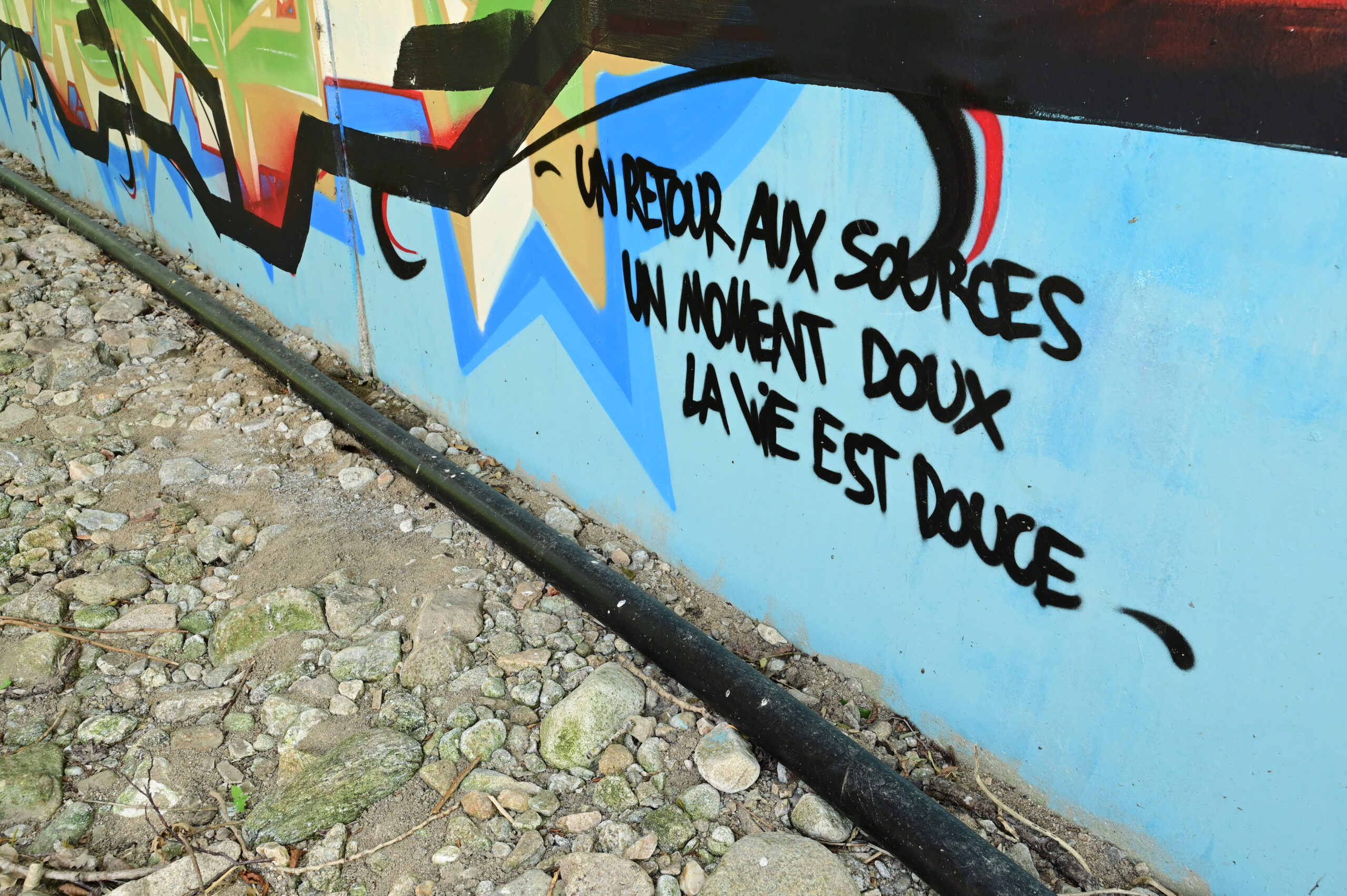
Culture Graffitists and modern architects alike are screaming into the void of mass culture. Photo by Romain Doucelin/NurPhoto via Getty Images Once more on my way from the center of Paris to the airport, I marvelled at the sheer hideousness of almost everything built since the end of the Second World War, the precise time when France was becoming richer than it had ever been. There must be a lesson here somewhere, but I don’t know what it is. Also remarkable, though not pleasing, was the sheer scale of the spray-painted tagging of practically all of the visible surfaces en route. This, too, must have its lessons, or at any rate some cultural meaning. The ubiquity of the tagging is something of a puzzle, at least to me, much like the rarity of visible dead animals and birds, though one knows that every single one of the billions of animals and birds that inhabit our world must die. In like fashion, though tagging is ubiquitous, and obviously done by many people, I have never seen anyone doing it. Graffiti is just there, as if by natural emanation from the surfaces on which it appears. In its way, this is impressive. The taggers have reached places that must be difficult, and even dangerous, of access. How do you paint the underside of a bridge with several lanes of traffic going in both directions? This bespeaks an ingenuity and determination that is more than ordinary. If only it were in pursuit of some worthy object! At any rate, it proves that the spirit of adventure among the young is not entirely dead. In many cases, unfortunately, it probably has little alternative outlet. There is surely more to tagging in dangerous places, however, than a taste for adventure. I can only surmise as to the motives of taggers, but a desire to make a mark, among those who would have difficulty otherwise in doing so, is likely to be one of them; and making a mark is of ever greater importance in a society obsessed with celebrity. There is a peculiar ethic among taggers that has emerged spontaneously: no one may cover or paint over another’s efforts. He who first sprays a surface—I assume most taggers are male—regards it much as colonists once regarded underpopulated lands inhabited by primitive or pre-political peoples, that is to say as terra nullius, an empty patch over which sovereignty might rightfully be claimed. At last, something of his own! Mostly what taggers spray is incomprehensible to passers-by, being some kind of signature, though on the way to the airport I saw two messages in huge letters: TRISTE ET SORDIDE (sad and sordid) and JÉSUS SAUVE! (Jesus saves). Whether the first was an ironic comment in general on the genre of tagging, I cannot say; but certainly, the overall impression of so much graffiti is of a society in which there is neither the effective exertion of authority nor any sense, at least among a certain stratum of society, of personal restraint or responsibility towards the public space. The ego and its expression are all. At a somewhat higher level, but with the same unpleasant effect, are the efforts of the star architects of our time. Their buildings are a form of tagging. “Here I am,” they say, “you can’t avoid me—I want to leave my mark.” How else does one explain, to take a single appalling example, Daniel Liebeskind’s extension to the Royal Ontario Museum in Toronto, which is not only completely out of keeping with the building that was already there, but out of keeping with any possible, any imaginable, building? He didn’t design it to fit in with the place; he designed it so that everyone who passed it would say as he did so, “Daniel Liebeskind,” or at the very least, “The architect!” The extension is, of course, hideous, a kind of splinter in the eye, its jagged and irregular shape giving the impression that this is precisely what it is intended to be. And what is true of Liebeskind’s work at the Royal Ontario Museum is true of an untold number of similar buildings designed by others of his ilk. Such architects have no more regard for the public space than the lowest and least imaginative of those who tag bridges, walls, and subway trains. Subscribe Today Get daily emails in your inbox But the egoism of individuals, though it certainly exists, is not sufficient to explain the erection of these buildings that are self-evidently and self-consciously designed to be “iconic”—a word whose application to any work or product is, like the term “world-class,” a guarantee of banality and mediocrity. Architects do not erect buildings by themselves. As a necessary condition for the completion of their bizarreries, they must have patrons with a great deal of money. Their wealth or power notwithstanding, such patrons are often in awe of the artists they enable, whose chief assets are not craftsmanship or artistic excellence, but rather self-promotion, self-confidence, and an ability to insinuate that those unwilling to bankroll the construction of their outrageous designs are like those art collectors who once scorned the “daubs” of Van Gogh. Patrons who refuse to toe the line, or be led by the nose, are thus terrorized into thinking that they might be on the wrong side of history. Many young people, if asked what they aim to do in life, will reply that they “want to make a difference.” I never heard this ambition in my own youth. I suspect that it is the making of the difference, which is to say the satisfaction of their egos, that is most important to them, not the improvement the difference might bring once made. The need, or desire, to leave a mark, to be noticed, to stand out in some way, grows ever stronger in an increasingly impersonal mass society. Tattooing is another manifestation of this desperate urge for individuality. Modern star architects are tattooists, or taggers, on a larger scale, more technically sophisticated, perhaps, but impelled by the same inglorious, though understandable, motives. We have entered an era of mass narcissism.
The Age of the Ego
Full Article
Original Source
Read the full article at Theamericanconservative →KhanList aggregates and links to publicly available news content. We do not host full articles from third-party sources. Always verify important information with original sources.