
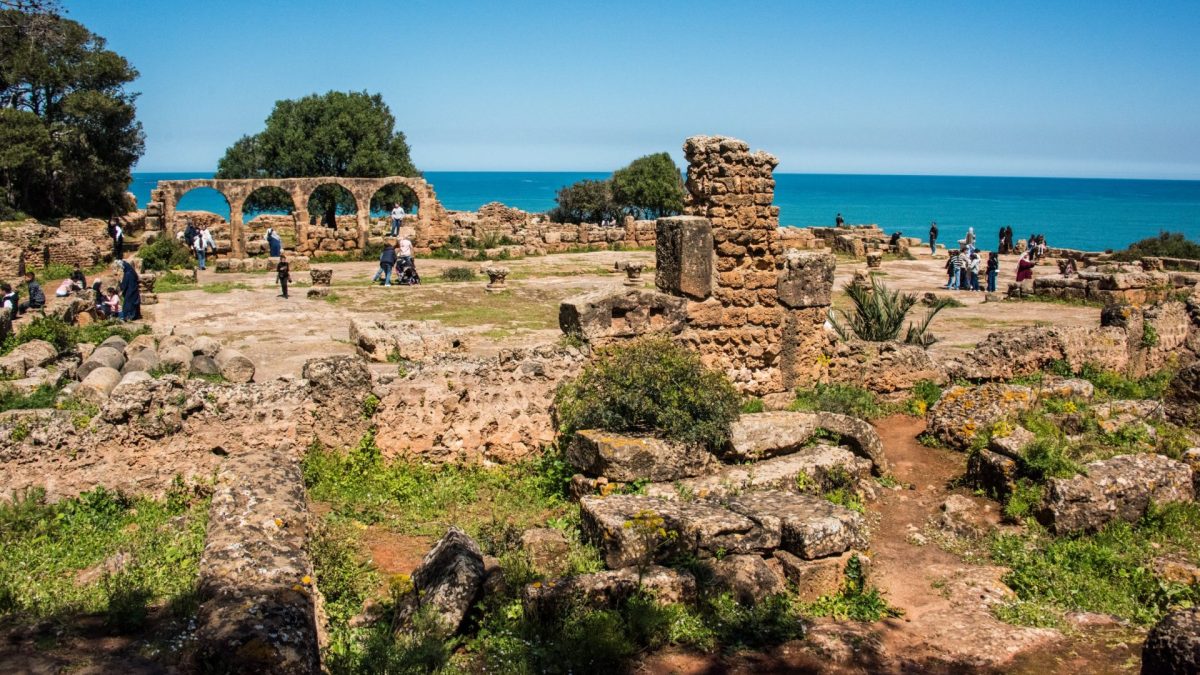
Wedged between Morocco and Tunisia, Algeria receives a fraction of the number of tourists of its neighbours. But that’s changing. The government wants to triple the number of visitors to 12 million in the next four years by restoring historical sites, encouraging hotel investment and easing visa restrictions. There are many compelling reasons for visiting Africa’s largest country, which is still imbued with its French past, scarcely touched by tourism, and contains some of the most-prized but least-visited sites of antiquity in the western world. Its size also gives it staggering diversity, from the fertile Mediterranean coast to the Atlas Mountains and Sahara Desert. I have to confess, however, that it was a bargain fish dinner that clinched it for me. On the smart quayside terrace of Le Dauphin, overlooking the old fishing port of Algiers, I was served a rich Provençal fish soup, a fine slab of grilled merou (grouper), and a half-litre bottle of Aboukir rosé for the equivalent of £42 at bank exchange rate – or £24 at the unofficial but easily available street rate. Shorts The Algerian capital is often compared to Marseille, 470 miles to the north, not least for the twin Notre Dame statues looking across the sea at each other atop the twin basilicas that dominate the two cities. At Le Dauphin’s Marseille equivalent, the classic Chez Fonfon say, my fish dinner would have cost £100. Price is clearly a motive for visiting Algeria. My room in Algiers’s stylishly brutalist Aurassi – in 1975 the largest luxury hotel in Africa – was a third of a Marseille equivalent. Rooms in renovated heritage hotels are typically less than £70 per night, while five-star beach resorts can cost less than £150. A taxi ride via Yassir – the admittedly unreliable local Uber-style service – costs £1 or £2, a ticket on the cool calm Metro around 28p. Taking advantage of expedited and more relaxed visa rules for those who travel with a tour agency, I joined a group tour of the Mediterranean coast, for many a curious blank space between Tunisia and Morocco, and, an hour west along the motorway from Algiers, I found the closest thing to mass tourism among the atmospheric tree-shaded ruins of the one-time Roman trading port of Tipaza. Notre Dame d’Afrique (Photo: Nabil Chettouh/Wikimedia Commons/Mustafagunes2) A few dozen, mainly Algerian, visitors strolled the massive stone-paved lanes around the beautiful azure bay eulogised by Albert Camus, while a small row of restaurants and gift stalls made a low-key attempt at commerce. However, the crowds were Pompeii-scale compared those at the ruins of Hippo Regius, in the suburbs of the eastern port of Annaba, about 100km from the Tunisian border. Here, hardly a soul disturbed the wildflowers and fig trees on the great stone floor outlines of the Roman baths, villas and forum. Nearby on a low hill, a 19th-century basilica dedicated to the early theologian-bishop and Christian superstar Saint Augustine contained a few small knots of visitors who were dwarfed by its soaring and immaculately restored interior. Romans, Christians, more Romans: on the hour’s flight back from neat little Annaba airport to Algiers, it struck me that I hadn’t yet visited a mosque. The Grand Mosque of Algiers (Photo: Hakim H/Getty) That was soon sorted at the Algerian showpiece of the millennium, the new Grand Mosque of Algiers. The third biggest in the world, it cost €1bn and was completed in 2019. Roaming its vast marble patios and prayer hall, I was struck by the sense that each prostrating worshipper seemed to have floor space the size of a tennis court, beneath a skyscraper minaret with glass windowed lifts accelerating smoothly to the thirty-seven 37th floor observation terrace. It was another monument minus crowds. Seen from the minaret, the Casbah, the crumbling Unesco-listed Ottoman kernel immortalised cinematically in Gillo Pontecorvo’s 1966 war film The Battle of Algiers, is a steep white hillside jumble, true to the epithet Alger la blanche. I first visited the Casbah more than 20 years ago when it was only just cleared of extremist militants from the 1990s Black Decade civil war. Now islands of restoration exist, and a more easy going pace of life has returned to its narrow stone alleys and steep stairways. The Palace of the Dey – once the residence of the Regency of Algiers in the Ottoman Empire – has been thoroughly renovated in gorgeous colours and in its garden a bustle of craftsmen was preparing it for eventual public opening. As I tried to navigate the Casbah’s maze, the slightest look of uncertainty would have friendly residents stopping to walk me to my intended destination, however far. Sidi El-Houari is one of Oran’s most historic neighbourhoods (Photo: Makrouf Walid/Getty) About 200km from the Moroccan border, Oran – Algeria’s second city – is known for its Haussmannian-style streets, libertine atmosphere (well, relatively) and Spanish heritage. Thanks to its 10th-century Andalucian merchant founders, it is more Alicante than Marseille. The old bullring, long disused, was hosting pétanque games when I visited, and it’s hoped that it will soon host events and concerts. An excursion through scrub-covered hills took me to Tlemcen, heart of Algeria’s Andalucia, the fiefdom of the medieval Muslim dynasties expelled from Spain to refuges such as Tlemcen’s peaceful Mechouar palace, with its Granada-like tilework and fountained patios. Back in Oran, along the Corniche, where wailing rai pop music pumps out of cabaret cafés – contributing to Oran’s louche reputation – I called by another emblematic site. Les Andalouses was one of the first State tourism projects in newly independent Algeria, created in 1973 by the prolific French architect Fernand Pouillon. A low white replica Mediterranean village lining the golden sand of the coast, it is under renovation for tourism’s second coming. Expect beach cafés, watersports and west-facing sunset views. A boulevard in central Algiers near Place Emir Abdelkader (Photo: Sergio Amiti/Getty) Personally, I was hooked. I am itching to go south and see the red city of Timimoun and the Saharan oasis jewel of Djanet. And I’ve still got unfinished business along the Mediterranean. There’s the Roman hill city of Djamila, Constantine with its very own Clifton Suspension Bridge, and more investigative clambering round the Casbah. And most importantly, a bargain dinner on the seafront in Jijel, the capital of Algerian fish couscous. How to get there Air Algerie flies direct from Stansted and Heathrow to Algiers, while British Airways flies from Gatwick. Among the companies offering Algeria tours is Wild Frontiers Travel. Its 11-day Algeria: Saharan Desert Adventure group tour starts from £3,245pp for a 14 March 2027 departure. Alternatively, join the waiting list for its Algeria: Roman Ruins and Mediterranean Shores (Eclipse Special), which is nine days from £3,895pp, departing 27 July 2027. wildfrontierstravel.com More information British passport holders require a tourist visa, which costs £85, algerian-consulate.org.uk ont.dz tourismalgeria.com
The affordable country with a Mediterranean coast and crowd-free Roman ruins
Full Article
Original Source
Read the full article at Inews →KhanList aggregates and links to publicly available news content. We do not host full articles from third-party sources. Always verify important information with original sources.