
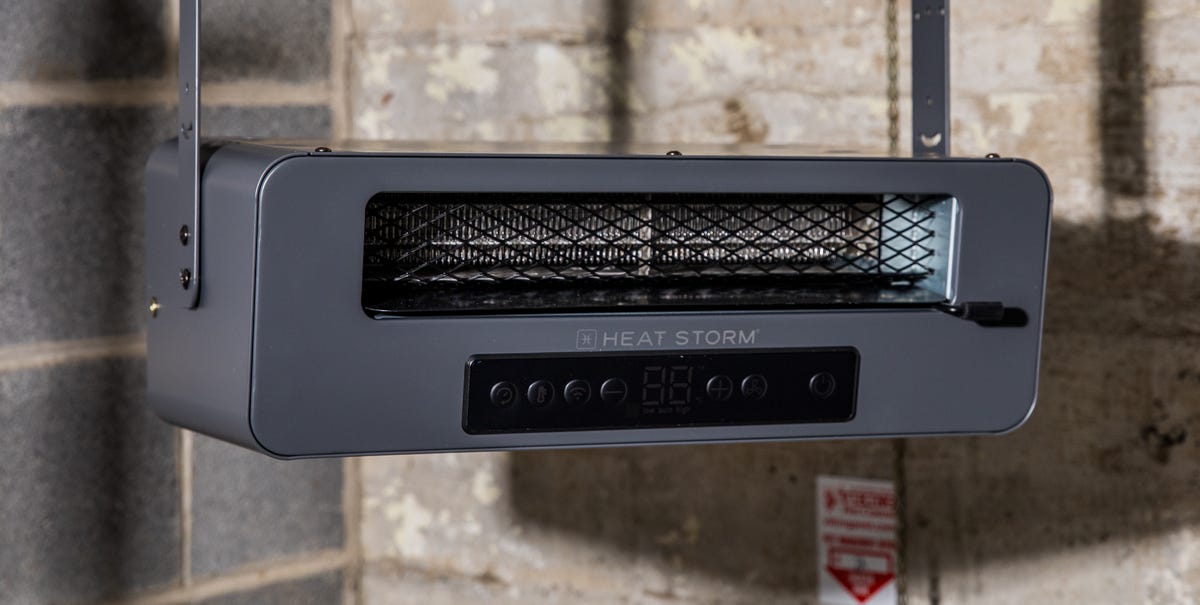
ProsCompact size Remote-controlled thermostatCan be used mounted or unmounted ConsWall-mounted thermostat sold separatelyThis 240-volt compact garage heater is the best all-around choice for most spaces, with 7,500 watts of heating power and the option to mount it on the wall or ceiling.According to the manufacturer, it warms a typical garage or unheated building to between 50 and 85 degrees Fahrenheit and should be installed with a foot of clearance from combustible surfaces.The garage heater’s adjustable louvers let you direct air where you need it most, and a remote-controlled thermostat is built into the front of the heater. A wall-mounted thermostat is available for the unit as well, but it’s sold separately.Key SpecsTypeElectric, forced airHeat Output25,591 BTUsInstallationHardwiredSize15 x 19 x 13 in.Weight26 lbs.ProsWi-Fi-enabledHeats up to 1,000 square feetEasy-to-read displayThanks to its Wi-Fi capability, you can operate this heater from virtually anywhere to ensure your garage is warm when you get home, or to heat the space before you spend time at your workbench. You can turn the unit on and off and set recurring schedules through the app.The garage heater is rated to warm a 1,000-square-foot area, with an adjustable output of up to 20,000 BTUs. It can be mounted to the wall or ceiling, and its large digital temperature display is easy to read, even from across the room.But for the price, it’s disappointing that the garage heater doesn’t include wiring.Key SpecsTypeInfraredHeat Output20,000 BTUsInstallationHardwiredSize21.3 x 10 x 16 in.Weight20.2 lbs.Advertisement - Continue Reading BelowProsHeats up to 600 square feetTwo different fan settingsBuilt-in cord wrapConsCarry handle could be more comfortable For a powerful 5,600-watt portable garage heater, we recommend this NewAir model. It’s designed to warm spaces up to 600 square feet, and it includes a 6-foot cord that neatly coils on top of the unit, with brackets to hold it down.The fan has two settings: automatic (which turns on when the heating element activates) and continuous. You can switch between the two manually.Use continuous mode to keep air moving in spaces with high ceilings or when you’re operating an air-cleaning appliance, like a bench-top air filter, as it helps push dusty air through to speed up the process.Key SpecsTypeInfrared, fanHeat Output19,107 BTUsInstallationPlug-inSize 11 x 10.5 x 14 in.Weight16.6 lbs.ProsBuilt-in safety shutoffAdjustable tripod standIP55 ratingDesigned for outdoor areas like patios, this Briza heater still works well in a garage thanks to its dust-resistant properties. It comes with an adjustable tripod that you can set between 44 and 84 inches tall. Selecting between its three heat settings—900, 1,200, or 1,500 watts—is easy with the unit’s remote control.The heater has a built-in safety sensor that automatically shuts the appliance off if it tips over. A timer provides additional safety (and energy savings) by automatically shutting the heater off after 1 to 9 hours of operation.Key SpecsTypeInfraredHeat Output5,000 BTUsInstallationPlug-inSafety ListingNot listedSize35.5 x 4 x 4 in.Weight17.2 lbs.Advertisement - Continue Reading BelowProsOffers a localized heating solution Compact, lightweight designNo electricity requiredConsOnly suited for small spacesFor a compact, affordable garage heater ideal for targeted heating, this propane-fueled unit from Mr. Heater is a great choice. It delivers 4,000 to 9,000 BTUs from a single 1-pound liquid propane canister and can heat up to 250 square feet. It works great on the floor by your workbench or desk.The heater can run for up to three hours on high, or you can upgrade to a 20-pound tank with a separately sold adapter. The heater’s size and weight make it easy to reposition, and it’s easy to bring with you to a shed, campsite, or other workspace.Key SpecsTypePropaneHeat Output4,000 to 9,000 BTUsInstallationN/ASize13.4 x 8.3 x 15 in.Weight10.6 lbs.ProsHeats up to 450 square feetRemote-controlled thermostatBuilt-in timerConsNot a lot of coverage for the priceThis heavy-duty, 240-volt garage heater is ideal for climates with major temperature swings, featuring a two-stage high-and-low heating system.Its lower heat output suits mildly cool days, while the higher stage can warm garages in single-digit temperatures. It also has a fan mode ideal for increasing airflow in a potentially stuffy garage, plus an energy-saving setting that defaults to the lowest wattage to maintain the desired temperature.A universal bracket is included for easy mounting to a ceiling or wall, and this heater has a remote-controlled thermostat. The only drawback is that it doesn’t offer much coverage for the price.Key SpecsTypeElectrical, forced airHeat OutputNot listedInstallationHardwiredSize 13.5 x 15 x 16.5 in.Weight31.5 lbs.Advertisement - Continue Reading BelowProsHeats up to 2,000 square feet120-volt powerPropane conversion kit includedConsThermostat, hose, and regulator sold separatelyLengthy installation processIf you have an uninsulated wood garage or another minimally insulated space, this large, ceiling-mounted garage heater is worth a look.It runs on natural gas (a propane conversion kit is included) and, with a built-in electric fan, can warm areas up to 2,000 square feet thanks to its impressive 80,000-BTU output. It also has a powered exhaust that allows for vertical or horizontal venting.Note that the Big Maxx does not come ready to install; you’ll have to purchase a thermostat, gas hose, fittings, and regulator separately. For most people, it’s best to have a licensed heating-cooling contractor install this garage heater.Key SpecsTypeNatural gasHeat Output80,000 BTUsInstallationHardwiredSize30.3 x 27.6 x 22 in.Weight88.2 lbs.What to ConsiderSafetyThere’s a lot to consider when using a heater to keep your garage safe and comfortable. So we picked the brain of Pat Porzio, a mechanical engineer and multi-licensed tradesman (electrical, plumbing, HVAC). He’s also the HVAC manager for Russo Brothers in East Hanover, New Jersey. We also spoke with David Shapiro, an electrician, author, and expert on old house wiring who contributes to electrical product and installation standards.Both agree on one thing: Your overarching concern in heating a garage is safety. The first words out of both their mouths were identical: “Pull a permit.” That is, if you plan to use a permanently installed electric or gas-fired garage heater, you need to file a building permit for the work—whether you do the work yourself or hire a contractor. Permitted installations are inspected by the town or other authority with jurisdiction over this work where you live, which increases the likelihood of a safe installation.Aside from pulling a building permit for the electrical work, Shapiro steers homeowners away from any heater without a UL (or other safety-related U.S. testing agency) listing.Using a 120-volt space heater is simpler; same goes for small propane-fired and kerosene heaters. You don’t need a building permit to use one of these in a garage. Still, there are safe and unsafe ways to use these heaters. For more on that topic, check out our garage heater safety tips below.TypeAs we mentioned earlier, there are a couple of different types of garage heaters. Electric heaters are easier to install, don't require a vent, and are generally safer. But depending on your local electricity rates, they can be more expensive to run. Gas heaters use natural gas or propane, and they can be a more cost-effective option for heating larger garages. They require ventilation, which can be a pain if you don't already have the right setup.Infrared heaters heat objects rather than the air, so they can be a good companion for localized projects at your workbench. Forced-air heaters use a fan to distribute heat quickly and work well for large spaces, but they require good insulation to run efficiently and may kick up dust around your workshop.For most garages, an electric heater is often the most viable option because it's easy to install, safe, and effective. But if you have a larger or poorly insulated garage, a gas heater might be the way to go.Size“A bigger heater is not necessarily better,” Porzio says. “An oversized heater will short cycle. That is, it will turn on and off too frequently. It satisfies heating demand very quickly and abruptly turns off. A heater that is too small will do just the opposite. It will run and run and never fulfill the heating demand, eventually wearing itself out.” Before contractors install a boiler or furnace, they perform a series of calculations, called a Manual J, to determine the correct size. While homeowners can get a rough estimate by multiplying the area's square footage by 50 to get the required BTUs, Porzio recommends using simplified Manual J forms online or a sizing tool like those on King-Electric.com and Newair.com.For reference, a two-car garage will need a heater ranging from 30,000-50,000 BTUs to reach a consistent, comfortable temperature.InstallationWhether you attempt the electrical work or hire it out, Shapiro has two more recommendations. First, don’t install the heater so that a power cord leading to a machine or tool could be draped directly in front of it. The heat can damage the cord.Second, consider installing a CO alarm in the garage. A CO alarm can make the garage a safer place to work, especially if you’re heating it with gas, and it can also protect the occupants of the house.Advertisement - Continue Reading BelowGarage Heater Safety TipsNever modify any heater such that it can be used in a manner that the manufacturer did not intend. For example, unless a manufacturer specifically states otherwise, an electric heater intended for hard-wired installation should not be modified to be plugged into an outlet.Any permanently installed heater must be installed so it doesn’t become a fire hazard. For example, the heater must be kept a safe distance from combustible surfaces. Consult the manufacturer’s installation data and local building or fire safety codes for this information.Any heater (portable or installed) can pose a fire hazard when it’s used in the presence of combustible liquids and gases, particularly gasoline. For example, don’t refill a snow thrower’s gas tank in a garage with a heater running nearby. A heater can ignite gasoline fumes.When using a portable heater, be mindful of pets and children coming near the heater and potentially touching hot surfaces.Don’t use any portable propane or kerosene heater in the garage that isn’t equipped with safety features. These include a low-oxygen cutoff or a safety shutoff that turns the appliance off if it’s violently jarred or tipped over.Every shop needs a fire extinguisher placed in an accessible location.Amber is a Reviews Editor with bylines on Popular Mechanics, Runner’s World, Bicycling, and Best Products sites. Specializing in kitchen gadgets, small appliances, lifestyle, and consumer tech, she brings hands-on testing and a detail-oriented approach to every review. In her free time you can likely find her trading trinkets at an EDM festival, searching for hidden gems at thrift stores, or cuddling with her two cats.Rachel is the Deputy Editor of Reviews for Hearst's Enthusiast and Wellness Group where she supports Popular Mechanics, Runner's World, and Best Products. Her background is in service journalism and earlier in her career she worked as a daily newspaper reporter and book editor. She spent more than a decade as a staff editor and writer at TripAdvisor and Penguin Random House and her byline has appeared in Time Out New York, the New York Daily News, and New York Magazine. Outside of work, Rachel can be found planning her next trip, visiting museums and galleries, and walking her wirehaired dachshund in Central Park.
The 7 Best Garage Heaters for Your Workshop
Full Article
Original Source
Read the full article at Popularmechanics →KhanList aggregates and links to publicly available news content. We do not host full articles from third-party sources. Always verify important information with original sources.