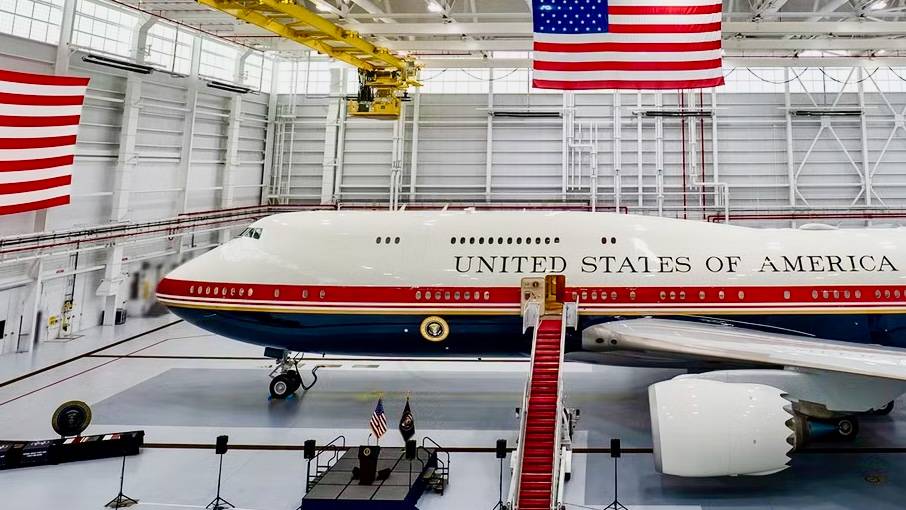
Published Jul 18, 2026, 1:00 PM EDT Airline and Airport Management Graduate, Student Commercial Pilot and Commercial Aviation Writer. Based in London & Nagoya Air Force One, arguably the most recognizable symbol of American diplomatic and military power globally, is getting a serious makeover through a brand-new jet. Beneath the familiar blue-and-white paint job of the next-generation fleet lies a surprising, rather convoluted backstory. The United States government is currently spending billions of dollars to transform two commercial Boeing 747-8 airframes that spent years sitting idle in the California desert into the ultimate airborne command posts. Known formally as the Boeing VC-25B program, it has become one of the most highly scrutinized and financially painful defense contracts in recent memory. The decision to buy pre-built aircraft rather than ordering custom-made airframes from scratch was originally pitched as a clever, cost-saving shortcut for the American taxpayer. However, stripping down a pair of commercial jumbo jets and rebuilding them to withstand nuclear electromagnetic pulses, evade surface-to-air missiles, and provide uninterrupted global communications has proven to be anything but simple or cheap. From Passenger To Presidential Credit: US Air Force The two jumbo jets destined to become the next presidential transports did not start their lives with government contracts or secret handshakes. Instead, they were rolled out of the Boeing factory in Everett, Washington, configured as standard passenger airliners for Transaero, a major Russian commercial carrier. Before the airline could take delivery of its new flagships, economic realities intervened, and Transaero filed for bankruptcy in 2015. Suddenly, Boeing found itself holding a pair of massive, highly expensive 747-8 aircraft with no buyer in sight, leaving the manufacturer to fly them out to the Mojave Desert for long-term storage. For two years, these pristine aircraft sat under the intense desert sun, their engines covered, and their windows sealed, waiting for an uncertain future. The turning point arrived in 2017 when the United States Air Force, facing pressure to replace its rapidly aging fleet of VC-25A aircraft, recognized a unique acquisition opportunity. The Air Force purchased these orphaned commercial airframes outright, skipping the lengthy initial manufacturing queue and adding the platforms at a significant discount compared to a brand-new custom order. The initial purchase seemed like a financial win, but it immediately introduced unique engineering challenges. The aircraft had already been built to commercial airline passenger standards, and so, engineers could not just install military hardware as the fuselage was assembled. Instead, technicians faced the tedious, labor-intensive task of peeling back the existing commercial infrastructure to make room for heavy-duty military modifications. This process essentially required dismantling perfectly good commercial airframes to build something entirely new and custom from the inside out. Surviving All Possibilities Credit: US Air Force Turning a commercial passenger jet into a secure military command center naturally needs structural alterations that push the limits of modern aerospace engineering. The most demanding upgrade involves complete structural hardening against an electromagnetic pulse, an intense burst of energy caused by a high-altitude nuclear detonation that can instantly fry conventional civilian electronics. To shield the aircraft, technicians have to install more than 200 miles (321 km) of heavily insulated, military-specification wiring throughout the airframe, which is roughly double the amount found in a standard commercial 747. The layout of the jet is also completely reimagined across its 4,000 square feet (372 square meters) of interior floor space. The lower deck is heavily modified to include autonomous baggage handling systems and integrated airstairs, allowing the aircraft to operate completely independently of ground support equipment at remote or compromised airfields. The main and upper decks are converted into an airborne executive suite, complete with a dedicated medical annex featuring a fold-out operating table, a secure briefing room, private quarters for the commander in chief, and robust galleys capable of feeding up to 100 people at a time. These extensive modifications significantly alter the weight distribution and electrical demands of the platform. The standard commercial engines are optimized with four advanced General Electric GEnx-2B turbofans, each delivering 66,500 pounds (30,164 kg) of thrust to handle the increased operational weight. Additionally, the aircraft has a second auxiliary power unit and highly upgraded electrical generators to supply continuous energy to the massive array of secure satellite communication links and defensive countermeasure suites. Not All Straightforward Credit: Shutterstock The VC-25B is unlike any other aircraft on the planet, though the business side of the program has been plagued by severe financial stress. In 2018, Boeing agreed to a fixed-price contract worth $3.9 billion to cover the cost of the modifications. Under a fixed-price arrangement, any development expenses that exceed the initial budget have to be absorbed entirely by the contractor rather than the government. As technical issues mounted, most notably severe deficiencies discovered in the intricate custom wiring systems, Boeing's financial losses on the project skyrocketed past $2.8 billion, making it a stark lesson in the financial perils of fixed-price defense procurement. The combination of technical setbacks, supply chain shortages, and a lack of highly cleared personnel capable of working on top-secret defense systems pushed the expected delivery dates back by several years. The first fully upgraded VC-25B jet is now not anticipated to enter active service until 2028 or 2029, leaving the military with a serious dilemma as the older VC-25A airframes approach the hard limits of their operational life cycles. Filling in for the time being and helping relieve operational strain, the Air Force recently accepted a temporary, modified Boeing 747-8 gifted from the government of Qatar, designated as the VC-25B Bridge aircraft, which entered service in the summer of 2026 to assist with executive transport duties until the permanent fleet is complete. Despite the ongoing delays and intense political debate surrounding the project's financial management, defense officials stress that shortcuts are not an option when it comes to presidential safety. As the Air Force conducts commissioning flights for its temporary interim transport, work continues around the clock on the permanent fleet. Secretary of the Air Force Troy Meink remarked that the delivery “proves that the US Air Force can move fast without sacrificing quality, security, or reliability,” demonstrating the rigorous, disciplined engineering approach required for the ultimate presidential mission. How Long Can The Existing Fleet Last? Credit: Shutterstock The severe financial overruns and production delays facing the next-generation transport planes directly impact the day-to-day operational readiness of the active presidential fleet. With the official delivery dates for the incoming VC-25B models deferred by several years, the responsibility for maintaining continuous global executive transport falls squarely back on the shoulders of the two existing VC-25A platforms. These heavily modified aircraft have served as the flying command centers for American presidents since the 1990s, meaning their structural components are rapidly approaching the hard limits of their engineered service lives. Managing these decades-old airframes brings with it an extraordinary amount of specialized maintenance that strains military logistics channels. According to the US Air Force Presidential Airlift Fact Sheet, the VC-25A fleet requires intense depot-level overhauls after a relatively low number of flight hours compared to standard commercial passenger variants. Commercial OEM suppliers stopped producing parts for the classic Boeing 747-200B airframe layout decades ago, necessitating custom-fabricated individual replacement components made from scratch by third-party companies, driving total operational cost per hour to historic levels. This ongoing logistics hurdle creates a narrow window for scheduling overseas presidential trips, as one airframe must constantly remain undergoing deep technical evaluations while the other handles active flight duties. Those in charge of keeping the presidential fleet running, therefore, need to manage the remaining structural life of these icons, balancing the need for top-tier executive security against the harsh reality of aging metal fuselages. Moving Into A Library? Credit: Shutterstock A highly unusual solution to delays came when the US military accepted a VIP-configured Boeing 747-8 directly from the royal family of Qatar as a formal diplomatic donation. Valued at approximately $400 million at the time of its transfer, this immense aircraft was absorbed into the military transport system to be a crucial temporary bridge platform, soaking up flight hours that would otherwise rapidly deplete the remaining structural lifespan of the main fleet. Operating under a temporary framework, the ex-Qatari airliner received roughly around its total value in added taxpayer-funded defense overhauls, including advanced tactical countermeasure suites and encrypted secure communications terminals required to safely move the head of state. While the aircraft successfully conducted its inaugural presidential mission, its long-term destination has triggered intense legislative and logistical debates. According to current operational proposals, plans are underway to formally transfer ownership of this temporary asset to a private presidential library foundation in Miami by January 1, 2029, making it a permanent post-service monument. The quick retirement schedule presents a great challenge, as the massive passenger liner stretches a full 250 feet (76 m) in length. Permanently parking a jumbo jet inside a skyscraper-style library structure in downtown Miami will require engineers to completely disassemble the wings and tail sections before reconstructing the airframe inside the purpose-built civilian lobby. Such an unprecedented plan has faced strict federal scrutiny, as the disposal of active military hardware remains heavily restricted by international security regulations. Next Generation Of Presidential Travel Credit: US Air Force Resolving the lateness of the presidential transport ecosystem ultimately depends on the manufacturer's capacity to stabilize its assembly lines and deliver the permanent VC-25B platforms to the flight line. The temporary reliance on a foreign-gifted bridge aircraft highlights the fragile state of modern defense manufacturing, illustrating how easily global supply issues can disrupt the most critical transportation networks in the world. Boeing is still absorbing structural losses and refining the complex wiring layouts on the two primary airframes, but the focus remains firmly locked on achieving full military certification before the close of the decade. The extreme difficulties encountered throughout this modification project show that the modern airborne command center is an entirely unique breed of military machine, requiring an industrial precision that civilian assembly lines are rarely built to accommodate. Promising and guaranteeing absolute survivability for the executive branch means that timeline metrics must always take a back seat to engineering perfection. Looking ahead toward the late 2028 operational target, the strategic map for the presidential airlift program will finally begin to clear as the permanent fleet nears completion. Once these highly customized flying fortresses enter active duty, they will secure the skies for decades to come, bringing a long-awaited end to an industrial saga that redefined the boundary between commercial aviation and national defense.
The $5.3 Billion Program Turning 2 Stored Boeing 747-8s Into America's Next Air Force One
Full Article
📰 Original Source
Read full article at Simpleflying →KhanList aggregates and links to publicly available news content. We do not host full articles from third-party sources. Always verify important information with original sources.