
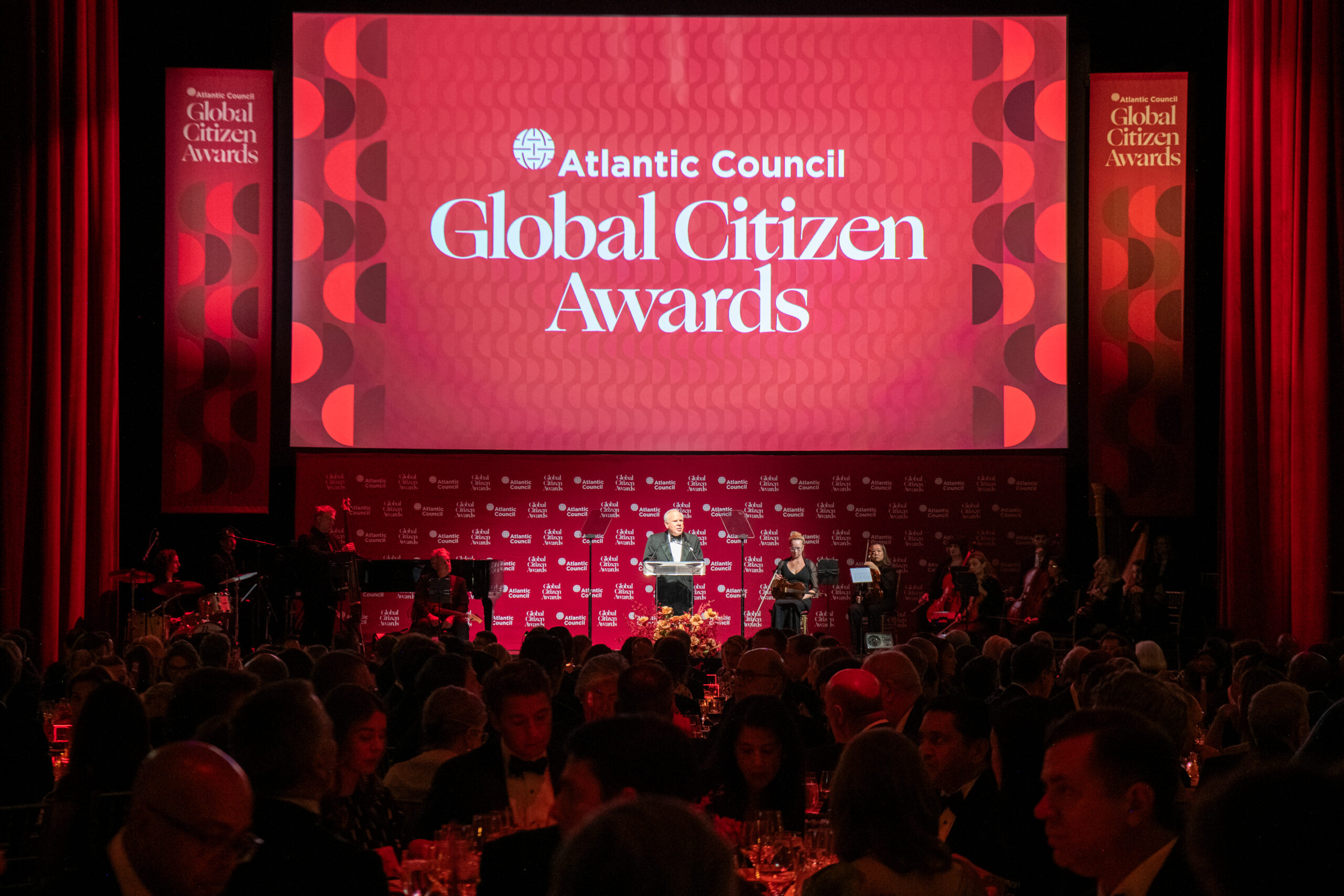
Fitting for an event with global in its name, the fifteenth annual Atlantic Council Global Citizen Awards began with a striking assessment of the world today. “We are living through something larger than a period of instability,” Atlantic Council Chairman John F.W. Rogers told the packed house at the Waldorf Astoria in New York on Wednesday night. “We are living in between world orders.” Rogers explained that the old international order is giving way to something “much more complicated” than what existed over the past few decades. Multiple centers of power are emerging; alliances are overlapping; partnerships are shifting. Globalization and democracy are being challenged, too, but the rules of the new order remain unwritten. “The task is to build what comes next,” Rogers told the audience of some seven hundred leaders in business, government, civil society, and the arts. “In moments of fracture, we need leaders who look outward, who build bridges instead of walls, who choose partnership over isolation, and who bend the arc of events toward something better and brighter,” Rogers said. That is the work embodied by the four honorees this year. Finnish President Alexander Stubb; Australian Prime Minister Anthony Albanese; Formula 1® President and CEO Stefano Domenicali; and actress, singer, author, and producer Cynthia Erivo were each presented with a Global Citizen Award for their leadership in shaping a brighter future. Building this future will require new institutions, too. Announcing the launch of the Atlantic Council’s Power of Sports Center, Atlantic Council President and CEO Frederick Kempe described the shared aspirational values of sports and international order: “Imagine a world where people from different nations, cultures, backgrounds can come together, not as adversaries but as teammates and as competitors. That is the power of sports.” Below are more highlights from the evening celebrating these four global citizens. Alexander Stubb: “The transatlantic partnership is not going to die” Stubb spoke of his transatlantic background, growing up in Finland before moving to South Carolina for college on a golf scholarship. “For me, what the Atlantic Council does is exactly what I’ve tried to do most of my life,” he said. “I’m pro-European. I’m pro-American. And therefore, I’m a pro-transatlanticist.” The Finnish president spent much of his time at Furman University in the library studying international relations, which informs his view of the global scene today. “I do think that we are witnessing a 1918, 1945, or 1989 moment in international relations—so a moment when the order is changing,” he said. The turning point, he said, was Russia’s 2022 full-scale invasion of Ukraine: “We’re all very good at criticizing it, but I don’t think that’s enough.” In responding to this new order, “we have a fairly binary choice,” Stubb said. “The [first] choice is a multipolar, transactional, and conflictual world, where interest drives what you do. I quite often think it’s rather short-sighted. The other option is much better, and that’s multilateralism.” “There are a lot of people who are extremely worried about the transatlantic partnership right now,” said Stubb, who quipped that perhaps he is less concerned as a Finn because “when I get worried, I go to the sauna and take a cold plunge.” But he added: “The transatlantic partnership is not going to die. It is going to come back, and it’s still coming back. So keep that in mind.” In introducing Stubb, Czech President Petr Pavel praised the Finnish president’s “remarkable ability to analyze complex situations, understand the forces shaping them, and anticipate where they may lead.” Learn more about the awards Stefano Domenicali: The power of sports is to unite while embracing differences Sports has taught Domenicali an essential life lesson, he said when accepting his Global Citizen Award: “It is possible to compete at the highest level without ever losing respect for others.” Domenicali marveled at how competition brings different people together, as seen before each Formula 1® race: “Thousands of people arrive from every corner of the planet. They speak different languages and come from different cultures, histories, and perspectives.” Yet each shares a desire to compete and win, he said. And the power of sports extends beyond the track, field, or court, Domenicali added. “Fans come from all over the world,” too, he explained, but “when the lights go out, millions of people, even thousands of miles apart, share the same emotion at the very same moment.” Too often in the world today, he explained, differences between people become distances, and distances become divisions. Sports offer a necessary and practical reminder that “we can be different, we can compete, we can even be rivals, without ever ceasing to recognize and respect one another.” Of course, part of recognizing and respecting others is embracing one’s own origins. “I have always carried with me who I am and where I come from,” Domenicali said, reflecting on growing up in Italy. At the same time, he added, “being proud of your roots doesn’t mean closing yourself off.” Being a true global citizen, he explained, means “knowing where we come from while never losing the curiosity and respect needed to understand others.” Introducing Domenicali, Hollywood actor Keanu Reeves hailed how under Domenicali’s leadership, Formula 1® has “evolved from a global racing championship into a global cultural force,” reaching new audiences and inspiring them to connect with the sport in new and meaningful ways. Anthony Albanese: Leadership at its best makes people’s lives better “The world we live in is changing rapidly,” Albanese told the audience. Many prevailing assumptions—for example, that openness was security, that efficiency mattered more than resilience, and that international rules would be observed as a matter of course—are being tested, he explained. “Australia’s response to this is to actively seek to shape and build the order that replaces the old, while preserving the rules that matter most,” Albanese said. “Our alliance with the United States is the anchor of Australia’s foreign policy,” Albanese said. At the same time, his country’s approach to China, Australia’s largest trading partner, is also clear, he said: “We cooperate where we can, we disagree where we must, but we engage in the national interest.” But the Indo-Pacific is not simply “a chessboard on which superpowers move the pieces,” Albanese noted. “Its countries and its people are not spectators. They’re shaping their own future, and they’re writing their own script,” he said, noting Australia’s two new alliances with Papua New Guinea and Fiji as examples. “It’s not been unnoticed in Australia that an Australian getting an Atlantic Council award … says something about your organization as well,” Albanese said, given that his country fronts the Pacific, Indian, and Southern oceans but not the Atlantic Ocean. It says that “you understand that all of the world matters.” The prime minister of Papua New Guinea, James Marape, in his introduction praised Albanese’s focus on people. “At a time of conflict, geopolitical competition, climate change, and economic uncertainty, we need leadership that recognizes that international relationships must ultimately improve the lives of people across all borders,” Marape said. “My friend Anthony understands this responsibility.” Cynthia Erivo: “Art can be a lifesaver” Erivo—who has played characters ranging from abolitionist Harriet Tubman to Elphaba in Wicked—said her choices are intentional. “I pick the roles that force me to learn about the human condition, about loss, about change, about identity, about pain, about joy, about beauty, about love,” she said. “Because if I don’t make the choice to keep learning, I short-change myself. But most importantly, I short-change you. How can I share what I don’t understand?” Erivo spoke about the power of art to bring people together, “to try to understand that our differences are what make us unique and special.” “Art can be a lifesaver,” she added. “And I think the work isn’t just to be a vessel for it … but to be someone who can provide the space and the opportunity for more artists to grow and take on the challenge of changing the world.” Erivo mused that she’s not sure that “I’m quite as deserving of this award as you think,” but she would “continue to make choices in my work that create the space for love, curiosity, and understanding.” Then, perhaps one day, she will come upon her Global Citizen Award and think “at last I’ve earned it.” Atlantic Council Executive Vice Chair Adrienne Arsht introduced Erivo by speaking of her unmistakable voice and style, but also the power of her work. “Art cannot negotiate a treaty or pass a law, but it can change the people who do,” Arsht said. “It can cross a boundary that argument cannot. It can make a stranger’s humanity impossible to ignore. Cynthia Erivo’s work has done that again and again.” Watch the event Daniel Malloy is the managing editor at the Atlantic Council. John Cookson is the editor of Dispatches. Image: Atlantic Council Chairman John F.W. Rogers speaks at the 2026 Global Citizen Awards in New York on September 23, 2026.
The 2026 Global Citizen Awards: Celebrating leadership that builds what comes next
Full Article
Original Source
Read the full article at Atlanticcouncil →KhanList aggregates and links to publicly available news content. We do not host full articles from third-party sources. Always verify important information with original sources.